AI technical title is built by PatSnap AI team. It summarizes the technical point description of the patent document.
a technology of microcapsules and clusters, applied in the field of microcapsule compositions, to achieve the effect of facilitating surface adhesion
Pending Publication Date: 2020-10-08
ENCAPSYS LLC
View PDF0 Cites 0 Cited by
Summary
Abstract
Description
Claims
Application Information
AI Technical Summary
This helps you quickly interpret patents by identifying the three key elements:
Problems solved by technology
Method used
Benefits of technology
Benefits of technology
The patent aims to create microcapsule clusters that have a positive zeta potential, which helps them adhere to surfaces. These clusters can have a zeta potential of up to 60 millivolts, with a preferred range of -30 millivolts to +23 millivolts. Cationic microcapsule clusters can help improve the performance of a variety of products, such as cosmetics and adhesives.
Problems solved by technology
With certain capsules such as poly(meth)acrylate microcapsules, a continuing challenge is depositing or adhering such microcapsules efficiently, and minimizing leakage of benefit agent.
Method used
the structure of the environmentally friendly knitted fabric provided by the present invention; figure 2 Flow chart of the yarn wrapping machine for environmentally friendly knitted fabrics and storage devices; image 3 Is the parameter map of the yarn covering machine
View more
Image
Smart Image Click on the blue labels to locate them in the text.
Viewing Examples
Smart Image
Click on the blue label to locate the original text in one second.
Reading with bidirectional positioning of images and text.
Smart Image
Examples
Experimental program
Comparison scheme
Effect test
examples
[0152]In the following examples, the abbreviations correspond to the following materials:
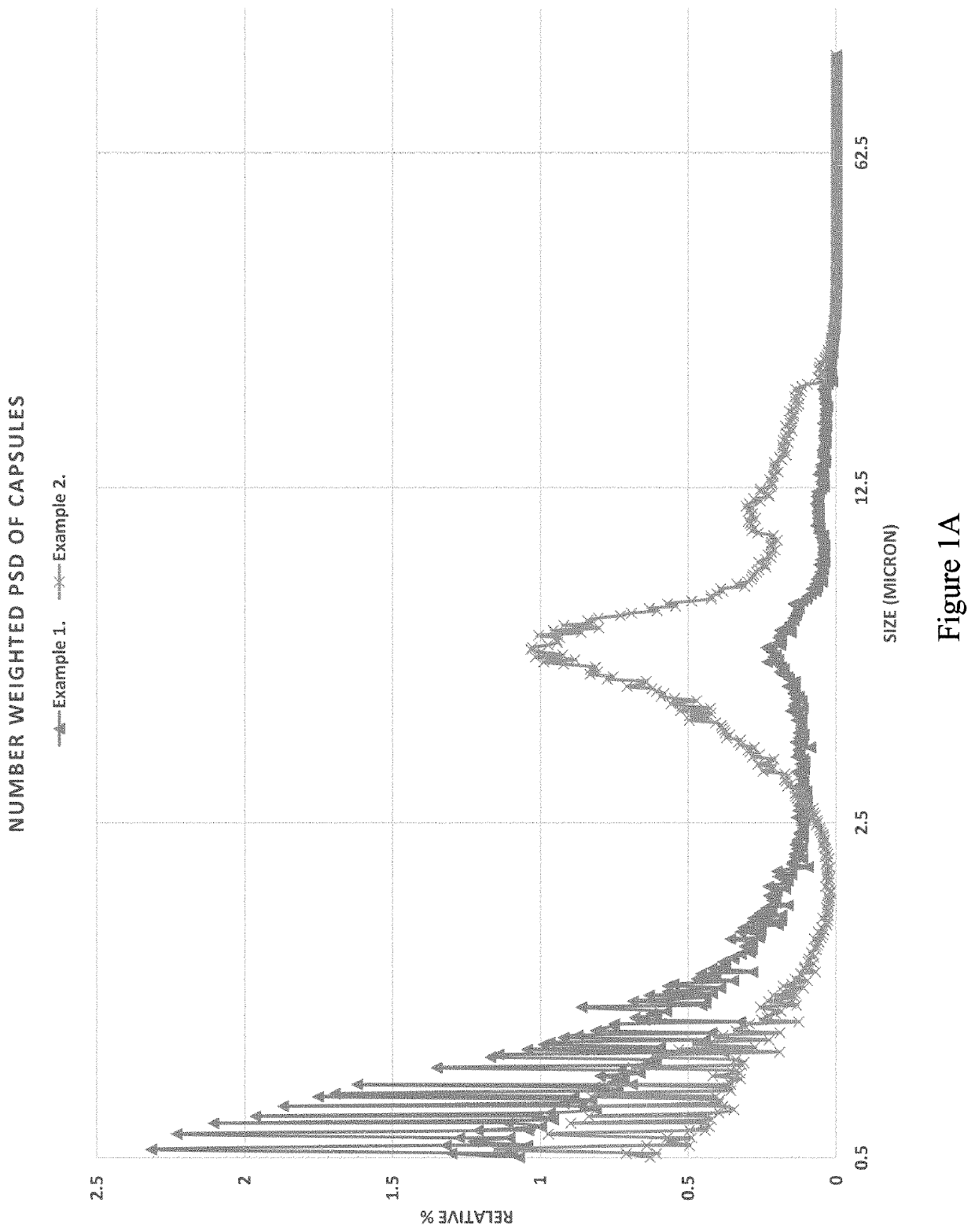
[0153]Aluminum sulfate was added and after milling of the emulsion. A succession of heating steps was used: heated to 75° C., held at 75° C. for 5 hours, heated to 95° C., held at 95° C. for 7 hours, and cooled to room temperature. The detailed experiment procedure is listed in Table 2. The number weighted median particle size distribution (PSD) shifted from 0.84 microns for the control to 20.78 microns for 12.1% aluminum sulfate as seen in FIG. 1 and Table 3. The size of the aggregated clusters can be selectively controlled by using di...
the structure of the environmentally friendly knitted fabric provided by the present invention; figure 2 Flow chart of the yarn wrapping machine for environmentally friendly knitted fabrics and storage devices; image 3 Is the parameter map of the yarn covering machine
Login to View More
PUM
Property
Measurement
Unit
Fraction
aaaaa
aaaaa
Particle size
aaaaa
aaaaa
Zeta potential
aaaaa
aaaaa
Login to View More
Abstract
The present invention teaches a composition and process for irreversibly agglomerated charge stable core shell microcapsules, each microcapsule containing a benefit agent core material, which may be the same or different, the polymeric all or walls comprising one or more (meth)acrylate polymers, or optionally combinations with other polymers, along with a polyvalent cation. The capsules of the invention adhere better to surfaces, are more stable and are useful for delivery of benefit agents.
Description
FIELD OF THE INVENTION[0001]This invention relates to microcapsule compositions and particularly to microcapsules delivering a benefit agent, and processes for making and using such compositions.BACKGROUND OF THE INVENTION[0002]Various processes for microencapsulation, and exemplary methods and materials are set forth in Schwantes (U.S. Pat. No. 6,592,990), Baker et. al. (U.S. Pat. No. 4,166,152), Matsukawa et. al. (U.S. Pat. No. 3,965,033), Matsukawa (U.S. Pat. No. 3,660,304), Ozono (U.S. Pat. No. 4,588,639), Irgarashi et. al. (U.S. Pat. No. 4,610,927), Brown et. al. (U.S. Pat. No. 4,552,811), Scher (U.S. Pat. No. 4,285,720), Shioi et. al. (U.S. Pat. No. 4,601,863), Kiritani et. al. (U.S. Pat. No. 3,886,085), Jahns et. al. (U.S. Pat. Nos. 5,596,051 and 5,292,835), Matson (U.S. Pat. No. 3,516,941), Chao (U.S. Pat. No. 6,375,872), Foris et. al. (U.S. Pat. Nos. 4,001,140; 4,087,376; 4,089,802 and 4,100,103), Greene et. al. (U.S. Pat. Nos. 2,800,458; 2,800,457 and 2,730,456), Clark (U....
Claims
the structure of the environmentally friendly knitted fabric provided by the present invention; figure 2 Flow chart of the yarn wrapping machine for environmentally friendly knitted fabrics and storage devices; image 3 Is the parameter map of the yarn covering machine
Login to View More
Application Information
Patent Timeline
Application Date:The date an application was filed.
Publication Date:The date a patent or application was officially published.
First Publication Date:The earliest publication date of a patent with the same application number.
Issue Date:Publication date of the patent grant document.
PCT Entry Date:The Entry date of PCT National Phase.
Estimated Expiry Date:The statutory expiry date of a patent right according to the Patent Law, and it is the longest term of protection that the patent right can achieve without the termination of the patent right due to other reasons(Term extension factor has been taken into account ).
Invalid Date:Actual expiry date is based on effective date or publication date of legal transaction data of invalid patent.





 Login to View More