Unlock instant, AI-driven research and patent intelligence for your innovation.

Chimeric Antigen Receptor Specific for BDCA2 Antigen

a chimeric antigen and receptor technology, applied in the field of cancer treatment, can solve the problems of bpdcn not being treated uniformly, unable to achieve complete remission, and unable to achieve consensus, etc., and achieves less cytokine release syndrome (crs), less cytokine release syndrome, and high efficiency

Active Publication Date: 2020-11-12
MILTENYI BIOTEC B V & CO KG
View PDF0 Cites 0 Cited by
  • Summary
  • Abstract
  • Description
  • Claims
  • Application Information

AI Technical Summary

Benefits of technology

The inventors have created special immune cells (NK and T cells) that can specifically kill cancerous cells that highly express a specific antigen. These cells (called BDCA2-CAR cells) were found to be much more efficient at killing the cancerous cells than other types of immune cells. Additionally, BDCA2-CAR NK cells are safer and less toxic than BDCA2-CAR T cells because they release less inflammatory chemicals called cytokines. BDCA2-CAR NK cells may be a better treatment option for BPDCN than BDCA2-CAR T cells because they are short-lived and are expected to be cleared from the patient's body after a few months of treatment.

Problems solved by technology

At present, there is no uniform, consensus, worldwide standard of care treatment for BPDCN.
Using of multiple—agent, intensive chemotherapy initially produce remission, however relapse tends to occur quickly.
The technique has now been tested in multiple clinical trials, with spectacular results, often resulting in complete remission.

Method used

the structure of the environmentally friendly knitted fabric provided by the present invention; figure 2 Flow chart of the yarn wrapping machine for environmentally friendly knitted fabrics and storage devices; image 3 Is the parameter map of the yarn covering machine
View more

Image

Smart Image Click on the blue labels to locate them in the text.
Viewing Examples
Smart Image
  • Chimeric Antigen Receptor Specific for BDCA2 Antigen
  • Chimeric Antigen Receptor Specific for BDCA2 Antigen
  • Chimeric Antigen Receptor Specific for BDCA2 Antigen

Examples

Experimental program
Comparison scheme
Effect test

embodiments

[0093]The present invention also encompasses nucleic acids (DNA or RNA) constructs comprising sequences encoding for amino acids sequences of a CAR specific for BDCA2 such as SEQ ID NO:1 and SEQ ID NO:2.

[0094]In one embodiment of the invention a DNA construct (vector, plasmid) is generated encoding for a CAR specific for BDCA2. A nucleic acid sequence encoding for an antigen binding domain specific for BDCA2 is fused at least to a nucleic acid sequence encoding a transmembrane domain and subsequent a nucleic acid sequence encoding an intracellular domain. The construction of such expression vectors can be performed by recombinant methods well known in the art. Alternatively, the nucleic acid sequences can be produced synthetically.

[0095]In one embodiment of the invention a cell expressing the CAR of the invention is generated. The DNA construct encoding the CAR of the invention can be transfected or transduced into a host cell by methods well known in the art (e.g. viral-based syste...

example 1

Generation of NK and T Cells Expressing BDCA2 CAR

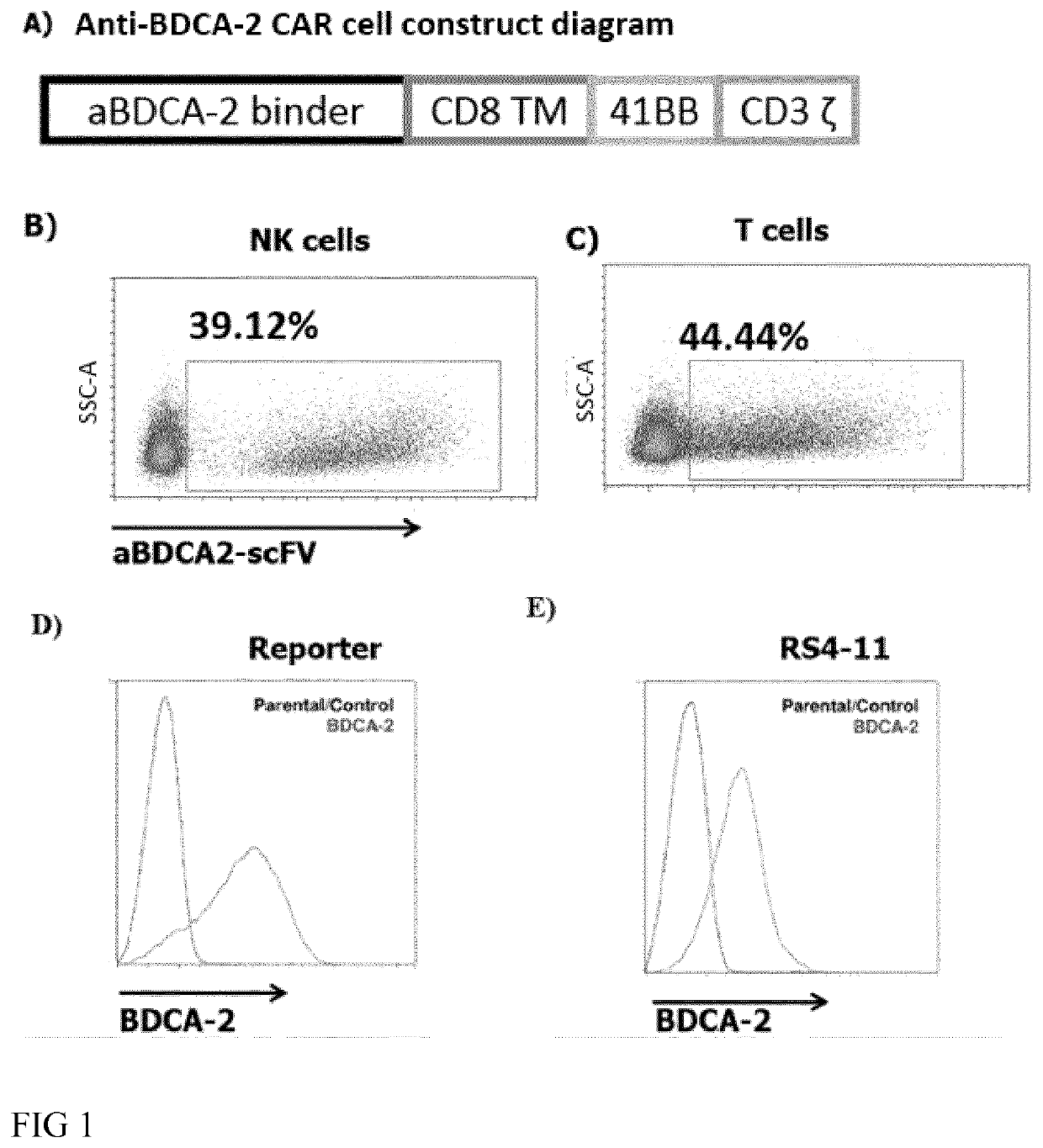
[0181]We have cloned aBDCA2-scFV into lentiviral vector backbone and generated high-titer lentiviral vectors (LVs). Primary NK and T cells were isolated from donor peripheral blood mononuclear cells (PBMCs). NK cells were cultured in NK cell medium (Miltenyi Biotec) containing IL-2 and IL-15 for 2 days. On day 2, we transduced the pre-activated NK and T cells with lentiviral vectors containing aBDCA2-scFV. We determined the CAR expression with specific idiotype against aBDCA2-scFV on day 8 (FIG. 1B and 1C). The BDCA2 CAR expressed by these cells comprise the BDCA2 binding domains of SEQ ID NO:1 and SEQ ID NO:2 in the order from the N-terminus to the C-terminus: SEQ ID NO:1 followed by SEQ ID NO:2.

[0182]NK cells have natural cytotoxicity against many cell lines. We found two cell lines (human RS411 and mouse A95-KK) that are resistance to natural killing of NK cell thus representing a good choice as a target for engineered CAR-NK and C...

example 2

Cytotoxicity of BDCA2-CAR Transduced Effector Cells

[0183]The specific cytotoxicity of BDCA2-CAR was determined by flow cytometry based cytotoxic assay (Granzin M, et al., Cytotherapy. 2015). Activated NK and T cells without CAR-BDCA2 showed little killing (70% killing at E:T=1:1) against target cells expressing BDCA2 (FIG. 2, reporter-BDCA2 and RS4-11-BDCA2, upper and lower panel, respectively). Surprisingly, these target cell lines are highly resistant to the natural killing of non-engineered NK cells, suggesting that the engineered CAR-NK cells can overcome the natural resistance of cancer cells. CAR-NK cells showed slightly higher killing of target cells than CAR-T cells despite having lower expression of aBDCA2 CAR (FIG. 2).

the structure of the environmentally friendly knitted fabric provided by the present invention; figure 2 Flow chart of the yarn wrapping machine for environmentally friendly knitted fabrics and storage devices; image 3 Is the parameter map of the yarn covering machine
Login to View More

PUM

No PUM Login to View More

Abstract

The present invention discloses a chimeric antigen receptor (CAR) comprising an antigen binding domain specific for BDCA2, a population of engineered cells expressing said CAR and a pharmaceutical composition thereof. Said engineered cells are for treatment of cancer in a subject, wherein the cancerous cells of said cancer express BDCA2 such as Blastic Plasmacytoid Dendritic Cell Neoplasm (BPDCN).

Description

FIELD OF INVENTION[0001]The present invention relates to the field of treatment of cancer, in particular to the treatment of cancer by using the antigen BDCA2 as a target.BACKGROUND OF THE INVENTION[0002]Blastic Plasmacytoid Dendritic Cell Neoplasm (BPDCN) is a rare disease of the bone marrow and blood. The term BPDCN refers to a malignant neoplasm, or cancer, that affects blastic, or immature, plasmacytoid dendritic cells. The World Health Organization standardized the term blastic plasmacytoid dendritic cell neoplasm in 2008, listing it under “acute myeloid leukemia and related neoplasms.” (Vardiman J W et al., Blood. 2009). BPDCN affects multiple organs that include the skin and the lymph nodes. Unlike most other leukemias, BPDCN has a pronounced male predominance; approximately 75% to 90% of cases occur in men (Taylor J et al., Blood. 2013). Most patients survive for only 10 to 14 months after diagnosis, despite receiving various chemotherapeutic regimens (Roos-Weil D et al., Bl...

Claims

the structure of the environmentally friendly knitted fabric provided by the present invention; figure 2 Flow chart of the yarn wrapping machine for environmentally friendly knitted fabrics and storage devices; image 3 Is the parameter map of the yarn covering machine
Login to View More

Application Information

Patent Timeline
no application Login to View More
IPC IPC(8): A61K35/17C07K16/28A61K39/395A61P35/00
CPCC07K16/2851A61P35/00C07K2317/73A61K39/3955A61K35/17C07K14/7051C07K2317/622C07K2319/03C07K2319/033C07K14/70517C07K14/70578C07K2319/00A61K39/4631A61K39/4613A61K39/464402A61K2239/13A61K39/4611A61K2239/28
Inventor BARI, RAFIJULGRANZIN, MARKUSLEUNG, WINGDZIONEK, ANDRZEJMEYER, MARTIN
Owner MILTENYI BIOTEC B V & CO KG