Check patentability & draft patents in minutes with Patsnap Eureka AI!

Magnetocaloric alloys useful for magnetic refrigeration applications

a magnetic refrigeration and alloy technology, applied in the direction of magnetic bodies, lighting and heating apparatus, machine operation modes, etc., can solve the problems of high capital cost of a magnetic refrigeration system capable of >400 w of cooling power using traditional rare earth based mce materials, high cost and availability of mce materials, and high cost of mce materials, so as to limit thermal and structural hysteresis losses

Active Publication Date: 2021-03-04
RGT UNIV OF CALIFORNIA +1
View PDF2 Cites 0 Cited by
  • Summary
  • Abstract
  • Description
  • Claims
  • Application Information

AI Technical Summary

Benefits of technology

This patent is related to using cheaper alloys made of cerium, neodymium, and gadolinium for magnetic refrigeration applications. These alloys have advantages because they have limited thermal and structural hysteresis losses, meaning they can achieve higher efficiency in magnetic refrigeration compared to expensive rare-earth based materials. The patent claims that the performance of these alloys is similar or better to expensive rare-earth based materials.

Problems solved by technology

A critical challenge of developing low cost magnetic refrigerators is the cost and availability of MCE materials, which are typically rare-earth and very expensive.
Clearly, the capital cost of a magnetic refrigeration system capable of >400 W of cooling power using the traditional rare-earth based MCE materials would far exceed its economic feasibility.
One of the major hurdles inhibiting the development of magnetic refrigeration technologies is the lack of commercially available low cost magnetocaloric materials that will actually function, for a long period of time, in a magnetic refrigeration environment such as the active magnetic regenerator (AMR) which is in development by several entities.
Additionally, the structural changes typically manifest as volume expansion and contraction of the material, causing cracking during the magnetization and demagnetization cycles which quickly reduces the MCE response and lowers the thermal conductivity, making these materials incompatible in AMRs.
While methods to improve mechanical stability of MCE materials with first order transitions can be employed, this will also require significant additional materials and processing which will increase cost.
Further, scalable manufacturing of many MCE materials has yet to be demonstrated.

Method used

the structure of the environmentally friendly knitted fabric provided by the present invention; figure 2 Flow chart of the yarn wrapping machine for environmentally friendly knitted fabrics and storage devices; image 3 Is the parameter map of the yarn covering machine
View more

Image

Smart Image Click on the blue labels to locate them in the text.
Viewing Examples
Smart Image
  • Magnetocaloric alloys useful for magnetic refrigeration applications
  • Magnetocaloric alloys useful for magnetic refrigeration applications
  • Magnetocaloric alloys useful for magnetic refrigeration applications

Examples

Experimental program
Comparison scheme
Effect test

example 1

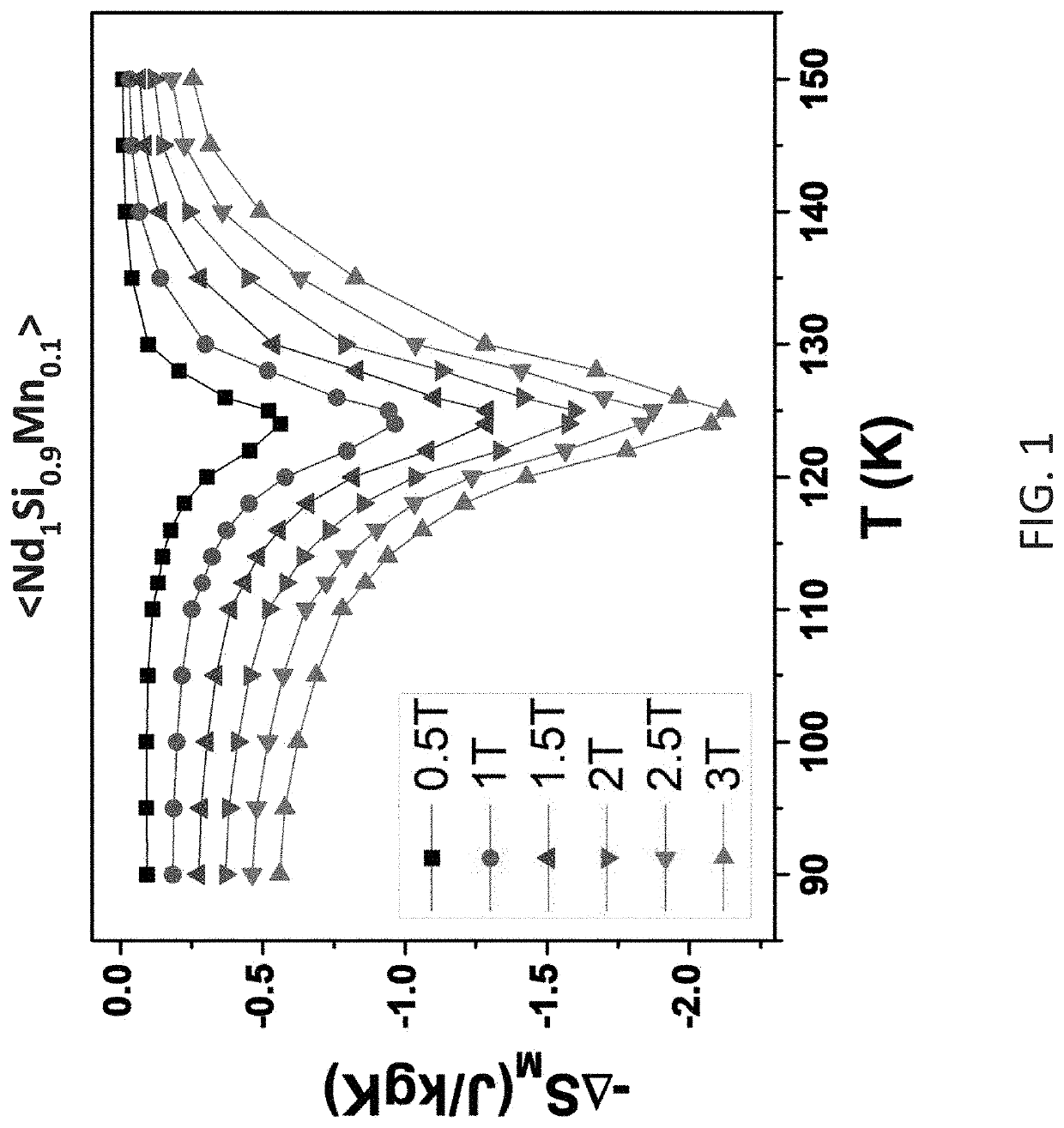
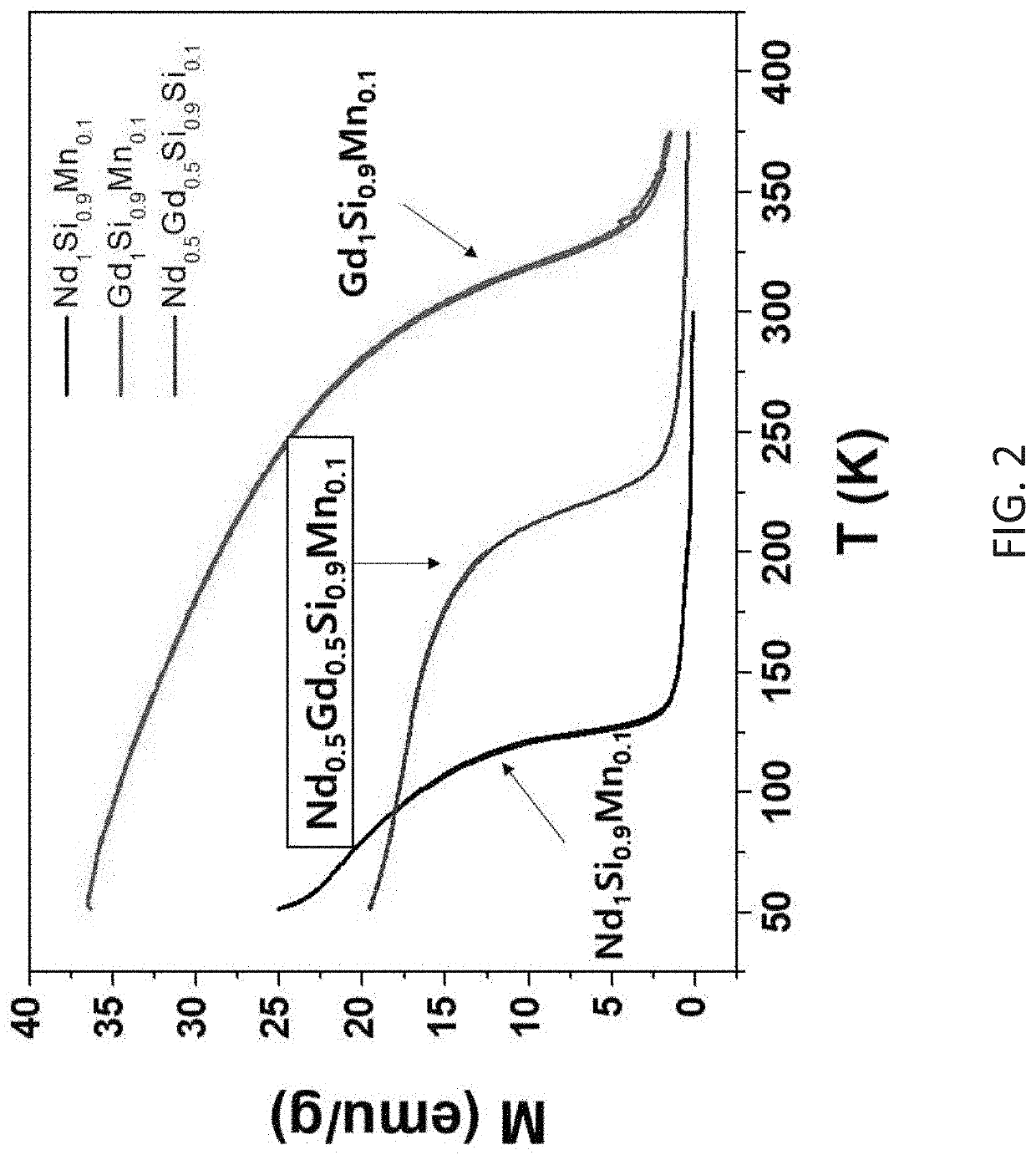
[0062]A Nd1.0Si0.9Mn0.1 ingot was prepared by arc melting in an argon atmosphere. The ingot was measured as-cast. FIG. 1 shows a plot of ΔS vs temperature and FIG. 2 shows a plot of magnetization versus temperature for the Nd1.0Si0.9Mn0.1 alloy with 2nd order phase transition occurring near 125° K.

example 2

[0063]A Nd0.5Gd0.5Si0.9Mn0.1 ingot was prepared by arc melting in an argon atmosphere. The ingot was measured as-cast. FIG. 2 shows a plot of magnetization versus temperature for the Nd0.5Gd0.5Si0.9Mn0.1 alloy with 2nd order phase transition occurring near 225° K.

example 3

[0064]A Gd1.0Si0.9Mn0.1 ingot was prepared by arc melting in an argon atmosphere. The ingot was measured as-cast. FIG. 2 shows a plot of magnetization versus temperature for the Gd1.0Si0.9Mn0.1 alloy with 2nd order phase transition occurring near 125° K.

the structure of the environmentally friendly knitted fabric provided by the present invention; figure 2 Flow chart of the yarn wrapping machine for environmentally friendly knitted fabrics and storage devices; image 3 Is the parameter map of the yarn covering machine
Login to View More

PUM

PropertyMeasurementUnit
temperatureaaaaaaaaaa
magnetocaloricaaaaaaaaaa
Login to View More

Abstract

This invention relates to magnetocaloric materials comprising alloys useful for magnetic refrigeration applications. In some embodiments, the disclosed alloys may be Cerium, Neodymium, and / or Gadolinium based compositions that are fairly inexpensive, and in some cases exhibit only 2nd order magnetic phase transitions near their curie temperature, thus there are limited thermal and structural hysteresis losses. This makes these compositions attractive candidates for use in magnetic refrigeration applications. Surprisingly, the performance of the disclosed materials is similar or better to many of the known expensive rare-earth based magnetocaloric materials.

Description

CROSS-REFERENCE TO RELATED APPLICATIONS[0001]This application claims priority to U.S. Provisional Patent Application No. 62 / 634,078 filed on Feb. 22, 2018 entitled “Magnetocaloric Alloys Useful for Magnetic Refrigeration Applications”, and U.S. Provisional Patent Application No. 62 / 693,719 filed on Jul. 3, 2018 entitled “Magnetocaloric Alloys Useful for Magnetic Refrigeration Applications” the contents of which are incorporated herein by reference in their entireties.GOVERNMENT LICENSE RIGHTS[0002]This invention was made with government support under DE-SC0015932 awarded by the Department of Energy. The Government has certain rights in this invention.BACKGROUND[0003]The present disclosure generally relates to magnetocaloric materials comprising alloys useful for magnetic refrigeration applications. In some embodiments, the disclosed alloys exhibit only 2nd order magnetic phase transitions, with limited thermal or structural hysteresis losses. This makes them attractive candidates fo...

Claims

the structure of the environmentally friendly knitted fabric provided by the present invention; figure 2 Flow chart of the yarn wrapping machine for environmentally friendly knitted fabrics and storage devices; image 3 Is the parameter map of the yarn covering machine
Login to View More

Application Information

Patent Timeline
no application Login to View More
Patent Type & Authority Applications(United States)
IPC IPC(8): H01F1/01C22C28/00H01F1/058
CPCH01F1/015C22C2202/02H01F1/058C22C28/00C22C30/02C22C30/06C22C30/00Y02B30/00F25B21/00F25B2321/002
Inventor IHNFELDT, ROBINKIM, EUNJEONGJIN, SUNGHOCHEN, RENKUNXU, XIA
Owner RGT UNIV OF CALIFORNIA
Features
  • R&D
  • Intellectual Property
  • Life Sciences
  • Materials
  • Tech Scout
Why Patsnap Eureka
  • Unparalleled Data Quality
  • Higher Quality Content
  • 60% Fewer Hallucinations
Social media
Patsnap Eureka Blog
Learn More