
Rapid polarization tracking in an optical channel
- Summary
- Abstract
- Description
- Claims
- Application Information
AI Technical Summary
Benefits of technology
Problems solved by technology
Method used
Image

Examples
Embodiment Construction
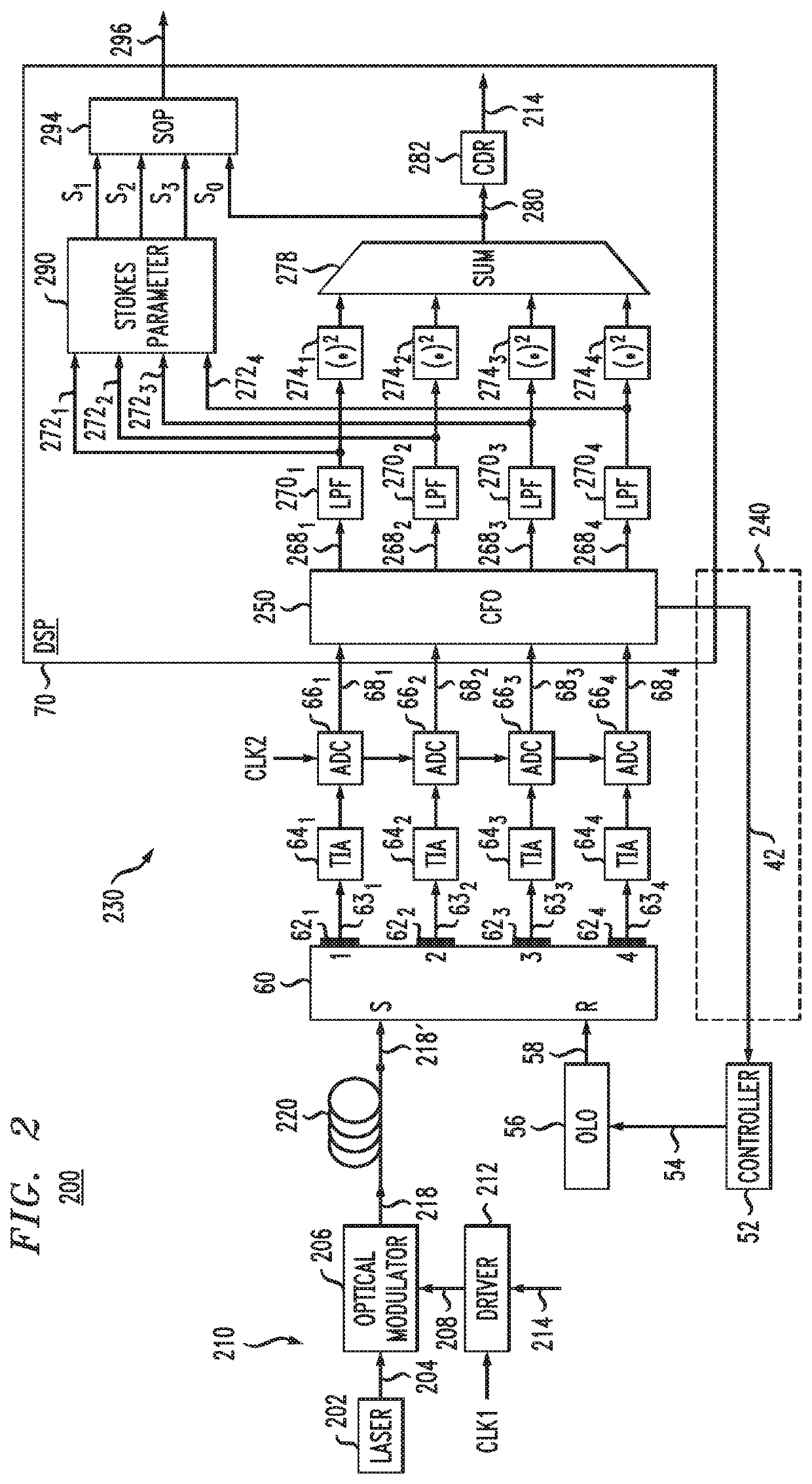
[0004]Disclosed herein are embodiments of an optical receiver, e.g., for an Optical Supervisory Channel (OSC), whose optical front end comprises a polarization-diversity coherent optical receiver configured to receive a conventional intensity-modulated (e.g., OSC) signal. In an example embodiment, four quadrature components of the received OSC signal detected by the polarization-diversity coherent optical receiver are sampled at a relatively high sampling rate and are used to calculate the Stokes parameters of the OSC signal. As a result, the Stokes parameters can be updated at the high sampling rate, which can be suitably selected to enable polarization tracking with a relatively high time resolution and / or at relatively high SOP-rotation speeds. The four detected quadrature components are appropriately combined in the receiver DSP to determine the intensity of the received OSC signal, which is then used in a conventional manner to recover the OSC data encoded therein.
[0005]Some em...
PUM
 Login to View More
 Abstract
Description
Claims
Application Information
 Login to View More