Check patentability & draft patents in minutes with Patsnap Eureka AI!

Ethylene-(Vinyl Alcohol) Copolymer and Method for Producing Same

a technology of ethylenevinyl alcohol and copolymer, which is applied in the field of ethylenevinyl alcohol copolymer and resin composition, can solve the problems of complex behavior of changes in melt viscosity over time, problems in the melt molding step or the performance of a shaped object to be obtained, etc., and achieve excellent coloration resistance, excellent viscosity stability, and improved viscosity stability of the evoh

Pending Publication Date: 2022-06-23
KURARAY CO LTD
View PDF0 Cites 1 Cited by
  • Summary
  • Abstract
  • Description
  • Claims
  • Application Information

AI Technical Summary

Benefits of technology

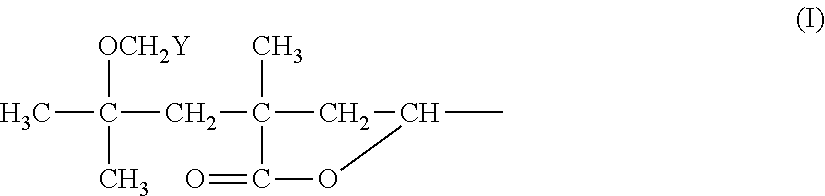
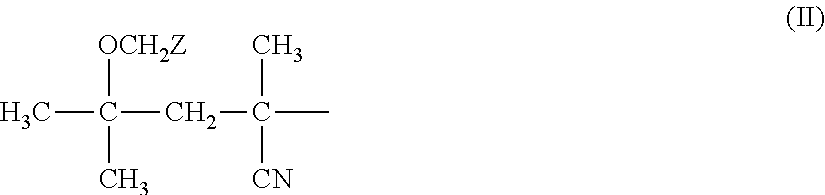
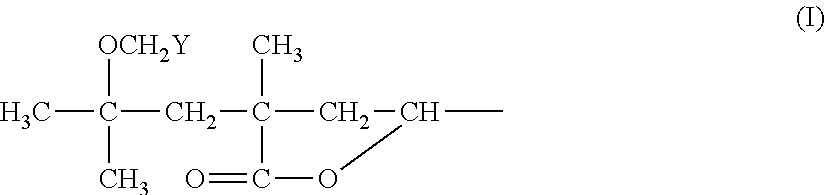
The present invention relates to a specific type of EVOH (ethylene-vinyl alcohol copolymer) with improved viscosity stability and coloration resistance during melt molding. The EVOH has a specific ethylene unit content and a saponification degree of 85 mol% or more. It also contains vinyl ester units as optional components. The EVOH has a molecule with a structure (I) at one end and a molecule with a structure (II) at the other end. The total content of structure (I) and structure (II) is between 0.002 and 0.020 mol% in all monomer units. The EVOH also has a molar ratio (I / II) of 0.8 or higher, which further improves viscosity stability and prevents sudden increase in viscosity during the melting process. The EVOH can be used for various applications such as film, packaging, and molded articles.

Problems solved by technology

However, the behavior of changes in melt viscosity over time is complex since various crosslinking reactions and various decomposition reactions competitively occur in EVOHs having a large number of active reactive groups at the molecular ends and in the molecular chains.
Such changes in melt viscosity over time may trigger fluctuations in the resin pressure and the resin temperature during melt molding and the thickness distribution of the shaped article and may cause problems in the melt molding step or the performance of a shaped article to be obtained.

Method used

the structure of the environmentally friendly knitted fabric provided by the present invention; figure 2 Flow chart of the yarn wrapping machine for environmentally friendly knitted fabrics and storage devices; image 3 Is the parameter map of the yarn covering machine
View more

Image

Smart Image Click on the blue labels to locate them in the text.
Viewing Examples
Smart Image
  • Ethylene-(Vinyl Alcohol) Copolymer and Method for Producing Same
  • Ethylene-(Vinyl Alcohol) Copolymer and Method for Producing Same
  • Ethylene-(Vinyl Alcohol) Copolymer and Method for Producing Same

Examples

Experimental program
Comparison scheme
Effect test

synthesis example 1

[0058]Using a pressure reaction vessel with a volume of 250 L, polymerization was performed using the following raw materials under the following conditions.

[0059]Vinyl acetate: 83.0 kg

[0060]Methanol: 26.6 kg

[0061]Polymerization initiator: 2,2′-azobis(4-methoxy-2,4-dimethylvaleronitrile) (2.5 g / L methanol solution) with an initial feeding amount of 362 mL and a continuous feeding amount of 1120 mL / hr

[0062]Polymerization temperature: 60° C.

[0063]Ethylene pressure in polymerization tank: 3.6 MPa

[0064]When the polymerization rate of vinyl acetate reached approximately 40%, sorbic acid was added, followed by cooling to terminate the polymerization. Then, after the reaction vessel was opened to atmospheric pressure to remove ethylene from the reaction system, the reaction liquid was fed to a purge column, and methanol vapor was introduced from a lower portion of the column, thereby removing unreacted vinyl acetate from the column top, to obtain a methanol solution of the ethylene-vinyl a...

synthesis example 2

[0065]By the same operation as in Synthesis Example 1, except for changing the polymerization conditions as below, a methanol solution of the ethylene-vinyl acetate copolymer with an ethylene unit content of 24 mol % was obtained.

[0066]Vinyl acetate: 102.0 kg

[0067]Methanol: 17.7 kg

[0068]Polymerization initiator: 2,2′-azobis(4-methoxy-2,4-dimethylvaleronitrile) (2.5 g / L methanol solution) with an initial feeding amount of 280 mL and a continuous feeding amount of 850 mL / hr

[0069]Ethylene pressure in polymerization tank: 2.9 MPa

synthesis example 3

[0070]By the same operation as in Synthesis Example 1, except for changing the polymerization conditions as below, a methanol solution of the ethylene-vinyl acetate copolymer with an ethylene unit content of 27 mol % was obtained.

[0071]Vinyl acetate: 85.2 kg

[0072]Methanol: 32.3 kg

[0073]Polymerization initiator: 2,2′-azobis(4-methoxy-2,4-dimethylvaleronitrile) (2.5 g / L methanol solution) with an initial feeding amount of 310 mL and a continuous feeding amount of 950 mL / hr

[0074]Ethylene pressure in polymerization tank: 2.9 MPa

the structure of the environmentally friendly knitted fabric provided by the present invention; figure 2 Flow chart of the yarn wrapping machine for environmentally friendly knitted fabrics and storage devices; image 3 Is the parameter map of the yarn covering machine
Login to View More

PUM

PropertyMeasurementUnit
temperatureaaaaaaaaaa
saponification degreeaaaaaaaaaa
melt moldabilityaaaaaaaaaa
Login to View More

Abstract

Provided is an ethylene-vinyl alcohol copolymer with an ethylene unit content of 15 to 60 mol % and a saponification degree of 85 mol % or more.

Description

TECHNICAL FIELD[0001]The present invention relates to an ethylene-vinyl alcohol copolymer, and a resin composition containing the copolymer and a shaped article thereof, and a method for producing the copolymer.BACKGROUND ART[0002]Ethylene-vinyl alcohol copolymers (which may hereinafter be abbreviated as “EVOHs”) are excellent in gas barrier properties and melt moldability and are thus molded into films, sheets, pipes, tubes, bottles, and the like by various melt molding methods to be widely used as packaging materials expected to have gas barrier properties in the fields of foods and industries. In order to stably produce packaging materials with uniform performance and quality such as gas barrier properties, mechanical properties, and appearance, the melt viscosity of EVOHs preferably changes little with time. However, the behavior of changes in melt viscosity over time is complex since various crosslinking reactions and various decomposition reactions competitively occur in EVOHs...

Claims

the structure of the environmentally friendly knitted fabric provided by the present invention; figure 2 Flow chart of the yarn wrapping machine for environmentally friendly knitted fabrics and storage devices; image 3 Is the parameter map of the yarn covering machine
Login to View More

Application Information

Patent Timeline
no application Login to View More
Patent Type & Authority Applications(United States)
IPC IPC(8): C08L23/08C08K5/09C08F4/46
CPCC08L23/0861C08K5/09C08L2203/30C08L2201/14C08F4/463C08F216/06C08F8/12C08F8/48C08F210/02C08F18/08C08F4/04C08F218/08C08F2500/27C08L29/04
Inventor YOSHIDA, KENTAROKATAYAMA, MASAKO
Owner KURARAY CO LTD
Features
  • R&D
  • Intellectual Property
  • Life Sciences
  • Materials
  • Tech Scout
Why Patsnap Eureka
  • Unparalleled Data Quality
  • Higher Quality Content
  • 60% Fewer Hallucinations
Social media
Patsnap Eureka Blog
Learn More