LIPID NANOPARTICLES FOR DELIVERING mRNA VACCINES
a technology of lipid nanoparticles and vaccines, applied in immunological disorders, antibody medical ingredients, inorganic non-active ingredients, etc., can solve the problems of unstable rna, hampered by inefficiency, and no natural cell surface receptors,
- Summary
- Abstract
- Description
- Claims
- Application Information
AI Technical Summary
Benefits of technology
Problems solved by technology
Method used
Image

Examples
example 1
ion of LNP Formulations
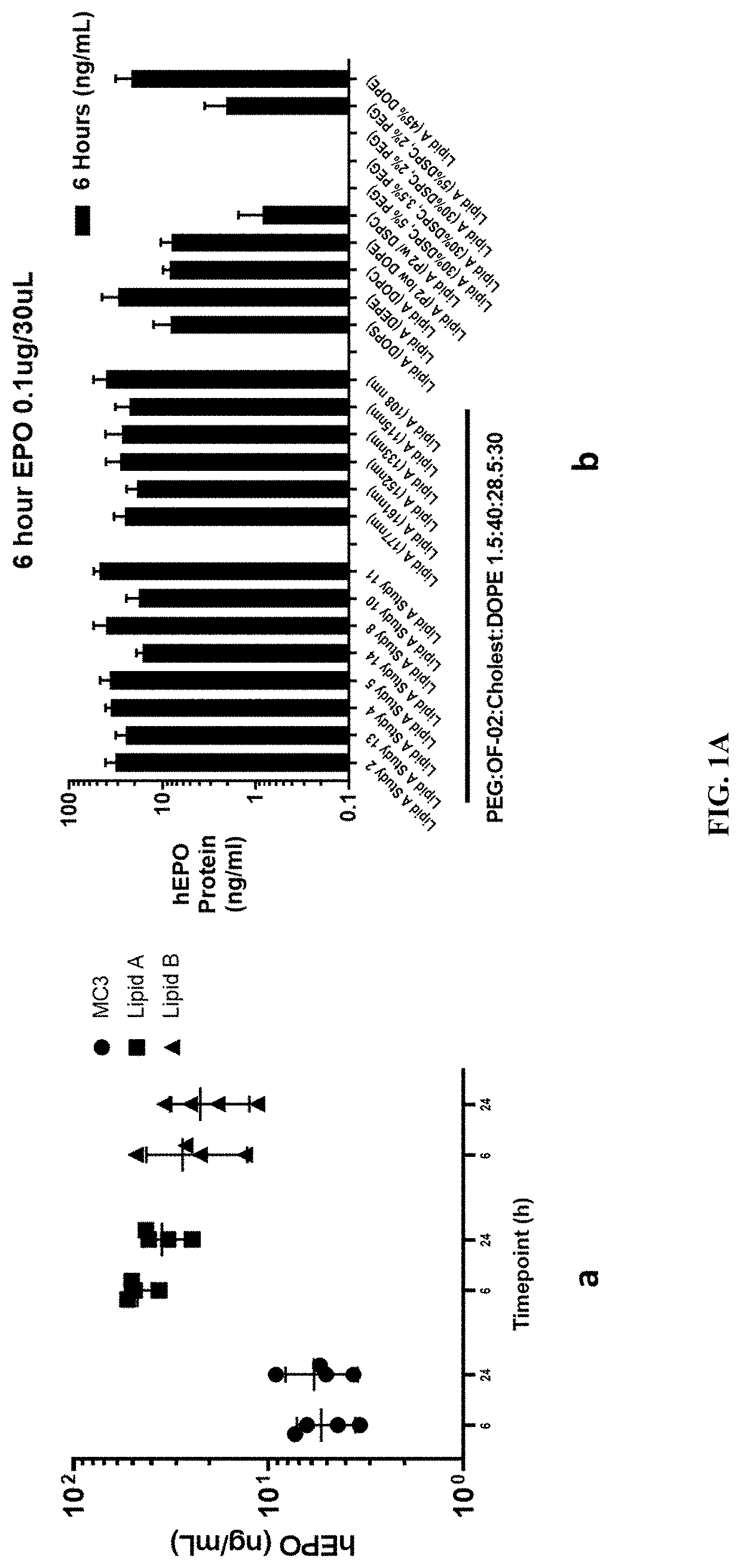
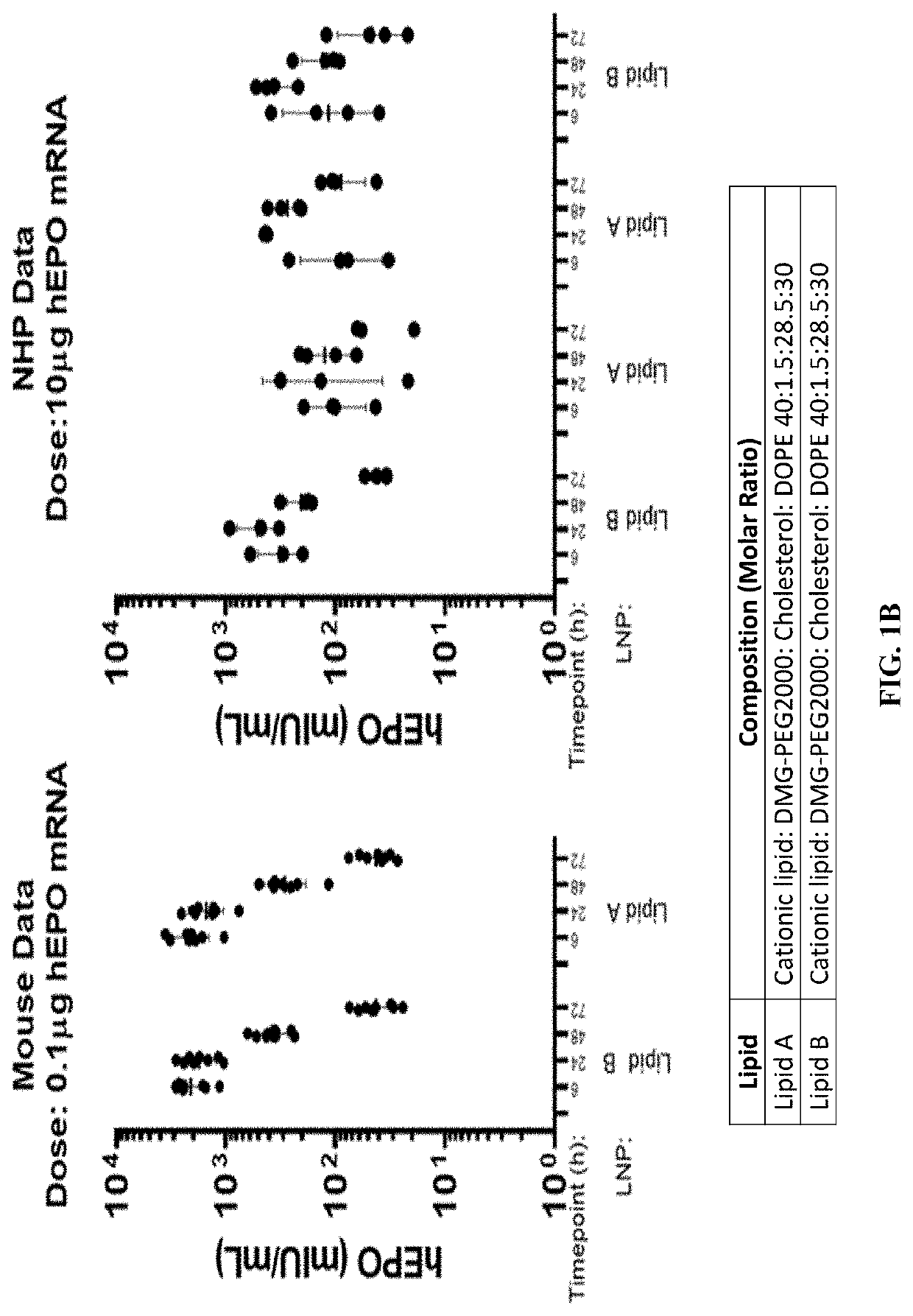
[0232]This Example describes a study in which a series of LNP formulations for mRNA vaccines was prepared from combinatorial libraries of various components. Rationally designed novel cationic lipids were synthesized. Altogether, more than 150 lipids and more than 430 formulations were tested. Human erythropoietin (hEPO) mRNA was used as a test mRNA. In the lead formulations described below, the mRNA was formulated into LNP using combinations of the cationic lipids and the three other lipids—helper lipids; cholesterol-based lipids; and PEGylated lipids—in various permutations of combinations.
[0233]The LNP formulations consisted of four lipid components—ionizable lipid, helper lipid DOPE, cholesterol, and PEGylated lipid DMG-PEG-2K. The PEGylated lipid molar fraction was held constant at 1.5%, while the ionizable lipid and the different helper lipids and their molar ratios were evaluated to identify the optimized ratios based on the hEPO screening studies.
[0234...
example 2
H1N1 LNP Vaccine Formulations
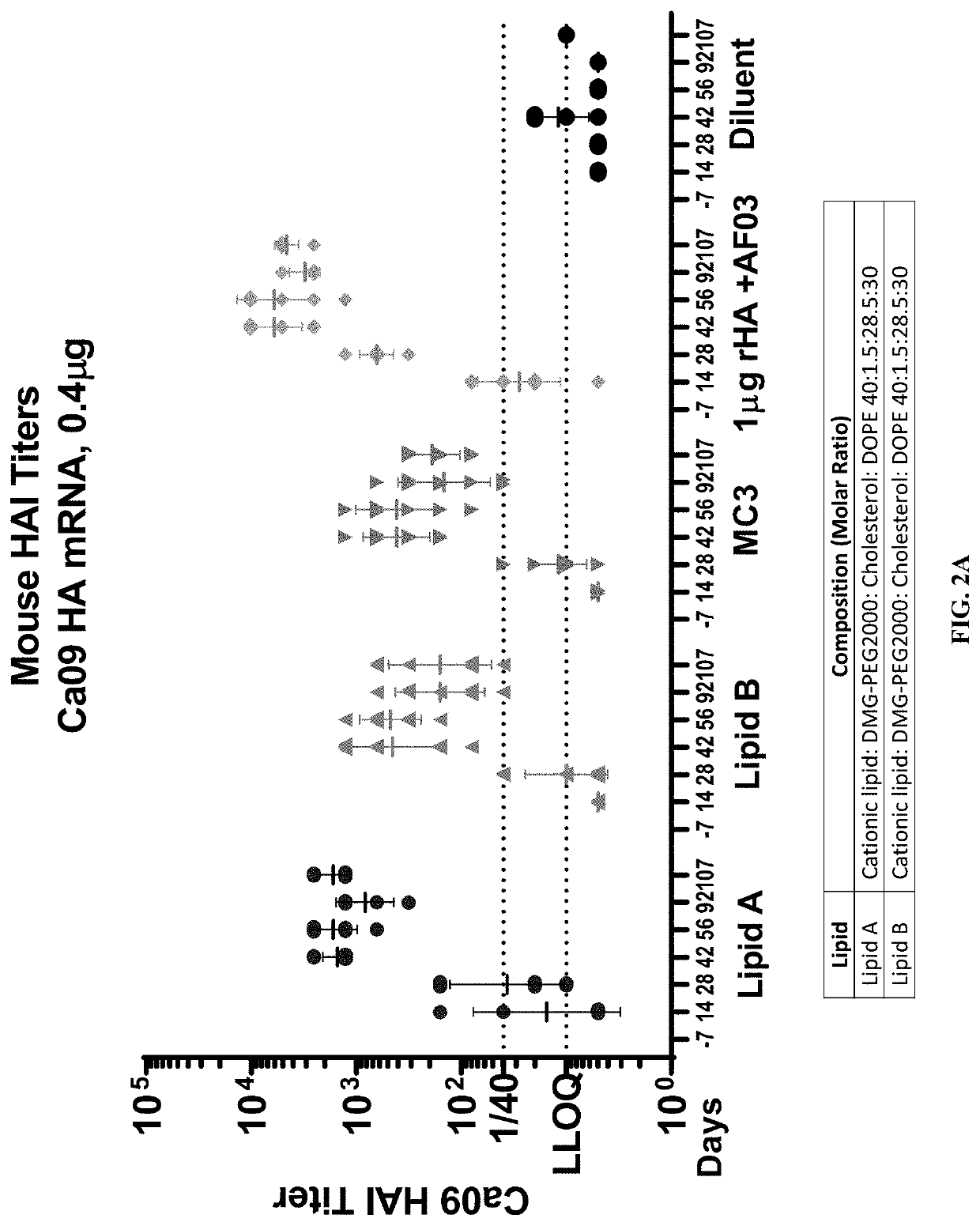
[0245]Influenza pandemics can occur when a novel influenza virus emerges in the human population. Such pandemics remain a major threat to public health, requiring vigilant attention and preparedness with countermeasures to be used in the event of sustained human-to-human spread of the virus. In the experiments described in this Example, hemagglutinin (HA) from a highly pathogenic H1N1 strain A / California / 7 / 2009 (CA09), the cause of the 2009 flu pandemic, was used as a prototype antigen to evaluate the potency of mRNA vaccines prepared with LNP formulations of Lipid A and Lipid B.
[0246]The HA mRNA was prepared as described above. Citrate buffer (1 mM citrate, 150 mM NaCl, pH 4.5) was used in the preparation of the LNP compositions. A citrate buffer containing the mRNA was mixed with the lipids in ethanol solution during the formulation process. The pH and the concentration of the buffer were selected to achieve the high encapsulation rate of mRNA in the L...
example 3
H3N2 LNP Vaccine Formulation
[0250]This Example describes experiments in which mRNA-LNP vaccine formulations for influenza strain Sing16 (H3N2) were evaluated for potency. One of the mRNAs used in these experiments is MRT1400. MRT1400 is a biosynthetic codon-optimized HA-H3 (influenza virus hemagglutinin, H3 subtype) messenger RNA (CO-HA-H3 mRNA) manufactured by in vitro transcription.
[0251]The protein sequence for influenza virus hemagglutinin, H3 subtype, is shown below:
(SEQ ID NO: 1)MKTIIALSYI LCLVFAQKIP GNDNSTATLCLGHHAVPNGT IVKTITNDRI EVTNATELVQNSSIGEICDS PHQILDGENC TLIDALLGDPQCDGFQNKKW DLFVERSKAY SNCYPYDVPDYASLRSLVAS SGTLEFKNES FNWTGVTQNGTSSACIRGSS SSFFSRLNWL THLNYTYPALNVTMPNKEQF DKLYIWGVHH PGTDKDQIFLYAQSSGRITV STKRSQQAVI PNIGSRPRIRDIPSRISIYW TIVKPGDILL INSTGNLIAPRGYFKIRSGK SSIMRSDAPI GKCKSECITPNGSIPNDKPF QNVNRITYGA CPRYVKHSTLKLATGMRNVP EKQTRGIFGAIAGFIENGWE GMVDGWYGFR HQNSEGRGQAADLKSTQAAI DQINGKLNRL IGKTNEKFHQIEKEFSEVEG RVQDLEKYVE DTKIDLWSYNAELLVALENQ HTIDLTDSEM NKLFEKTKKQLRENAE...
PUM
| Property | Measurement | Unit |
|---|---|---|
| diameter | aaaaa | aaaaa |
| diameter | aaaaa | aaaaa |
| molar ratio | aaaaa | aaaaa |
Abstract
Description
Claims
Application Information
 Login to View More
 - R&D
- Intellectual Property
- Life Sciences
- Materials
- Tech Scout
- Unparalleled Data Quality
- Higher Quality Content
- 60% Fewer Hallucinations
Browse by: Latest US Patents, China's latest patents, Technical Efficacy Thesaurus, Application Domain, Technology Topic, Popular Technical Reports.
© 2025 PatSnap. All rights reserved.Legal|Privacy policy|Modern Slavery Act Transparency Statement|Sitemap|About US| Contact US: help@patsnap.com