Check patentability & draft patents in minutes with Patsnap Eureka AI!

Radiation sensitive composition containing novel dye

Inactive Publication Date: 2000-08-29
SHIPLEY CO LLC
View PDF11 Cites 35 Cited by
  • Summary
  • Abstract
  • Description
  • Claims
  • Application Information

AI Technical Summary

Problems solved by technology

However, imaging equipment most prevalent in the industry is adapted for i-line or g-line exposure and the acid hardening resist compositions of the above references are largely insensitive to these exposure wavelengths.
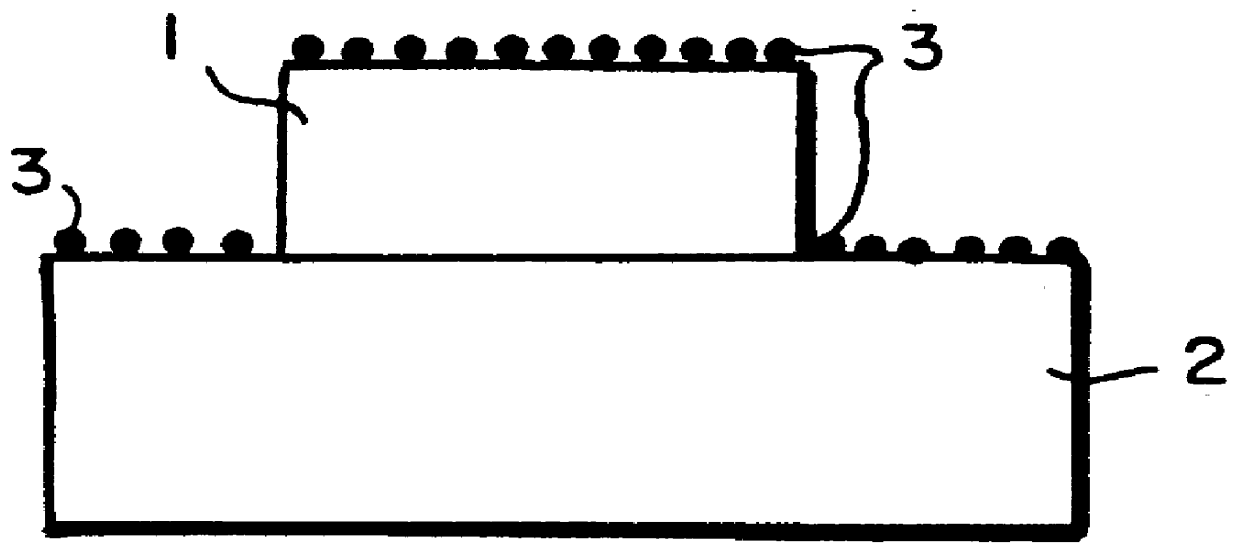
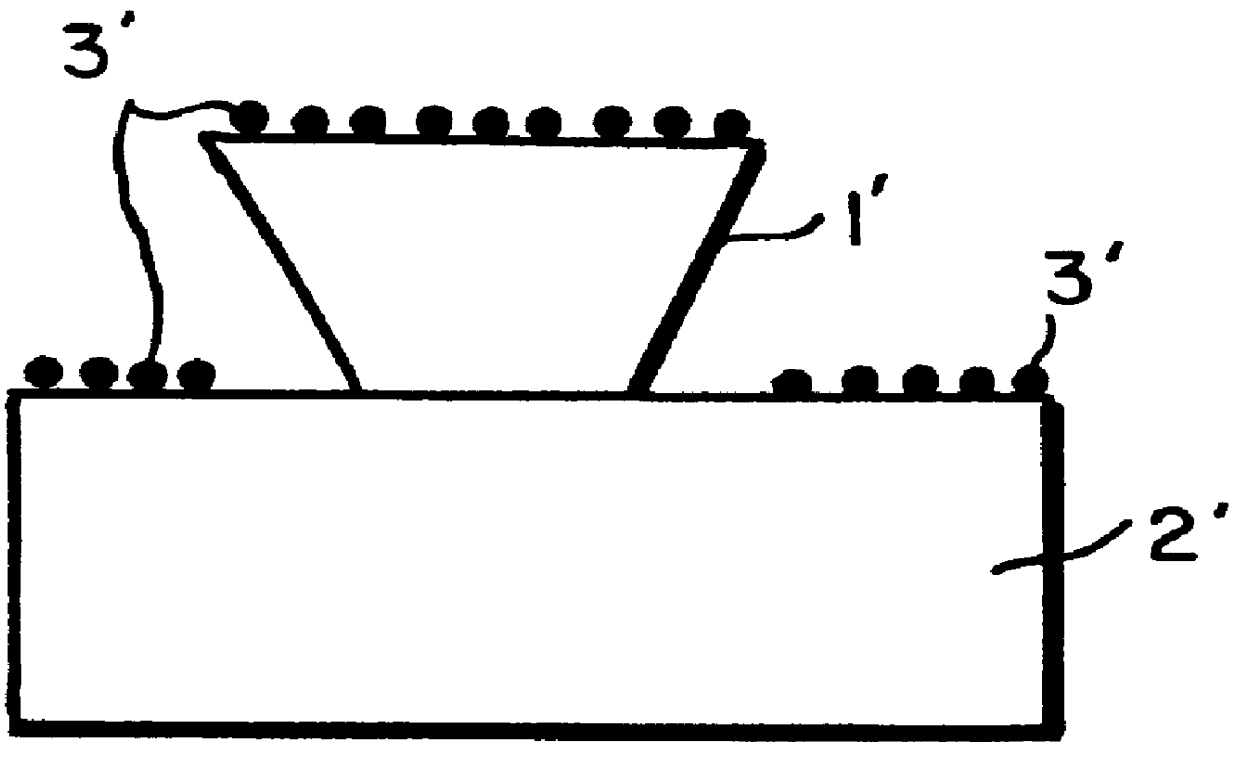
In this instance, light is reflected at an angle from the areas of the substrate into the photoresist causing localized regions of the photoresist to receive an additional dose of imaging radiation, which produces an undesirable profile shape and poor edge acuity after development.
The loss of profile shape can severely limit the ability to successfully survive subsequent processing steps such as the etching of the underlying substrate.
Uneven edge acuity can have highly deleterious effect on the electrical properties of a manufactured semiconductor device.
The sidewall angle of this composition was rather poor, about 60.degree.-70.degree., indicating only moderate resolution.
The analysis reported in the above reference indicates that dyed resist compositions may not significantly improve lithographic processing.
However, the trihydroxybenzophenone additive has the significant disadvantage of being an in vitro mutagen (TSCA Report 8E HQ-0484-0510).
However the (4-phenylazo)resorcinol component has insufficient absorbency at 436 nm to be useful as the only dye compound in the composition when a mercury g-line wavelength is used to expose the resist coating.
Regardless of the dye used, problems are encountered by the addition of a dye to a photoresist composition.
The dye in low concentration inadequately reduces reflected light from the substrate.
Other problems include undesirable reaction with resist components and poor solubility in the photoresist composition.
When the amount of the acid-generator is less than 0.01 parts by weight, it is difficult to form a resist pattern and when the amount exceeds 5 parts by weight, the ability to strip the resist from the substrate becomes difficult.
When the amount of the cross-linking agent used is less than 1 part by weight, curing of irradiated portions of the composition becomes difficult.
When the amount exceeds 10 parts by weight, strippability of the resist coating becomes difficult.
Consequently, because of the continuous nature of the coating, clean separation between the metal deposit on the substrate and the metal deposited on the photoresist layer is difficult to achieve.

Method used

the structure of the environmentally friendly knitted fabric provided by the present invention; figure 2 Flow chart of the yarn wrapping machine for environmentally friendly knitted fabrics and storage devices; image 3 Is the parameter map of the yarn covering machine
View more

Image

Smart Image Click on the blue labels to locate them in the text.
Viewing Examples
Smart Image
  • Radiation sensitive composition containing novel dye
  • Radiation sensitive composition containing novel dye

Examples

Experimental program
Comparison scheme
Effect test

examples 5-6

Effects of Adding HABA Dye to a Thicker-film Photoresist

example 5

batch of photoresist was prepared by dissolving the following materials to make a single-phase liquid composition:

example 6

tch of photoresist was prepared by dissolving the following materials to make a single-phase liquid composition:

The resists were filtered and processed in a manner similar to that described in examples 1-4, except that the film thickness was 3.0 .mu.m. Lithographic results are listed below where wall angles >90 are retrograde.

The above results indicate that example 6 exhibited a retrograde wall angle which was for liftoff processing.

the structure of the environmentally friendly knitted fabric provided by the present invention; figure 2 Flow chart of the yarn wrapping machine for environmentally friendly knitted fabrics and storage devices; image 3 Is the parameter map of the yarn covering machine
Login to View More

PUM

No PUM Login to View More

Abstract

A photoresist composition comprising an alkali soluble resin, a photoacid generating compound that undergoes photolysis when exposed to a pattern of activating irradiation within a wavelength of from 330 to 700 mu m, a crosslinking agent capable of crosslinking the composition when activated by photogenerated acid and a dye that is an aromatic carboxylic acid having phenylazo substitution. The photoresist is characterized by the dye which is soluble in the photoresist solution, unreactive with components of the photoresist composition and may be used in relatively high concentration.

Description

1. Field of the InventionThis invention relates to dyes used for the formulation of photoresists, especially acid hardened photoresist formulations having a capability of providing highly resolved features of submicron dimension.2. Description of the Prior ArtPhotoresists are photosensitive films used for transfer of images to a substrate. They form negative or positive images. After coating a photoresist on a substrate, the coating is exposed through a patterned photomask to a source of activating energy such as ultraviolet light to form a latent image in the photoresist coating. The photomask has areas opaque to activating radiation and other areas transparent to activating radiation. The pattern in the photomask of opaque and transparent areas defines a desired image that may be used to transfer the image to a substrate. A relief image is provided by development of the latent image pattern in the resist coating. The use of photoresists is generally described, for example, by Defo...

Claims

the structure of the environmentally friendly knitted fabric provided by the present invention; figure 2 Flow chart of the yarn wrapping machine for environmentally friendly knitted fabrics and storage devices; image 3 Is the parameter map of the yarn covering machine
Login to View More

Application Information

Patent Timeline
no application Login to View More
IPC IPC(8): G03F7/038G03F7/09G03F7/004H05K3/04H05K3/02C09B29/14
CPCG03F7/038G03F7/091G03F7/0045H05K3/048Y10S430/121G03F7/0046G03F7/022G03F7/0392G03F7/0397G03F7/11
Inventor TREFONAS, III, PETERSZMANDA, CHARLES R.VIZVARY, GERALD C.
Owner SHIPLEY CO LLC
Features
  • R&D
  • Intellectual Property
  • Life Sciences
  • Materials
  • Tech Scout
Why Patsnap Eureka
  • Unparalleled Data Quality
  • Higher Quality Content
  • 60% Fewer Hallucinations
Social media
Patsnap Eureka Blog
Learn More