
Ink-jet printing inks containing ester modified macromolecular chromophores
a macromolecular chromophores and inkjet printing technology, which is applied in the field of inks used in inkjet printing, can solve the problems of pigment particles agglomerating, inks taking a relatively long time to dry on the media, and inherently thermodynamic instability of dispersions, so as to improve the print properties of pigmented-based inks, black to color bleed and water resistan
- Summary
- Abstract
- Description
- Claims
- Application Information
AI Technical Summary
Benefits of technology
Problems solved by technology
Method used
Image

Examples
example i
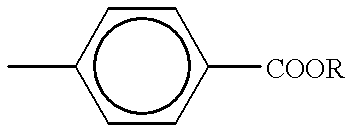
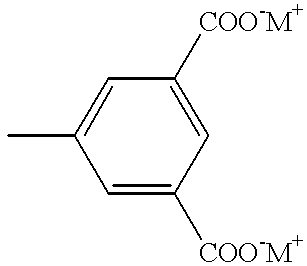
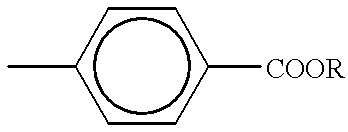
The following example describes the preparation of a modified carbon black pigment with 0.3 mmoles / g 5-aminoisophtalic acid (ISO) and 0.3 mmoles / g butyl 4-aminobenzoate (BAB).
Carbon black having a surface area of 200 m.sup.2 / g and a DBP absorption value of 122 ml / 100 g (300 g) is added to a batch pin mixer heated to 70.degree. C. To this is added 5-amino isophthalic acid (17.16 g). Mixing is started, and an aqueous solution of sodium nitrite (6.21 g dissolved in 107.3 g water) is added while mixing. Total mixing time is approximately 5 minutes. The mixing is then stopped, and butyl 4-aminobenzoate (17.57 g) is added. Mixing is started again, and a solution of nitric acid (8.1 g 70% nitric acid dissolved in 107.3 g water) is added while mixing. The mixing time is 4 minutes. Finally, an aqueous solution of sodium nitrite (6.21 g dissolved in 107.3 g water) is added while mixing for 5 minutes. The mixing is stopped, and the material is removed from the batch pin mixer and allowed to c...
example ii
Black inks were prepared containing the pigments shown in the following table:
Bleed and waterfastness for these inks are shown below. Improvements in waterfastness can be seen for attachment of EB and BB by comparing waterfastness results (OD transferred) of the above pigments with those modified with 0.3 and 0.4 mmole / g isophthalic acid alone. The black-yellow bleed data indicates that improved bleed is attained at ratios of 0.3 ISO / 0.3 EB, 0.3 ISO / 0.3 BB, 0.5 ISO / 0.5 EB and 0.5 ISO / 0.5 BB.
PUM
| Property | Measurement | Unit |
|---|---|---|
| mean diameter | aaaaa | aaaaa |
| pH | aaaaa | aaaaa |
| OD | aaaaa | aaaaa |
Abstract
Description
Claims
Application Information
 Login to View More