Bearing assembly for a vehicle

a technology for bearings and vehicles, applied in mechanical devices, instruments, transportation and packaging, etc., can solve problems such as inaccurate signals sent to electronic control units to control brake applications

US6854891B1Inactive Publication Date: 2005-02-15ROBERT BOSCH CORP
3 Cites 2 Cited by

Patent Information

Authority / Receiving Office
US · United States
Patent Type
Patents(United States)
Current Assignee / Owner
Publication Date
2005-02-15
Estimated Expiration
Not applicable · inactive patent

Smart Images

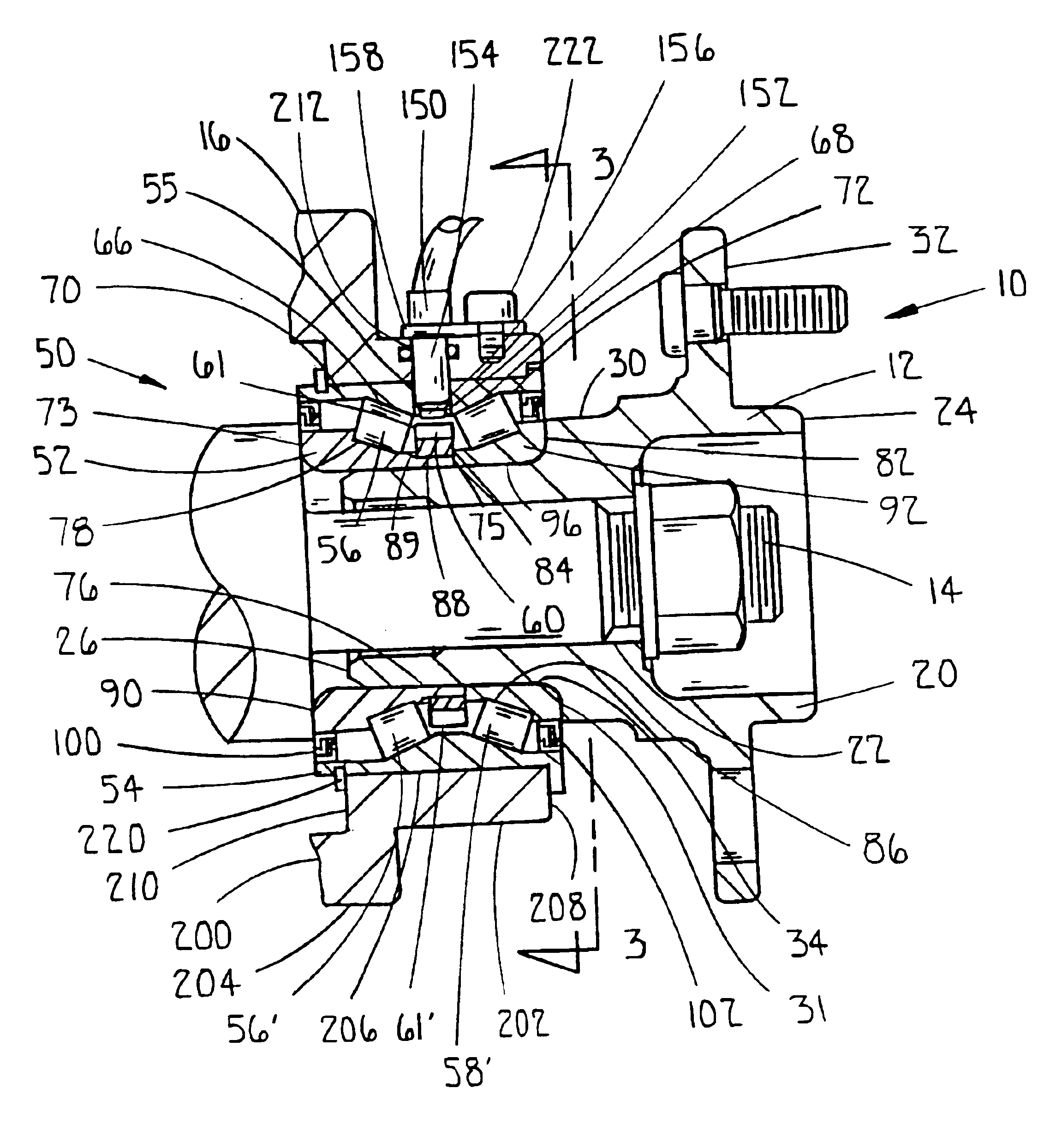
  • Figure 1
    Figure 1
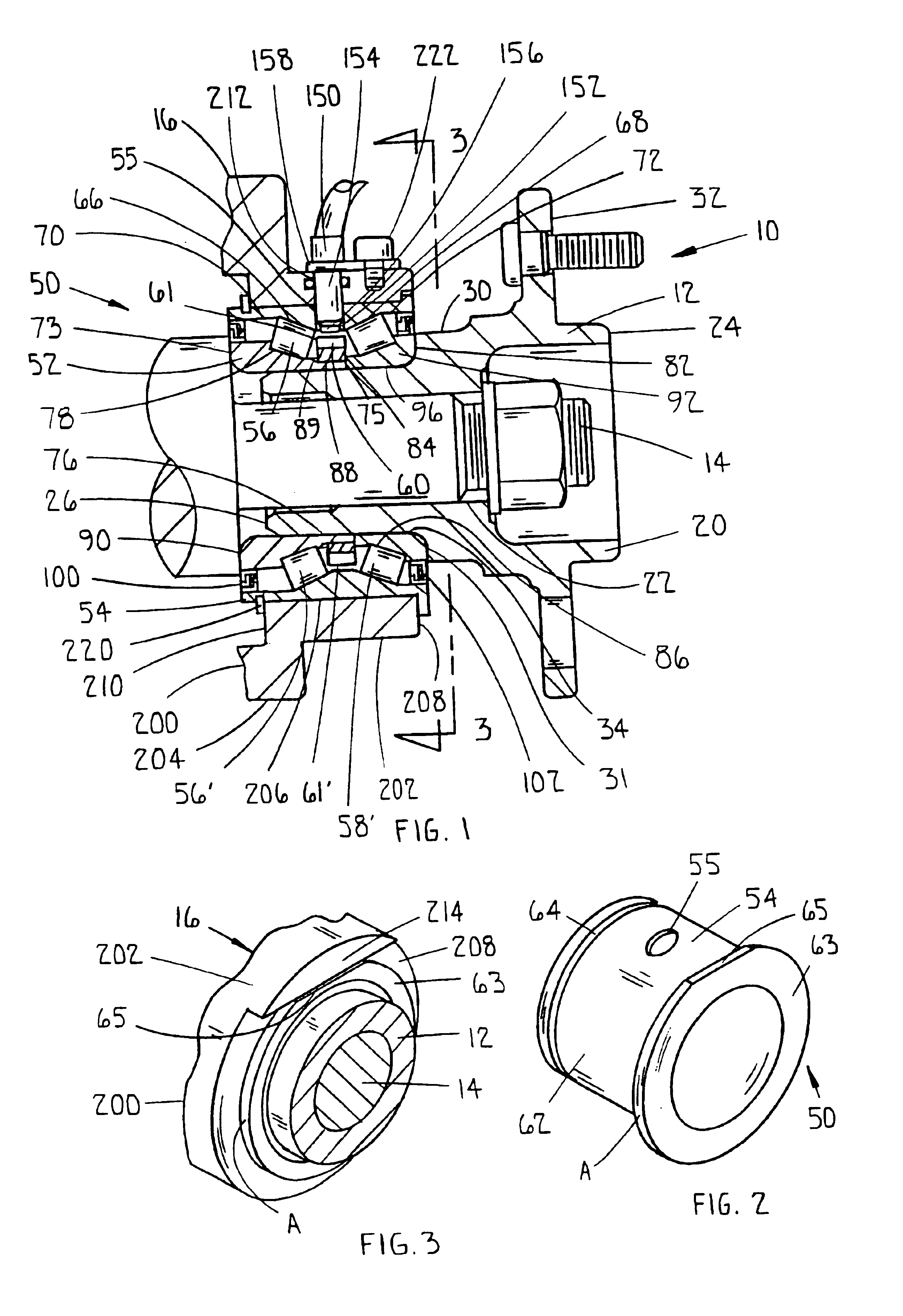
  • Figure 2
    Figure 2
Patent Text Reader

Abstract

A corner module for use in a motor vehicle having a bearing pack through which a wheel hub for the motor vehicle is connected with a support member. The bearing pack includes an inner race and an outer race for retaining first and second roller elements such that a wheel attached to the hub may rotate with respect to the support member. The bearing pack is characterized by an exciter ring that is located between the first and second roller elements and the outer race is characterized by an opening that is in radial alignment with the exciter ring. A sensor that is fixed to the support member has a functional length and a sensing area that extends through the radial opening in the outer race and into the bearing pack to a position adjacent the exciter ring such that the functional length and sensing area is protected from exposure to contamination that may be present in the environment. The sensing area is activated by movement of the exciter ring to provide an electronic control unit with a signal relating to the rotation of the wheel and used in the control of an anti-skid brake system.
Need to check novelty before this filing date? Find Prior Art

Description

This invention relates to a bearing pack through which a wheel hub is connected to a support member wherein a tone wheel or magnetic encoder is retained in the bearing pack and activates a sensor to provide an electronic control unit with a signal corresponding to rotative movement of the hub.BACKGROUND OF THE INVENTIONMost brake systems for cars and trucks currently have the capability of including anti-skid functions to prevent wheel lock from occurring during a brake application. In such systems, sensors are commonly located at each wheel to detect wheel rotation and when a potential lock up may occur, a signal is sent to an electronic control unit such that the pressure presented to the individual wheel brake is modulated and as a result wheel lock up may be avoided. The types of sensors used in a brake system vary and can be selected from a variety of devices such as variable reluctance devices commonly referred to as a passive sensors, Hall effect devices, AMR effect devices, ...

Examples

Embodiment Construction

The corner module 10 for use in a motor vehicle shown in FIG. 1 has a bearing pack 50 through which a hub 12 located on an axle 14 for the motor vehicle is connected with a support member 16. The bearing pack 50 includes a unitary outer race 54, see FIG. 2, and first 90 and second 92 cones that define an inner race 52. The bearing pack 50 includes an inner race 52 and outer race 54 for retaining first 56 and second 58 roller elements that allow the hub 12 to rotate with respect to the support member 16. The bearing pack 50 has an exciter ring 60 that is located between the first 56 and second 58 roller elements such that the exciter ring 60 is radially aligned with an opening 55 in the outer race 54. A sensor 150 that is fixed to the support member 16 has a cylindrical body with a functional length and sensing area 152 that extends through the radial opening 55 in the outer race 54 and into the interior of the bearing pack 50 to a position adjacent the exciter ring 60 and as a resul...