Asymmetric implementation of DSVD for voice/data internet access

a technology of voice/data internet access and asymmetric implementation, applied in the direction of data switching networks, digital transmission, multiplex communication, etc., can solve the problems of only having one physical channel switched connection, two users cannot transmit voice data, and the dsvd system has a number of serious limitations on how dsvd may be used, so as to achieve less circuitry, improve voice quality, and reduce production costs

US6904037B2Inactive Publication Date: 2005-06-07CISCO TECH INC
69 Cites 26 Cited by

Patent Information

Authority / Receiving Office
US · United States
Patent Type
Patents(United States)
Current Assignee / Owner
Publication Date
2005-06-07
Estimated Expiration
Not applicable · inactive patent

Smart Images

  • Figure 1
    Figure 1
  • Figure 2
    Figure 2
  • Figure 3
    Figure 3
Patent Text Reader

Abstract

Voice and data streams transmitted from a conventional DSVD modem are interfaced directly to a network access server through a modified DSVD modem according to the invention. The voice and data is formatted into network data packets that are then routed directly to different endpoints through the network access server. The modified DSVD modem includes a packet framer that removes conventionally transmitted V.76 DSVD framing formats and stuffs bytes into the voice and data to form network packets. The network access server then routes the voice and data packets to the different endpoints identified in a packet header. Since the voice and data are output from the DSVD modem in data packets, the voice and data can be routed more efficiently to different network endpoints.
Need to check novelty before this filing date? Find Prior Art

Description

BACKGROUND OF THE INVENTION

[0001] This invention relates generally to transferring voice and data over Internet systems and more particularly to an asymmetric Digital Simultaneous Voice / Data system that facilitates transmission of voice and data to different endpoints.

[0002] Many home users have only one phone line, and hence use Digital Simultaneous Voice / Data (DSVD) modems to simultaneously transfer voice and data at the same time over a common communication channel. DSVD modems conforming to a V.34 standard are beginning to become available at low cost and are expected to be ubiquitous in new consumer-oriented personal computers. PC hardware and software companies expect to significantly reduce support costs by providing concurrent voice and data access for help desks and support organizations.

[0003] Conventional DSVD operates as an “end-to-end” system. In an end-to-end system, a communication channel, such as through a Plain Old Telephone Service (POTS) telephone call, directly con...

Examples

Embodiment Construction

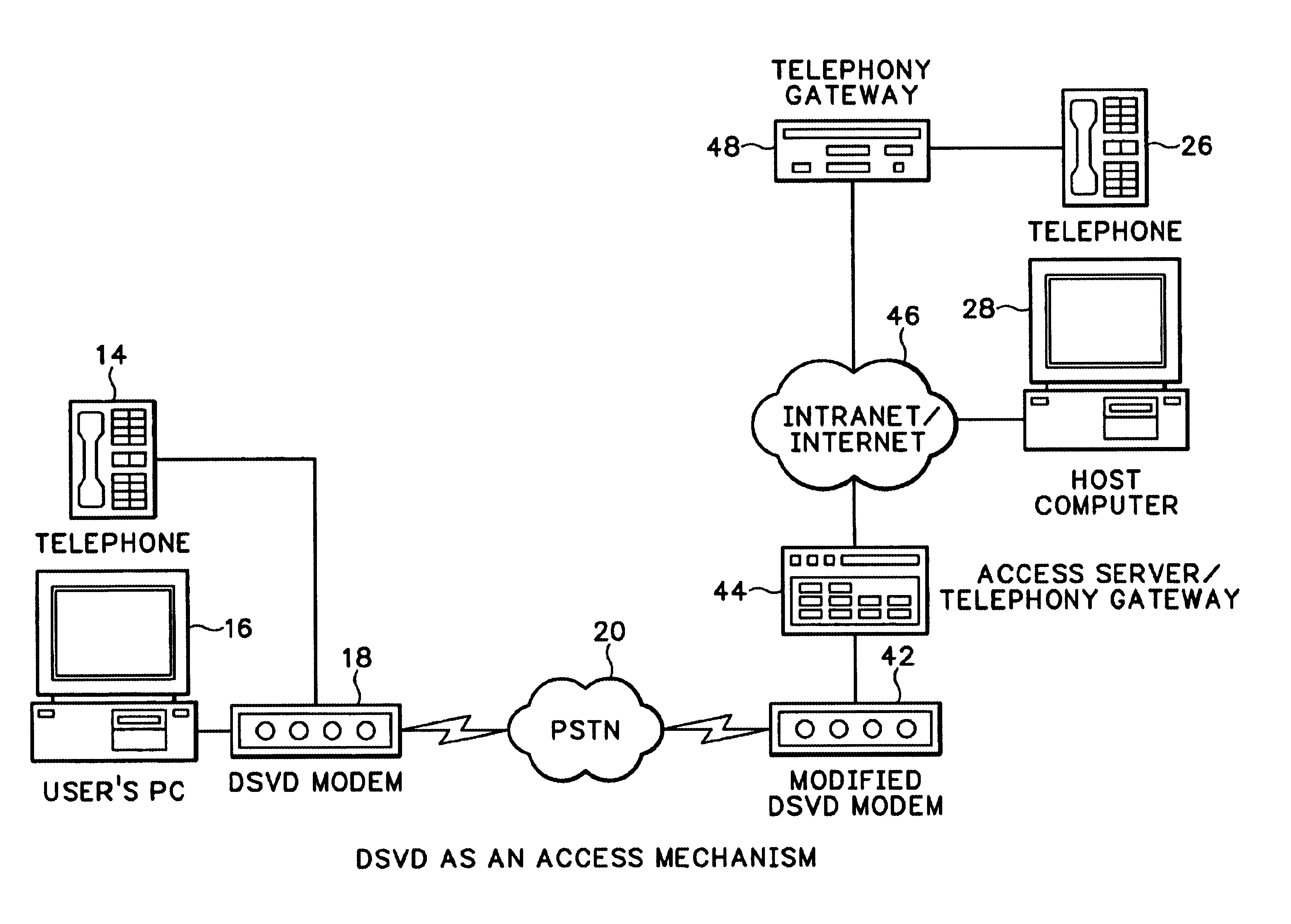
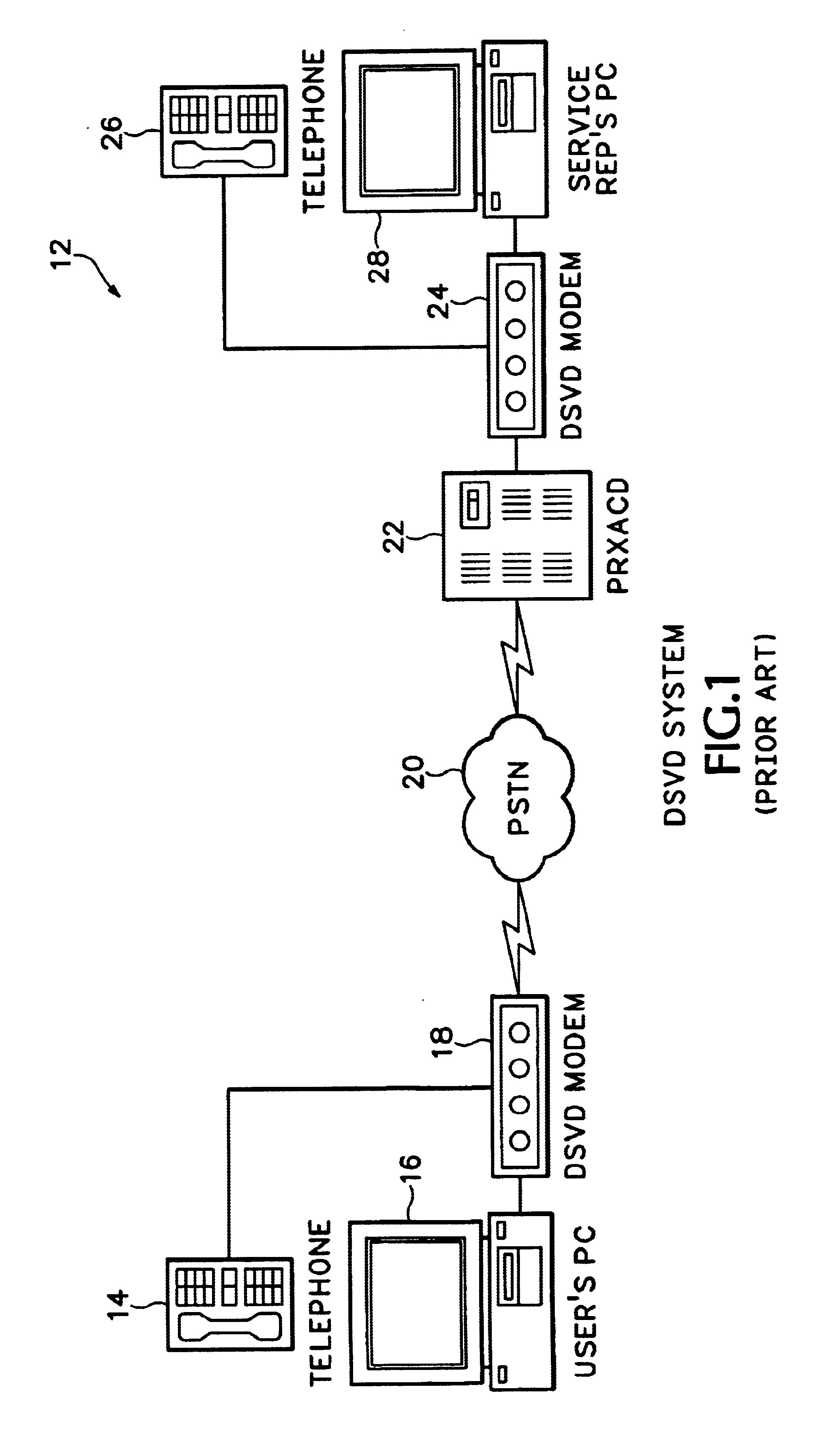
[0020]Referring to FIG. 3, a telephone 14, PC 16, DSVD modem 18 and PSTN 20 are used to transmit and receive voice and data in a similar manner as that previously described in FIG. 1. A modified DSVD modem 42 according to one embodiment of the invention is coupled between the PSTN 20 and an access server / telephony gateway 44. An access system 46 comprises an Intranet or Internet system that couples telephone 26 to the access server 44 through a telephony gateway 48 and couples a host computer 28 to the access server 44.

[0021]The network system 46 represents any standard packet switched network system. For example, the access system 46 represents a Local Area Network (LAN) or a Wide Area Network (WAN) 44 such as Ethernet, FDDI, T1 / E1, T3 / E3, ISDN PRI, or ATM. The access server 44 in one embodiment is a standard packet based router system such router Model No. AS50100 manufactured by Cisco Systems, 170 West Tasman Dr., San Jose, Calif. 95134-1706.

[0022]Telephony gateway 48, in one emb...