

Capacitive test point voltage and phasing detector
a capacitive test point and detector technology, applied in the direction of noise figure or signal-to-noise ratio measurement, frequency to phase shift conversion, instruments, etc., can solve the problem of giving inaccurate voltage readings at capacitive test points, and achieve accurate detection of presence, low input impedance, and low input impedance
- Summary
- Abstract
- Description
- Claims
- Application Information
AI Technical Summary
Benefits of technology
Problems solved by technology
Method used
Image



Examples
Embodiment Construction
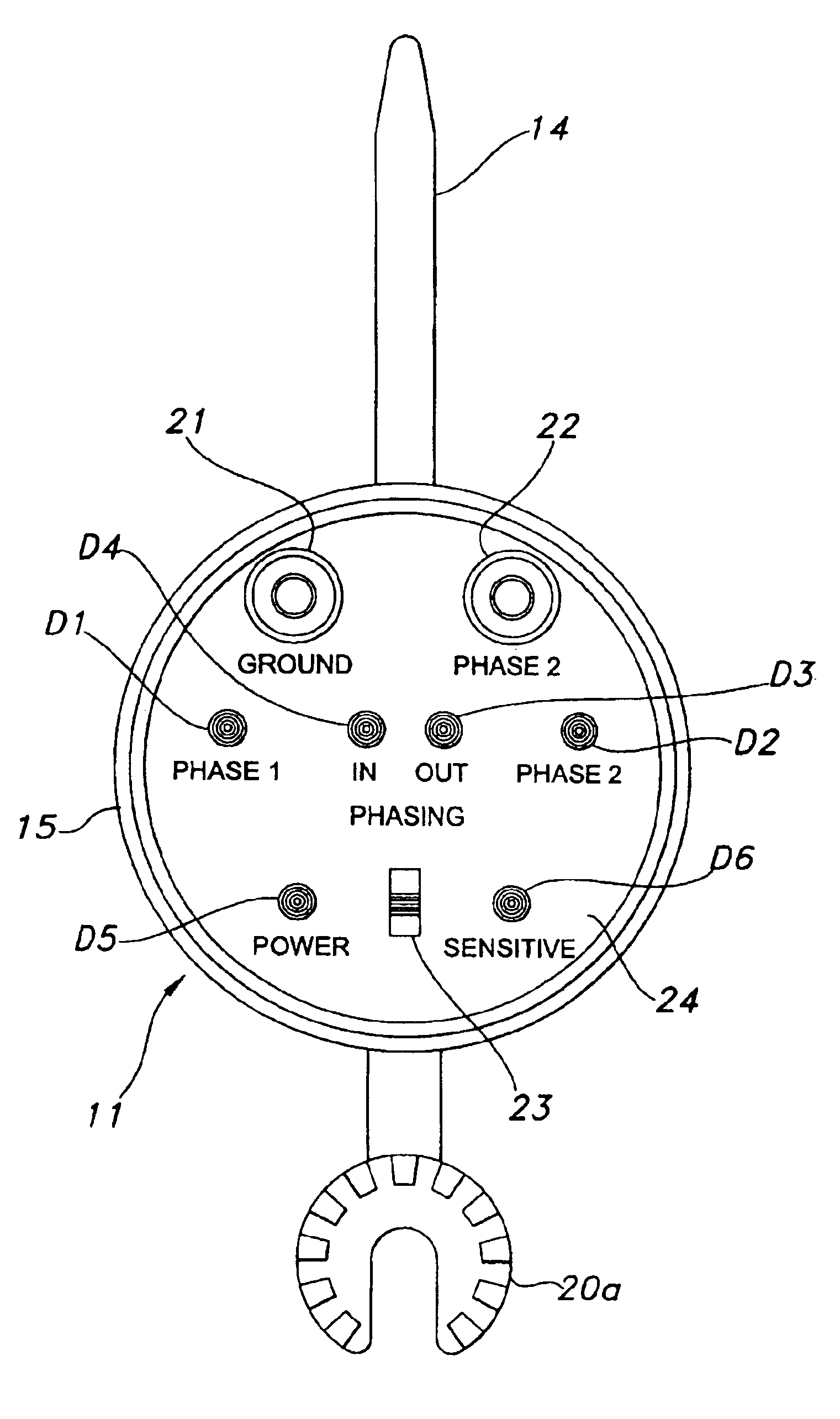
[0016]Referring now to FIG. 1, a capacitive test point voltage and phasing detector 10 is shown in use in an environment which is shown schematically. The capacitive test point voltage and phasing detector 10 generally includes a first detector member 11 and a second detector member 12 which are in electrical communication with each other by a phase 2 lead 13, which is merely a wire. Preferably the first detector member 11 includes a longitudinally extended first probe 14 having a pointed upper end 14a and a lower end 14b. The first detector member 11 also includes a circular shaped module 15 connected between the upper and the lower end of the first probe 14. The first probe 14 is configured to engage with a first capacitive point 16 at the pointed upper end 14a to take a voltage reading. The first probe 14 is electrically coupled to the module 15. Moreover, a first universal adapter 16 is connected to the lower end of the first probe 14 to facilitate the attachment of the first de...
PUM
 Login to View More
 Abstract
Description
Claims
Application Information
 Login to View More