
Viterbi decoder with direct current restoration
a decoder and direct current technology, applied in the direction of coding, code conversion, electrical equipment, etc., can solve the problems of loss of any read-back signal dc component, loss of any perpendicular recording nature, and damage to the integrity of the read-back signal, so as to avoid additional errors and eliminate the delay in the restoration of dc component
- Summary
- Abstract
- Description
- Claims
- Application Information
AI Technical Summary
Benefits of technology
Problems solved by technology
Method used
Image

Examples
Embodiment Construction
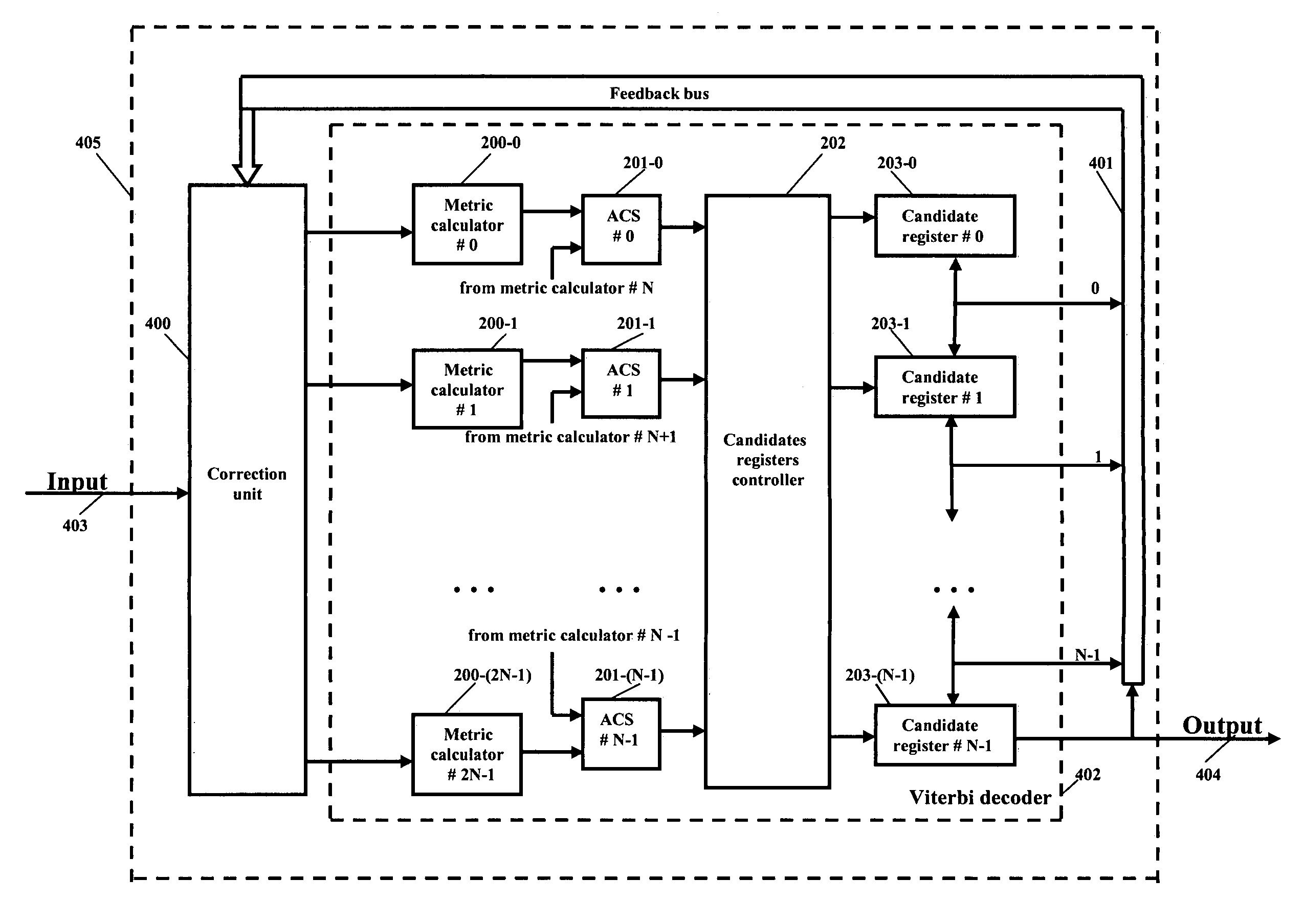
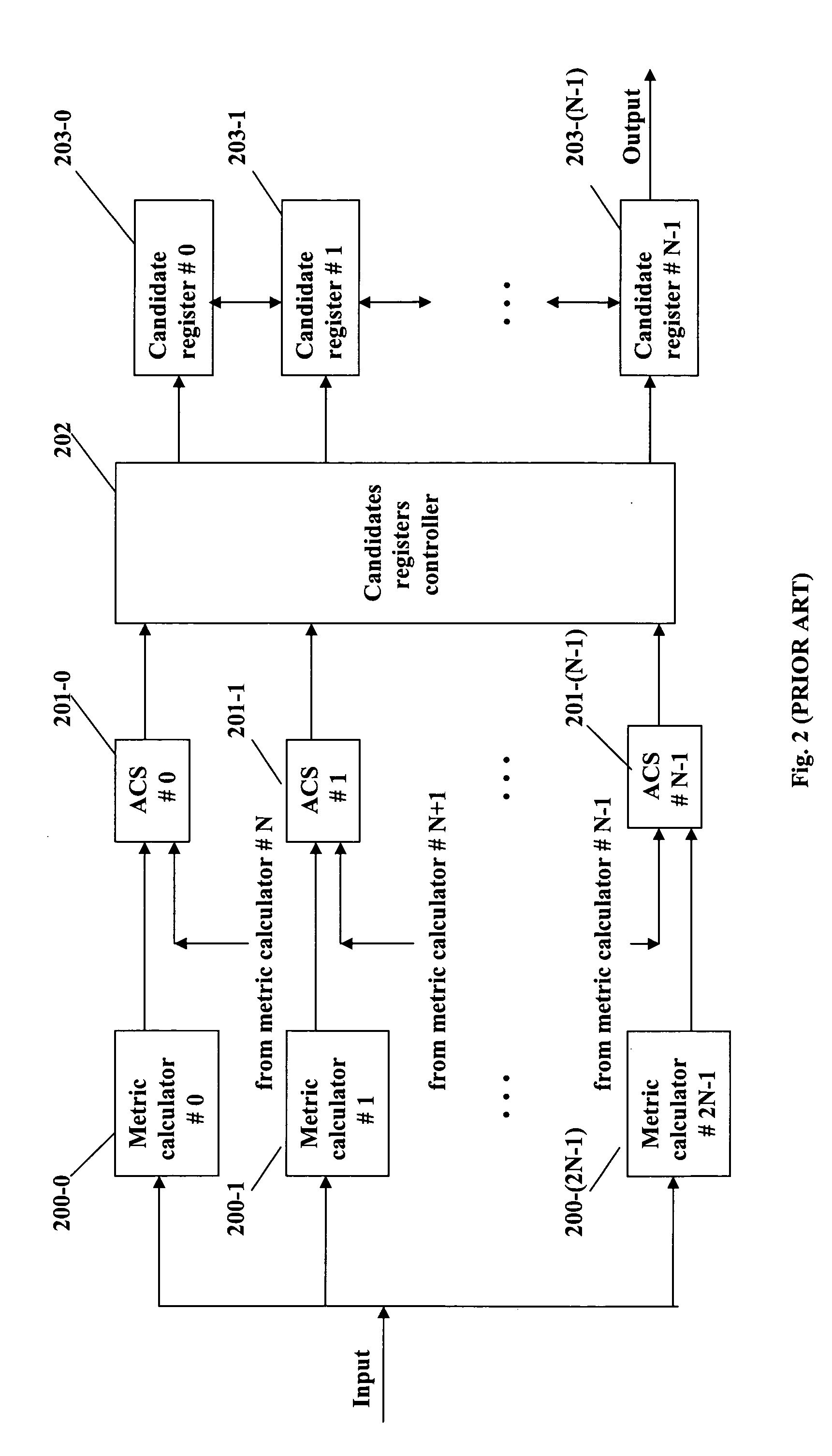
[0029]The 2N inputs of the metric calculators may be considered as partial inputs of the Viterbi decoder. In the block diagram of FIG. 2 they are united and connected to the input terminal of the decoder. The N bidirectional exchange inouts of the candidate registers may be considered as partial terminations of the decoder. According to the present invention DC component restoration is achieved by adding to a conventional-type Viterbi decoder not a single feedback circuit (as illustrated in the FIG. 3), but a set of feedback loops, one loop for each state. In every loop, a restored DC component is calculated in assumption that corresponding state will survive. The most recent sample of the restored DC component, is added to the respective current sample of the input signal and the resulting sum is placed at the corresponding partial input of the Viterbi decoder. An exemplary Viterbi decoder with DC component restoration 405 according to the present invention is shown in FIG. 4a. In ...
PUM
 Login to View More
 Abstract
Description
Claims
Application Information
 Login to View More