Enhancement of compressed images

US7206459B2Inactive Publication Date: 2007-04-17RICOH KK
9 Cites 54 Cited by

Patent Information

Authority / Receiving Office
US · United States
Current Assignee / Owner
Publication Date
2007-04-17
Estimated Expiration
Not applicable · inactive patent

Smart Images

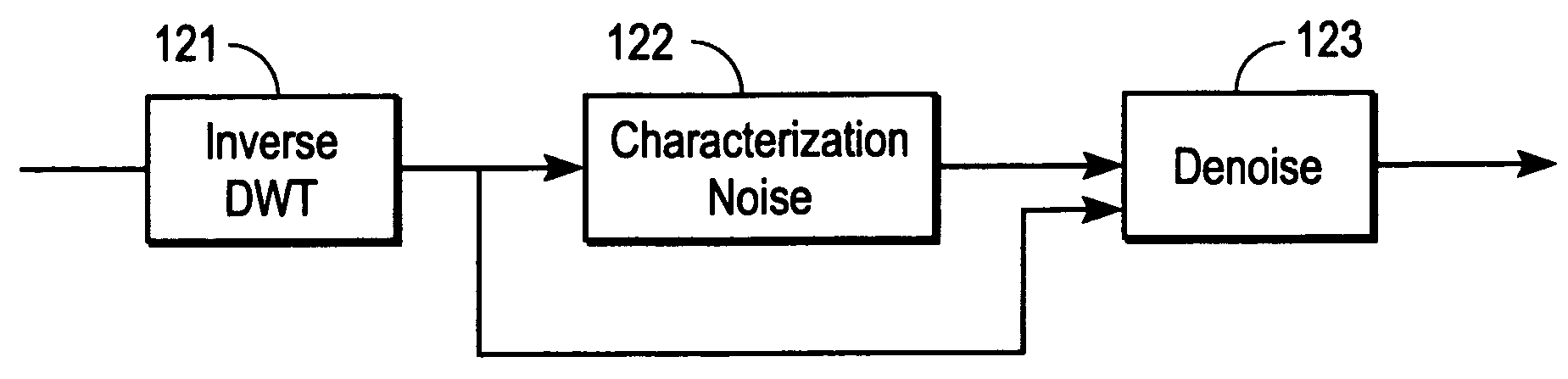
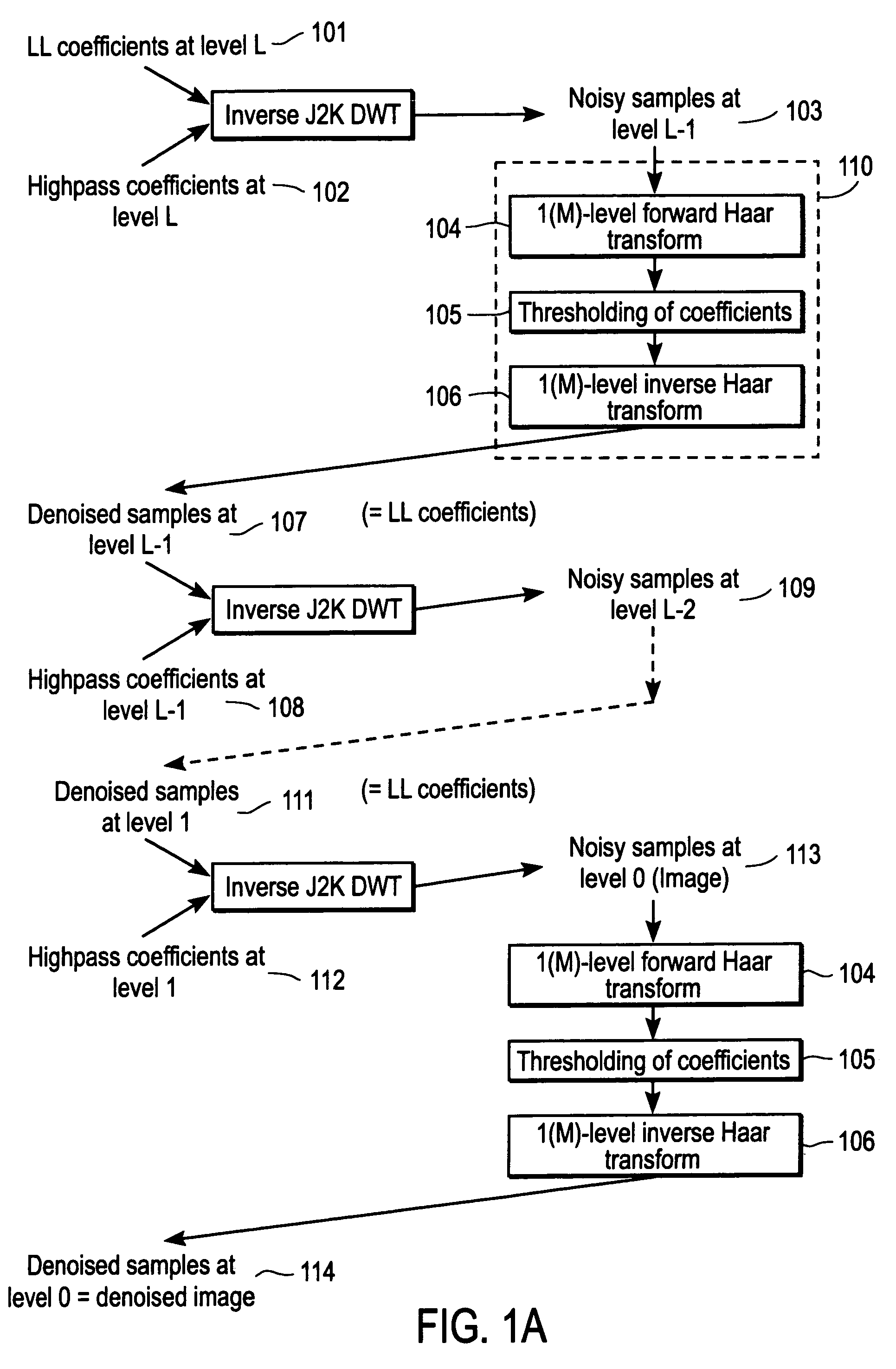
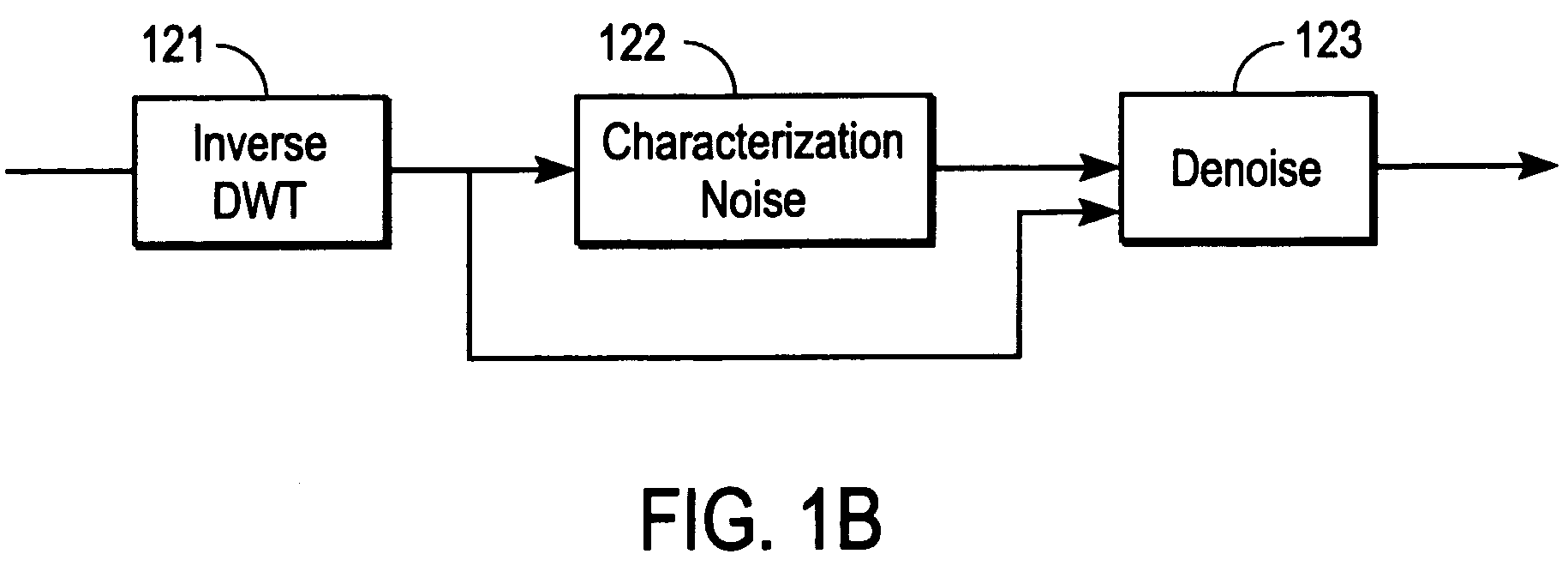
  • Figure 1
    Figure 1
  • Figure 2
    Figure 2
  • Figure 3
    Figure 3
Patent Text Reader

Abstract

A method and apparatus for enhancing compressed images is described. In one embodiment, the method comprises characterizing quantization noise in reconstructed low pass coefficients generated in response to application of an inverse wavelet transform and removing the quantization noise from the reconstructed low pass coefficients constructed during decoding.
Need to check novelty before this filing date? Find Prior Art

Description

FIELD OF THE INVENTION

[0001] A portion of the disclosure of this patent document contains material which is subject to (copyright or mask work) protection. The (copyright or mask work) owner has no objection to the facsimile reproduction by anyone of the patent document or the patent disclosure, as it appears in the Patent and Trademark Office patent file or records, but otherwise reserves all (copyright or mask work) rights whatsoever.

[0002] The present invention relates to the field of decompression and compression systems; more particularly, the present invention relates to enhancement of compressed images, such as, for example, those that are decoded by a decoder compliant with the JPEG 2000 Standard.BACKGROUND OF THE INVENTION

[0003] At lower bitrates, compressed images often show some artifacts due to the quantization of transform coefficients. The nature of these artifacts depends very much on the chosen transform and quantization scheme. The artifacts are often called quantizati...

Examples

examples

Example of Using Denoising with Decoding

[0215]The following simple example shows how wavelet denoising can improve lossy decompression of signals with smooth regions and edges. Source code and numerical results are provided below. The example processes a one-dimensional (1D) signal for simplicity. FIG. 6 illustrates an input signal with step edges.

[0216]FIG. 7 shows the high pass coefficients for a 5-3 transform assuming a mirror extension at boundaries. FIG. 8 shows the low pass coefficients for a 5-3 transform assuming the use of mirror extension at boundaries.

[0217]FIG. 9 shows the high pass coefficients being quantized with Q equal to 16. In such a case, 30 is quantized to 16+8=24 and −30 is quantized to −24.

[0218]Once the high pass coefficients have been quantized, an inverse transform is applied. FIG. 10 shows the result of applying the inverse transform. In this example, the result has a mean squared error (MSE) 3.44 difference with the input signal.

[0219]Thereafter, the redu...