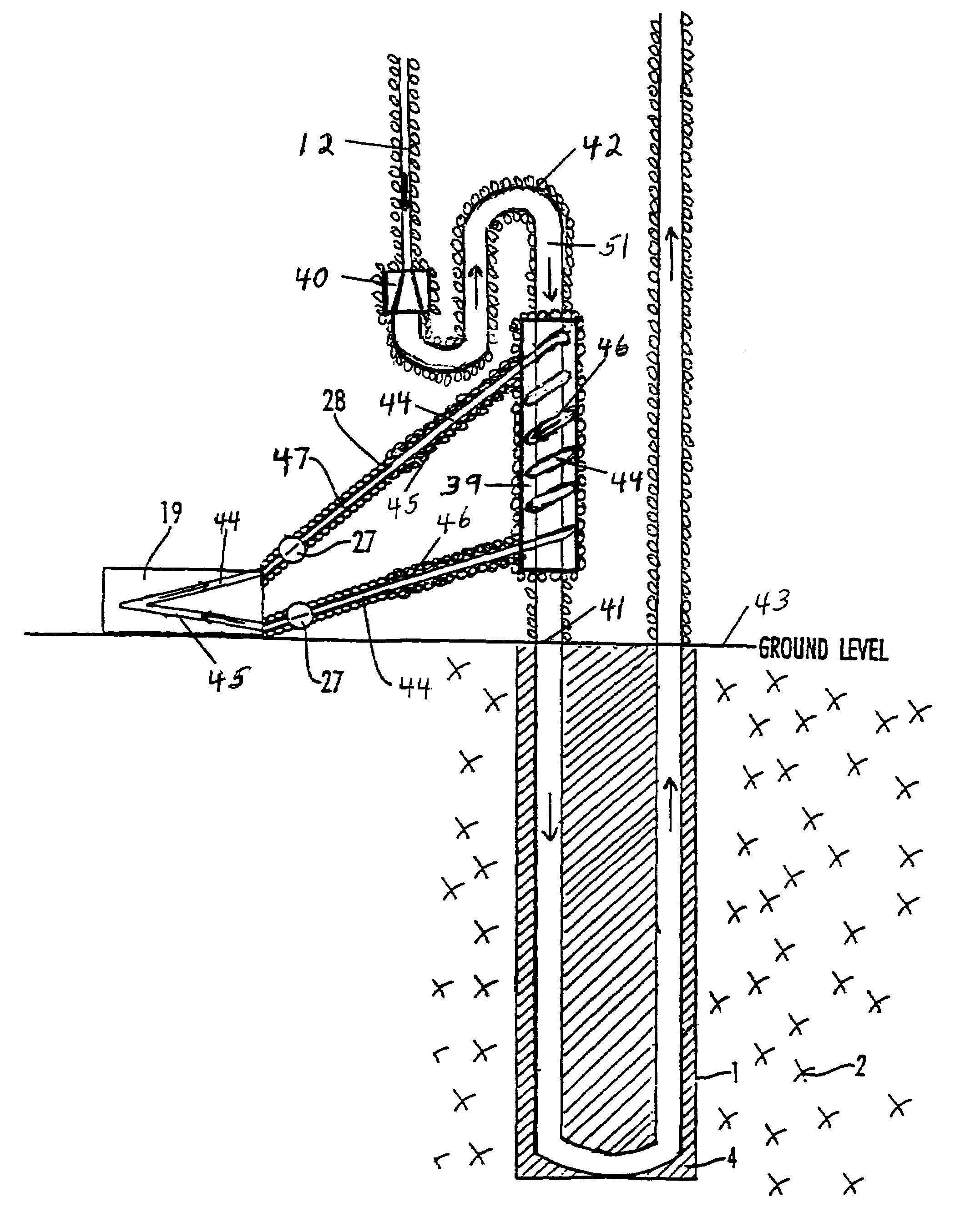
[0015]It is an object of the present invention to further enhance and improve the efficiency and installation cost functionality of predecessor geothermal heat exchange designs for closed-loop water-source
heat pump systems, and for direct expansion heat pump systems. This is accomplished by means of a
solar heat collector
solar system that is operatively connected to a new, or to an existing, geothermal direct expansion, or closed-loop water-source, heat pump system so as to provide supplemental heat in the heating mode, when advantageous, by means of natural
solar heat collector fluid
convection.
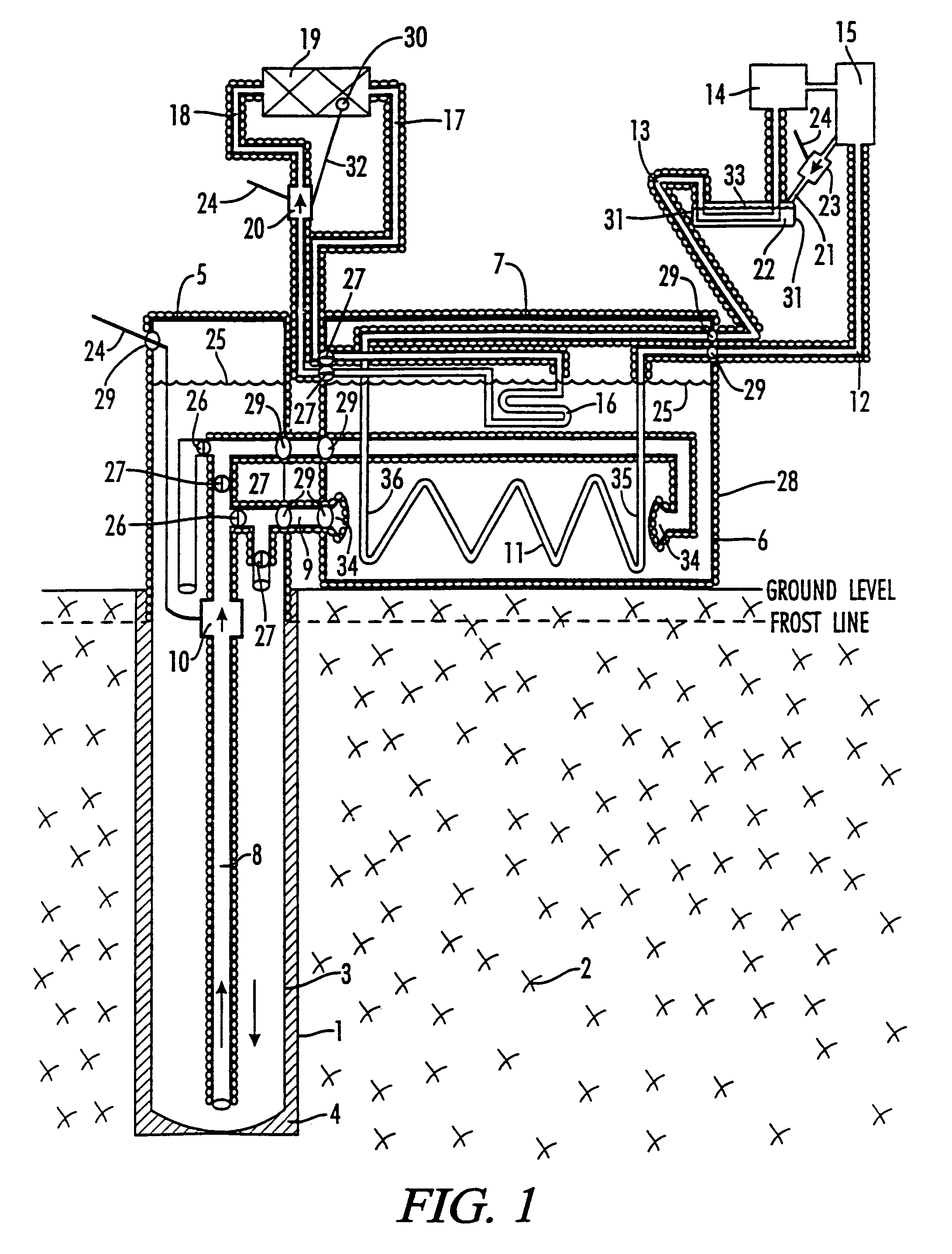
[0016]More specifically, a borehole is drilled to a specified depth, depending on the amount of
heat transfer desired, and a casement, such as a six inch
diameter steel or plastic casement, which casement has been sealed at the bottom and at all joint areas along the sides, is inserted into the full depth of the borehole. Next, a smaller
diameter, such as a two and one-half inch diameter open-ended plastic
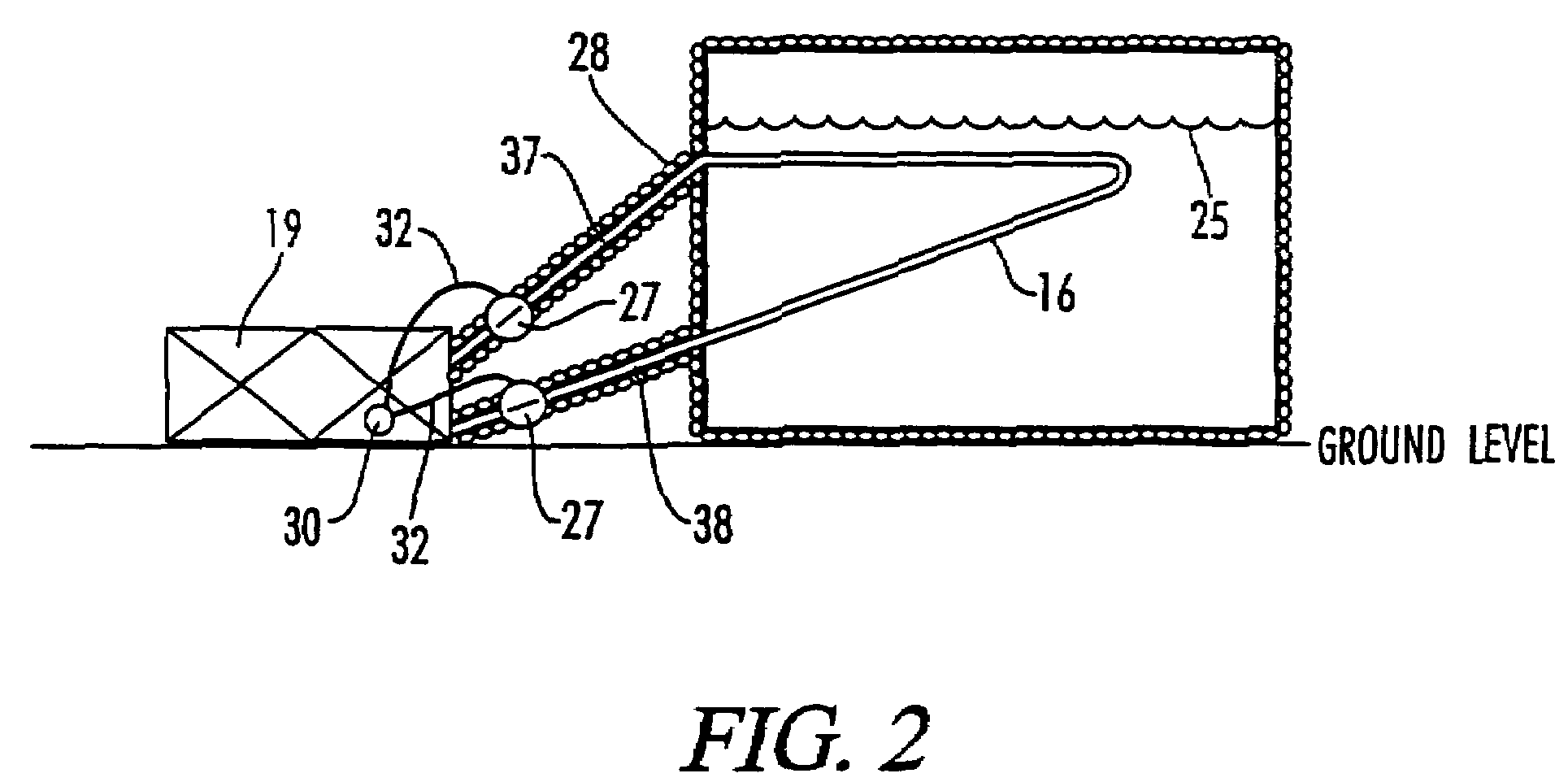
pipe, which has been fully insulated, is inserted to a depth near, within about six to twelve inches, the bottom of the sealed casement. The sealed primary casement extends to a point near, or above, the surface where the open-ended plastic pipe connects to a sealed container, such as a plastic tub. The plastic tub and the primary casement are fully insulated above-ground and to a depth at least equal to the maximum
frost / heat line. Heat exchange coils, such as
copper refrigerant tubing, having sufficient surface area to transfer the desired amount of heat, are placed into the sealed container, with an insulated supply and return refrigerant line extending to a conventional heat pump system, comprised of a compressor, an expansion valve, an interior
air handler, and other customary equipment well-known to those in the trade. The sealed container, casement, and open-ended pipe are all then filled with a heat transfer liquid, such as water and / or water and anti-freeze, and a liquid
circulating pump is attached near the top of the pipe so as to pull liquid up through the open-ended pipe from the bottom of the casement deep underground. As the liquid from the bottom of the casement is pulled up through the
insulated pipe, the liquid from the bottom of the casement, which is cool in the summer and warm in the winter, will circulate over the refrigerant heat
transfer line, which are hot in the summer and cold in the winter, and the liquid will be pulled back to the bottom of the casement, where heat supplied to, or taken from, the liquid, through the walls of the
copper refrigerant heat
transfer line by the circulating refrigerant, will be transferred to the surrounding geothermal soil and / or rock and / or water by means of natural heat
convection as the liquid travels to the bottom of the casement. Since the central pipe diameter is relatively large, and since the diameter of the casement is larger than the pipe, frictional efficiency losses will be minimized and efficiencies significantly increased. Further, since the pipe inside the casement is fully insulated, the common “short circuiting” heat transfer effect between the supply and return liquid lines will be substantially eliminated.
[0017]The subject invention also discloses a means of providing the warmest water from the bottom of the casement to the exiting portion of the refrigerant traveling to the compressor in the winter, as well as a means of providing the coolest water from the bottom of the casement to the exiting portion of the refrigerant traveling to the interior
air handler in the summer, by means of an arrangement of
piping and solenoid and / or check valves designed to switch liquid flow direction into and out of the container in a fashion commensurate with the desired refrigerant flow direction in either of the heat pump system's operational heating or cooling
modes. Also, a diffuser is incorporated at the entering / exiting portion of the liquid supply / return tubes within the container so as to provide relatively even
heat distribution along the refrigerant heat exchange line(s) within the container. This will enhance system efficiencies, as well as help to ensure that the warmest sensible air is provided to the interior conditioned
air space in the winter, and that the coolest sensible air is provided in the summer.



 Login to View More
  Login to View More