
Monoblock laser
- Summary
- Abstract
- Description
- Claims
- Application Information
AI Technical Summary
Benefits of technology
Problems solved by technology
Method used
Image

Examples
Embodiment Construction
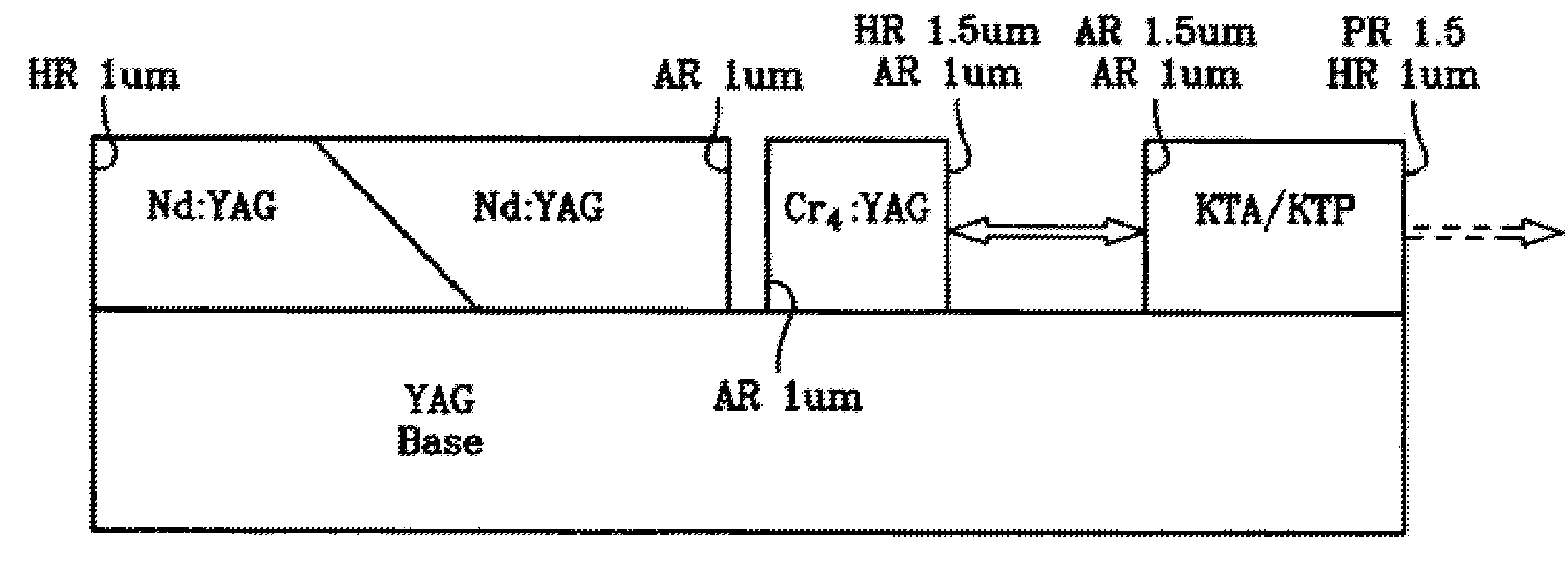
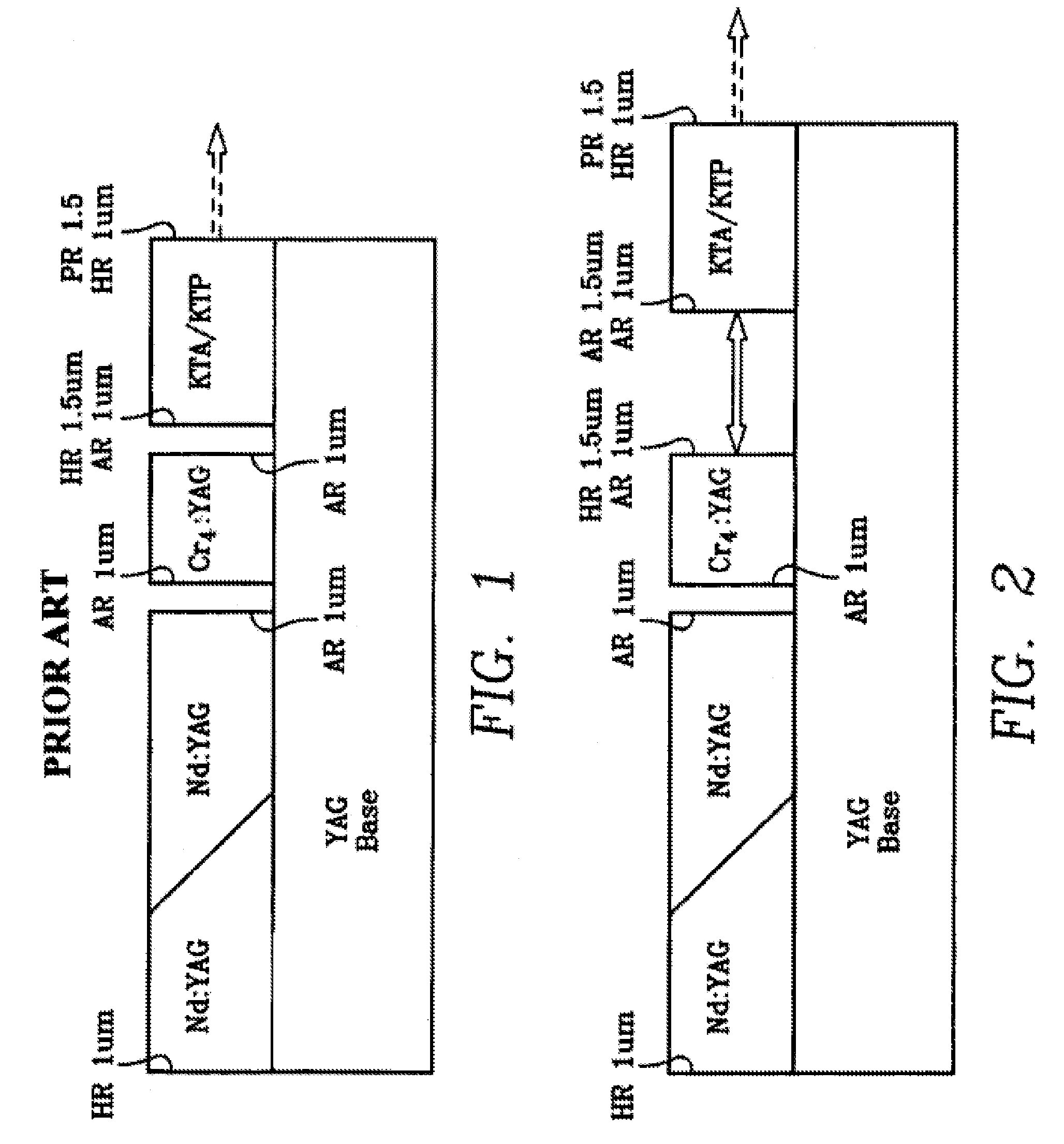
[0012]As shown in FIG. 1, the prior art monoblock laser compromises a block of laser gain material such as Neodymium:Yttrium-Aluminum-Garnet (Nd:YAG) and a high reflector having a wavelength about 1 um disposed on one side and an antireflector having a wavelength of 1 um disposed on an opposite end. Optically coupled to the laser gain material is a Q-switch made of a material such as Cr4+:YAG. The Q-switch is coupled to the laser gain material with an antireflector coating matching (1 um) the antireflector coated on the laser gain material. The Q-switch at the opposite end has another an antireflector coating of 1 um disposed at an output end of the Q-switch. Then, the Q-switch is optically coupled to the OPO cavity which has, in order, a high reflector coating of 1.5 um, an antireflector coating of 1 um on an input end and then, at the output end, a partial reflector coating of 1.5 and a high reflector coating of 1 um. The OPO cavity may be made of such materials as KTiOPO4 (KTP) / K...
PUM
 Login to View More
 Abstract
Description
Claims
Application Information
 Login to View More