[0007]It is therefore an object of the present invention to provide auto
cruise control that offers outstanding safety and comfort by optimally controlling
vehicle acceleration even under a condition, in which there developing a large vehicle speed deviation as in the resume mode, causing excessive acceleration or deceleration to occur.
[0010]Devices have conventionally been put into practical use, in which a
throttle opening is controlled so as to eliminate any deviation between the target vehicle speed and the actual vehicle speed, thus enabling vehicles to keep cruising speeds set by drivers. Such devices are generically called an auto cruise or
cruise control.
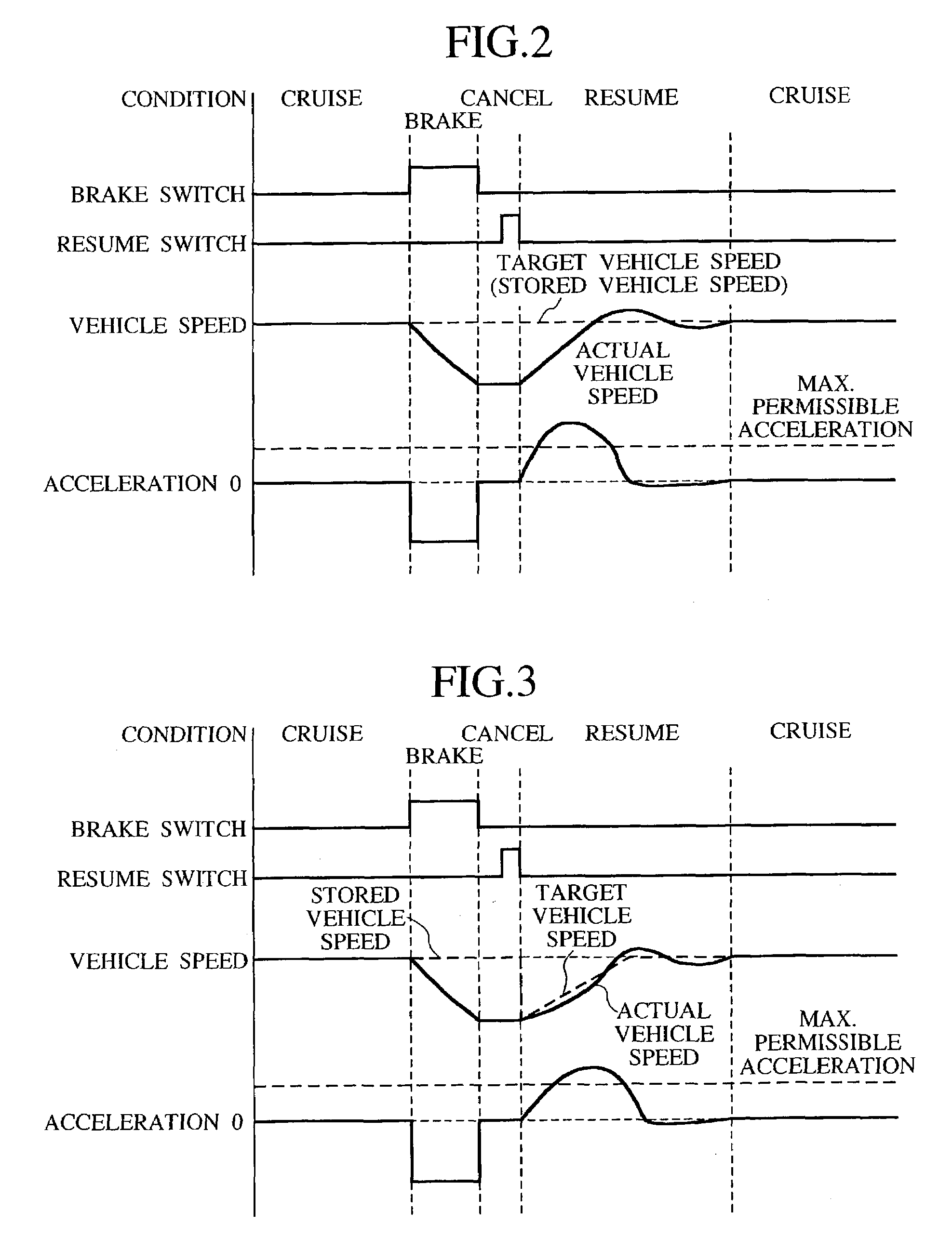
[0015]A prior art to solve this problem is disclosed in Japanese Patent Laid-open No. Hei 10-53046. The technique disclosed in Japanese Patent Laid-open No. Hei 10-53046 does not use the stored vehicle speed as the target vehicle speed for vehicle speed
feedback control in the resume mode, as shown in FIG. 3. Rather, the technique sets the actual vehicle speed developing when the resume operation is started as the target vehicle speed for the vehicle speed feedback control, thereby bringing the target vehicle speed gradually to the stored vehicle speed. This allows the vehicle speed deviation to be kept small at all times, thus effectively preventing acceleration from becoming excessively large. The
vehicle acceleration during this resume range is variable using increments of the target vehicle speed per unit time when the target vehicle speed is brought to the stored vehicle speed.
[0016]According to Japanese Patent Laid-open No. Hei 10-53046, if the vehicle speed feedback
gain is set appropriately so as to allow the actual vehicle speed to properly follow the target vehicle speed, it is possible to keep the vehicle speed deviation small at all times. This is effective in preventing acceleration from becoming excessively large. If, however, the feedback gain is made inappropriate as caused by a road inclination, a wind velocity, or other disturbance, the actual vehicle speed becomes unable to follow the target vehicle speed, thus making large the vehicle speed deviation, as shown in FIG. 3. In such a case, the vehicle speed feedback control device acts to make small the vehicle speed deviation. This gives rise to a problem, in which the vehicle acceleration becomes excessively large as a result of the engine torque changing by a large margin. To prevent excessive acceleration or deceleration under all possible conditions, therefore, it becomes necessary to control the acceleration itself based on actual acceleration information. More specifically, when the actual acceleration exceeds a predetermined acceleration level, it is considered effective to carry out a limiting process that limits the
control variable, such as a
throttle opening or the like. Alternatively, it is possible to provide acceleration feedback control based on the deviation between a target acceleration, which has been set during a period of acceleration, and the actual acceleration. Japanese Patent Laid-open No. Hei 11-34695 discloses a technique involving the acceleration feedback control. The Japanese Patent Laid-open No. Hei 11-34695 refers to an acceleration feedback control during acceleration performed by an ACC. The technique is intended for improving
throttle response, but not concerned with driver's comfort or vehicle stability.
[0017]The object of the present invention is to provide auto cruise control that offers outstanding safety and comfort by optimally controlling vehicle acceleration even under a condition, in which there developing a large vehicle speed deviation as in the resume mode, causing excessive acceleration or deceleration to occur.
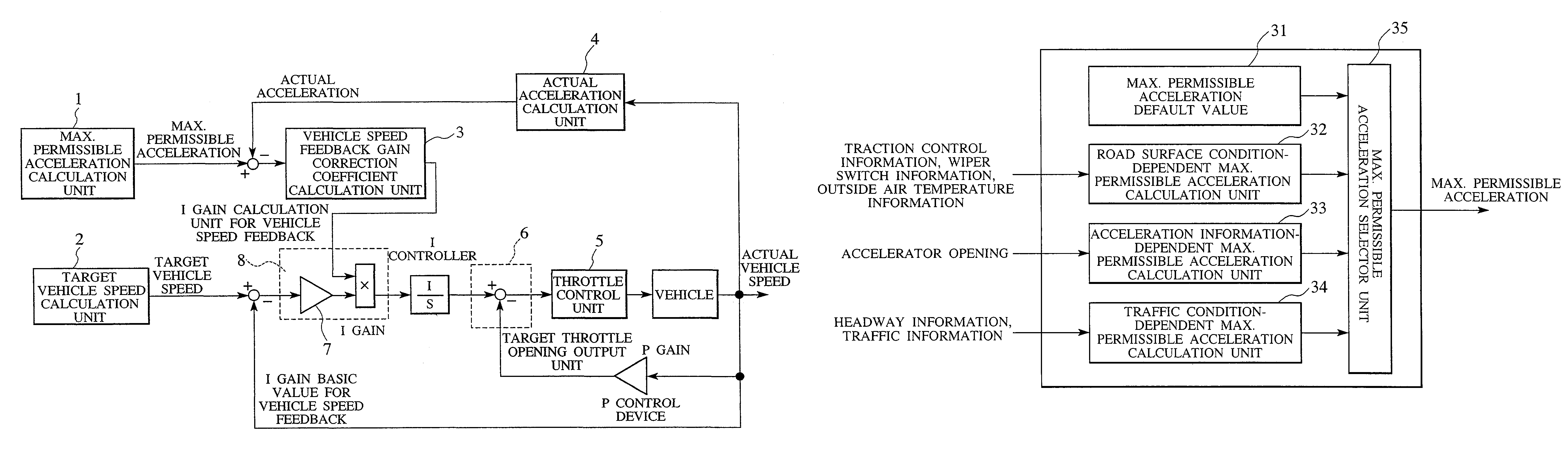
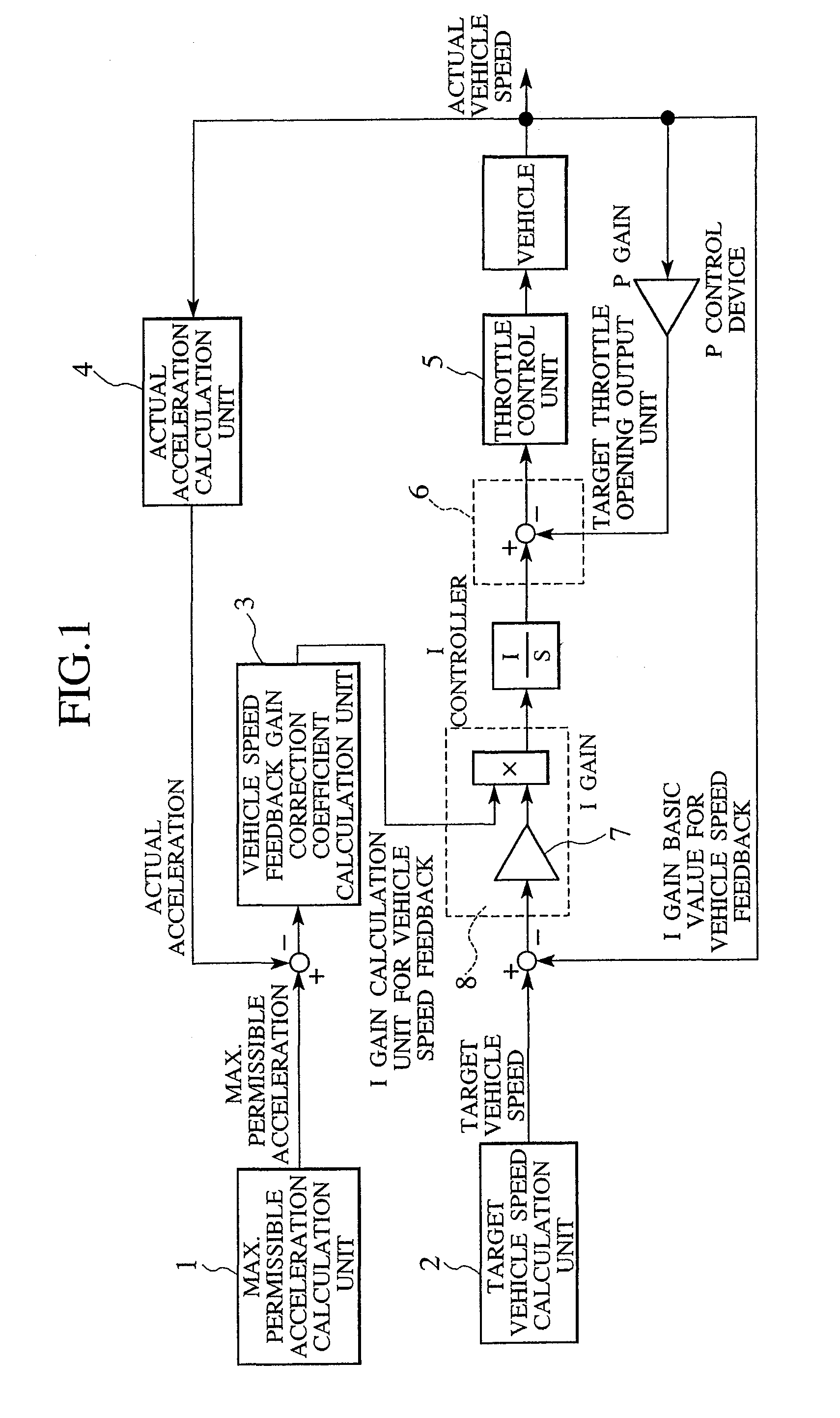
[0018]According to preferred embodiments of the present invention, a maximum permissible acceleration is calculated so as to take into account vehicle stability, driver's comfort,
road surface information and traffic information, driver's specific taste in acceleration and deceleration, and the like. The acceleration limiting process is carried out, in which the feedback gain in the vehicle speed feedback control is corrected as may be necessary based on the relationship between the maximum permissible acceleration and the actual acceleration information so as to keep the actual acceleration within the maximum permissible acceleration.


 Login to View More
  Login to View More