Unlock instant, AI-driven research and patent intelligence for your innovation.

Glass for laser processing

a laser processing and glass technology, applied in the field of glass laser processing, can solve the problems of not so much study progress, inability to avoid thermal influence, and difficulty in glass processing, and achieve the effect of low laser processing threshold value and low thermal expansion coefficien

Inactive Publication Date: 2008-07-15
NIPPON SHEET GLASS CO LTD
View PDF15 Cites 5 Cited by
  • Summary
  • Abstract
  • Description
  • Claims
  • Application Information

AI Technical Summary

Benefits of technology

The present invention provides a glass for laser processing that has a low laser processing threshold value and a low thermal expansion coefficient. The glass for laser processing is characterized by a composition that satisfies the following conditions: 60≦SiO2+B2O3≦79 mol %; 5≦Al2O3+TiO2≦20 mol %; and 5≦Li2O+Na2O+K2O+Rb2O+Cs2O+MgO+CaO+SrO+BaO≦20 mol%, wherein 5≦TiO2≦20 mol%. This glass for laser processing can be laser-processed by causing ablation or evaporation by laser beam energy absorbed therein.

Problems solved by technology

However, many of the lasers that are used for actual processing employ pulse widths of at least the nanosecond order, which makes it impossible to avoid the thermal influence.
The study, however, has not progressed so much from the viewpoint of improvement of materials to be irradiated with a laser.
Hence, the effective laser processing region is limited to the vicinity of the glass surface and therefore it still is difficult to carry out processing of glass including processing of the inner part thereof, for instance, processing to make a through hole in a glass sheet.
In addition, there is another problem that the ion exchange rate is low and it therefore is difficult to allow ions to reach the inner part of glass.
Moreover, glass for laser processing produced through the silver ion exchange contains a large amount of alkali metal or alkaline-earth metal and therefore has a high thermal expansion coefficient, which is a problem.
Hence, the dimensional accuracy of the processing part may deteriorate.
There also is a problem that such a dimensional change as described above may cause variations in the characteristics of optical elements.

Method used

the structure of the environmentally friendly knitted fabric provided by the present invention; figure 2 Flow chart of the yarn wrapping machine for environmentally friendly knitted fabrics and storage devices; image 3 Is the parameter map of the yarn covering machine
View more

Image

Smart Image Click on the blue labels to locate them in the text.
Viewing Examples
Smart Image
  • Glass for laser processing
  • Glass for laser processing
  • Glass for laser processing

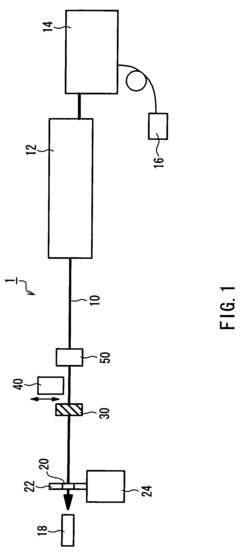
Examples

Experimental program
Comparison scheme
Effect test

examples

[0031]Examples in which the present invention is used are described below, but the present invention is not limited to them.

(1) Method of Producing Glass

[0032]Raw materials were blended so that 200 g of glass was to be produced. This was put into a platinum crucible, which then was placed in a melting furnace whose temperature had been raised to about 1500° C. This was maintained for six hours while being stirred several times. Casting was carried out by pouring the glass on an iron plate. Immediately thereafter, it was placed in an annealing furnace whose temperature had been raised to about 500° C. It then was maintained at a predetermined temperature for 30 minutes and then was cooled slowly to room temperature over 16 hours. A glass block thus obtained was cut and polished by a common method. Thus a sheet-like sample of glass for laser processing with smooth surfaces was prepared.

(2) Measurement of Laser-Irradiation Processing Threshold Value

[0033]A glass substrate was processed...

examples 1 to 12

[0042]The compositions of glasses for laser processing of the present invention according to Examples 1 to 12 are indicated in Table 1. The compositions of respective components are within the following ranges:[0043]a. network forming oxides (SiO2 and B2O3): 60 to 79 mol %;[0044]b. intermediate oxides (Al2O3 and TiO2): 5 to 20 mol %, wherein the content of TiO2 must be 5 to 20 mol %; and[0045]c. modifier oxides (Li2O, Na2O, K2O, MgO, CaO, SrO, and BaO): 5 to 20 mol %.

[0046]The glass for laser processing of the present invention consists substantially only of the compositions described above except for a very small amount of impurities.

[0047]The samples of glasses for laser processing having compositions mentioned above were irradiated with respective laser beams having wavelengths of 266 nm and 355 nm, with the irradiation energy being varied. Table 1 shows the processing threshold values obtained as a result.

[0048]It can be understood that in both the cases of using the respective ...

the structure of the environmentally friendly knitted fabric provided by the present invention; figure 2 Flow chart of the yarn wrapping machine for environmentally friendly knitted fabrics and storage devices; image 3 Is the parameter map of the yarn covering machine
Login to View More

PUM

PropertyMeasurementUnit
wavelengthaaaaaaaaaa
Login to View More

Abstract

A glass for laser processing of the present invention can be laser-processed by causing ablation or evaporation by laser beam energy absorbed therein, wherein the glass for laser processing has a composition that satisfies the following conditions:60≦SiO2+B2O3≦79 mol %;5≦Al2O3+TiO2≦20 mol %; and5≦Li2O+Na2O+K2O+Rb2O+Cs2O+MgO+CaO+SrO+BaO≦20 mol %,where 5≦TiO2≦20 mol %. The present invention can provide a glass for laser processing that has a low laser processing threshold value as well as a low thermal expansion coefficient.

Description

TECHNICAL FIELD[0001]The present invention relates to a glass for laser processing that can be laser-processed through laser beam irradiation. Particularly, the present invention relates to a glass for laser processing whose composition is suitable for laser processing.BACKGROUND ART[0002]Recently, the technique of processing materials using laser beam energy has been developing gradually to cover the field of micro-processing.[0003]In the processing technique using a mask pattern, the processable length has been extended to the range of nanometers that are further shorter than micrometers due to the progress of the patterning technique and the shortening of a laser wavelength.[0004]On the other hand, direct processing using a laser also has been practiced in the range of micrometers in the case of processing metal and organic matters such as polyimide as a result of the progress in shortening of the wavelength and pulse width of laser beams.[0005]Furthermore, processing such as per...

Claims

the structure of the environmentally friendly knitted fabric provided by the present invention; figure 2 Flow chart of the yarn wrapping machine for environmentally friendly knitted fabrics and storage devices; image 3 Is the parameter map of the yarn covering machine
Login to View More

Application Information

Patent Timeline
no application Login to View More
Patent Type & Authority Patents(United States)
IPC IPC(8): C03C3/089C03C3/091C03C3/093C03C3/076C03C23/00
CPCC03C3/076C03C23/0025C03C3/089
Inventor KOYO, HIROTAKATSUNETOMO, KEIJI
Owner NIPPON SHEET GLASS CO LTD