

Flash memory device and programming and erasing methods therewith
a flash memory and programming technology, applied in the field of flash memory devices and programming and erasing methods there, can solve the problems of low erasing speed and inability to maintain the constant threshold voltage, and achieve the effect of ensuring the programming and erasing characteristics
- Summary
- Abstract
- Description
- Claims
- Application Information
AI Technical Summary
Benefits of technology
Problems solved by technology
Method used
Image



Examples
first embodiment
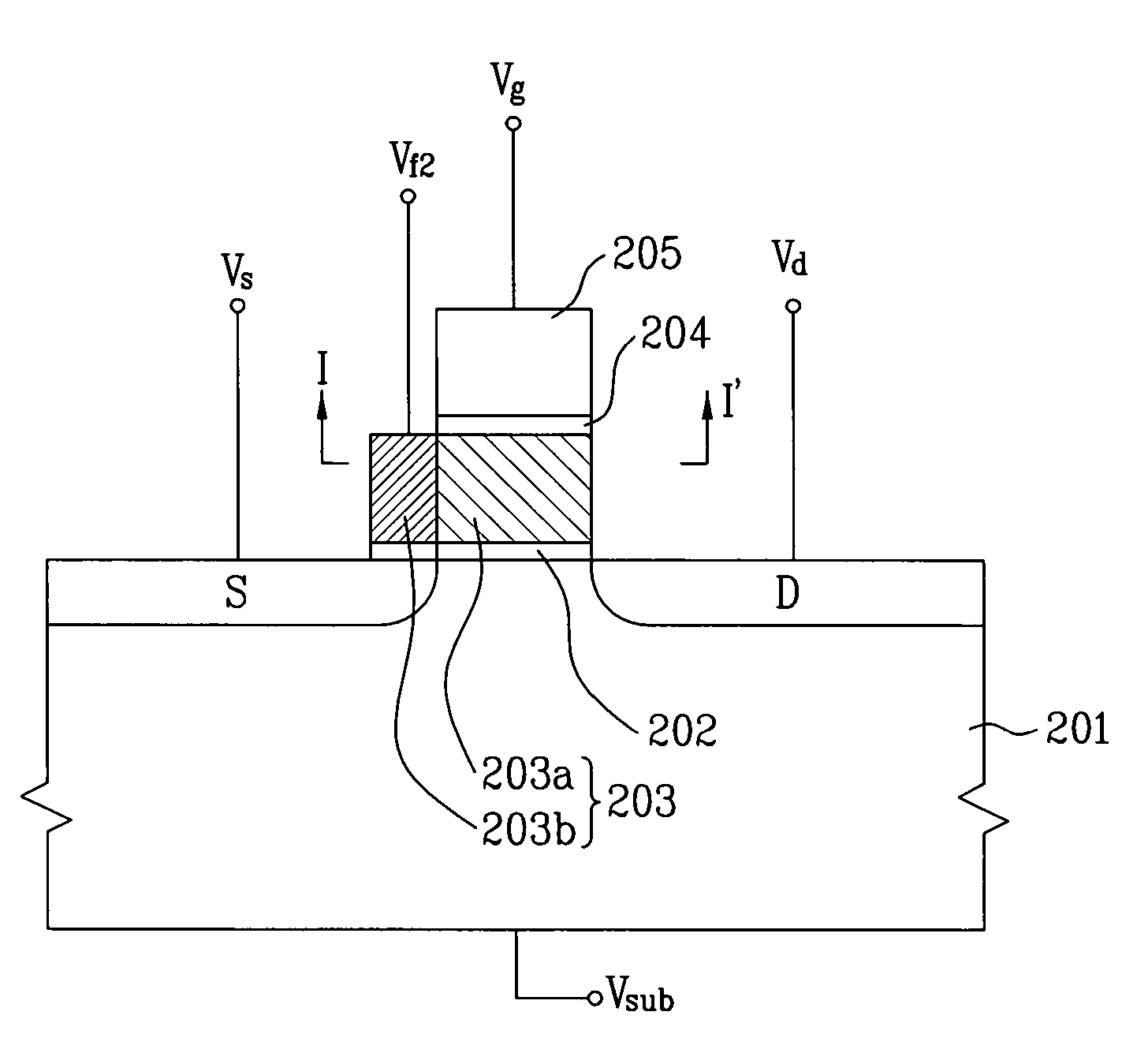
[0052]FIG. 2 shows a cross sectional view of a flash memory device according to the first embodiment of the present invention. In the flash memory device according to the first embodiment of the present invention, as shown in FIG. 2, a semiconductor substrate 201 is defined as a field area and an active area, and a device isolation layer (not shown) is formed in the field area.
[0053]In the active area of the semiconductor substrate 201, there are a tunnel oxide layer 202, a floating gate 203, a dielectric layer 204, and a control gate 205 formed in sequence. At this time, the semiconductor substrate 201 may be formed of n-type or p-type, wherein the p-type semiconductor substrate will be described for convenience of explanation. Although not shown, a passivation layer is deposited on an entire surface of the semiconductor substrate 201 including the control gate 205.
[0054]The dielectric layer 204 may be formed in a structure of oxide layer-nitride layer-oxide layer. Also, the floati...
second embodiment
[0067]A flash memory device according to the second embodiment of the present invention will be described as follows. FIG. 4 shows a cross sectional view of a flash memory device according to the second embodiment of the present invention.
[0068]In the flash memory device according to the second embodiment of the present invention, as shown in FIG. 4, a semiconductor substrate 201 is defined as a field area and an active area, and a device isolation layer (not shown) is formed in the field area. At this time, the semiconductor substrate 201 may be formed of n-type or p-type, wherein the p-type semiconductor substrate will be described for convenience of explanation.
[0069]In the active area of the semiconductor substrate 201, there are a tunnel oxide layer 202, a floating gate 203, a dielectric layer 204, and a control gate 205 formed in sequence. Then, n-type impurity ions are implanted into the semiconductor substrate 201 at both sides of the first floating gate 203 / the control gate...
third embodiment
[0085]A flash memory device according to the third embodiment of the present invention will be described with reference to FIG. 9. FIG. 9 shows a cross sectional view of a flash memory device according to the third embodiment of the present invention. In the flash memory device according to the third embodiment of the present invention, as shown in FIG. 9, a tunnel oxide layer 402, a floating gate 403, a dielectric layer 404 and a control gate 405 are sequentially deposited in an active area of a p-type semiconductor substrate 401 defined by a device isolation layer (not shown).
[0086]The floating gate 403 is comprised of a first floating gate 403a, a second floating gate 403b and a third floating gate 403c, wherein the first floating gate 403a is positioned in the center between the second floating gate 403b and the third floating gate 403c. At this time, the first floating gate 403a is formed at a width corresponding to that of the control gate 405.
[0087]Then, n-type impurity ions ...
PUM
 Login to View More
 Abstract
Description
Claims
Application Information
 Login to View More