
Connecting piece comprising a gripping element on the outer surface for rotating the connecting piece
a technology of connecting piece and outer surface, which is applied in the direction of screw threaded joints, rod connections, couplings, etc., can solve the problems of leakage points at the threads, the basic structure of the connecting piece to get damaged or the threads to get damaged, and the inability to use too much tightening for
- Summary
- Abstract
- Description
- Claims
- Application Information
AI Technical Summary
Benefits of technology
Problems solved by technology
Method used
Image

Examples
Embodiment Construction
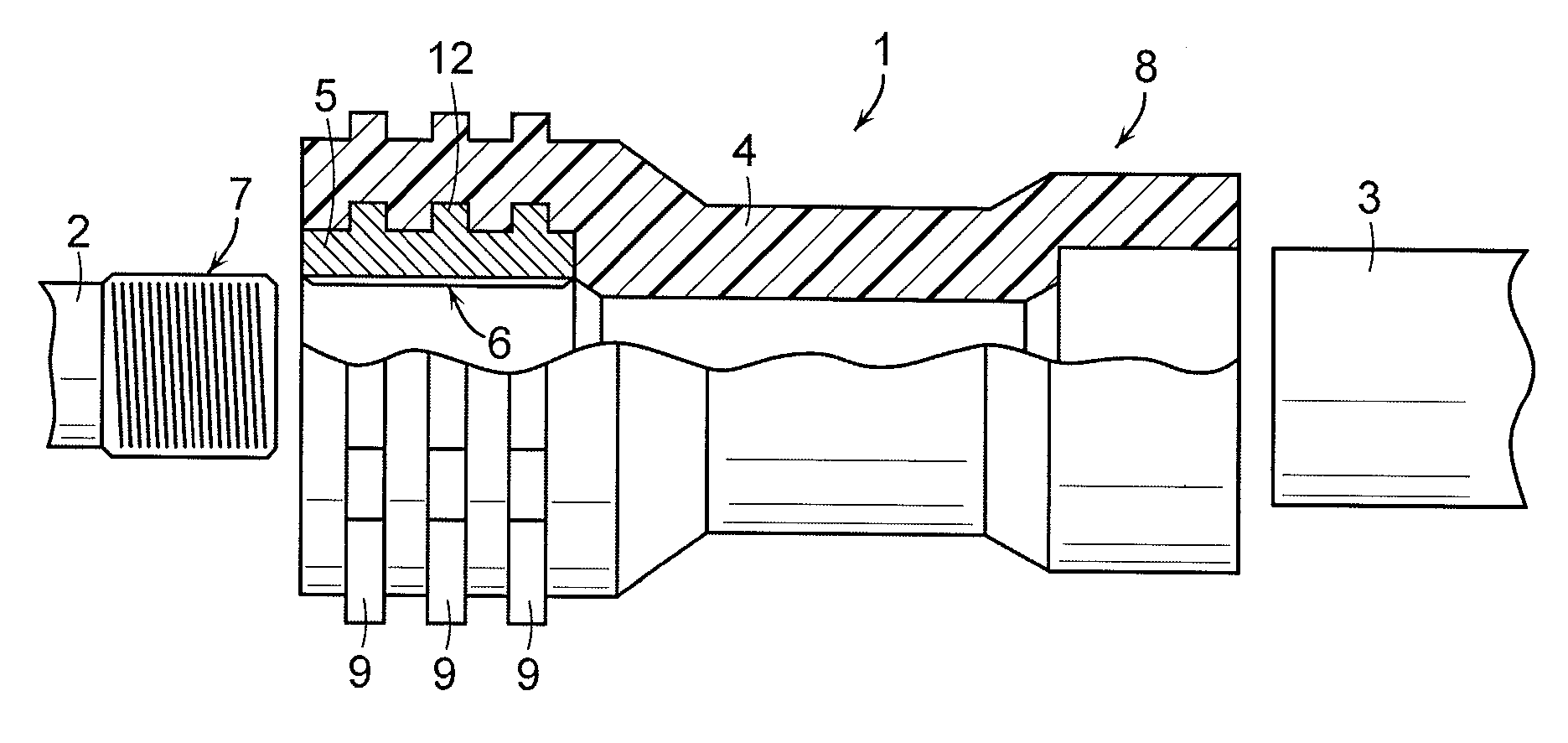
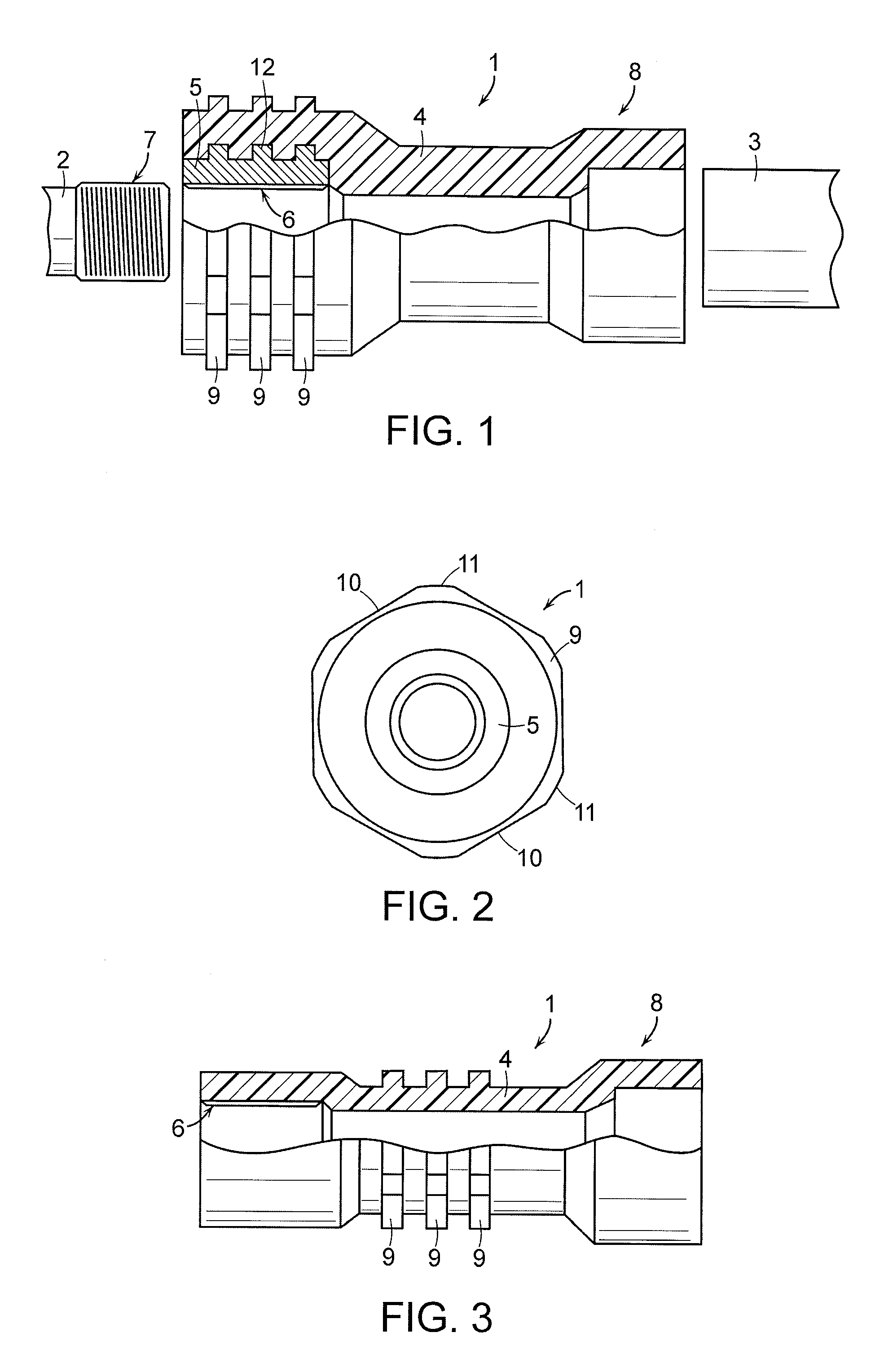
[0019]FIG. 1 shows a connecting piece 1. The connecting piece 1 is used between a first element 2 and a second element 3 to connect them. The first element 2 may be, for instance, a metal pipe or a fitting, such as a tap or the like, and the second element 3 may be a plastic pipe, for instance. The connecting piece 1 may be straight, as illustrated in FIG. 1, or it may be a bend, for example. Further, the connecting piece 1 may be a T branch, for example, in which case three elements are connected to each other with it. Hence, the appearance and the object of use of the connecting piece 1 may vary even to a large extent.
[0020]The body 4 of the connecting piece 1 is preferably of plastic, such as polyethylene PE, polypropylene PP, cross-linked polyethylene PEX, polyamide PA, polysulphone PSU or polyphenyl sulphone PPSU. A first end of the body 4 of the connecting piece 1 is provided with a metal insert 5. The metal insert 5 may be, for instance, of brass or other metal suitable for t...
PUM
| Property | Measurement | Unit |
|---|---|---|
| circumferential length | aaaaa | aaaaa |
| plastic | aaaaa | aaaaa |
| structure | aaaaa | aaaaa |
Abstract
Description
Claims
Application Information
 Login to View More