
Process for preparing light transmissive electromagnetic wave shielding material, light transmissive electromagnetic wave shielding material and display filter
a technology of electromagnetic shielding material and light transmission, which is applied in the manufacture of electrode systems, cold cathode manufacturing, and discharge tube/lamp manufacture. it can solve the problems of electromagnetic wave occurrence, precision equipment malfunction, and affect the human body, and achieve high adhesion, uniform thickness, and high dimensional accuracy.
- Summary
- Abstract
- Description
- Claims
- Application Information
AI Technical Summary
Benefits of technology
Problems solved by technology
Method used
Image

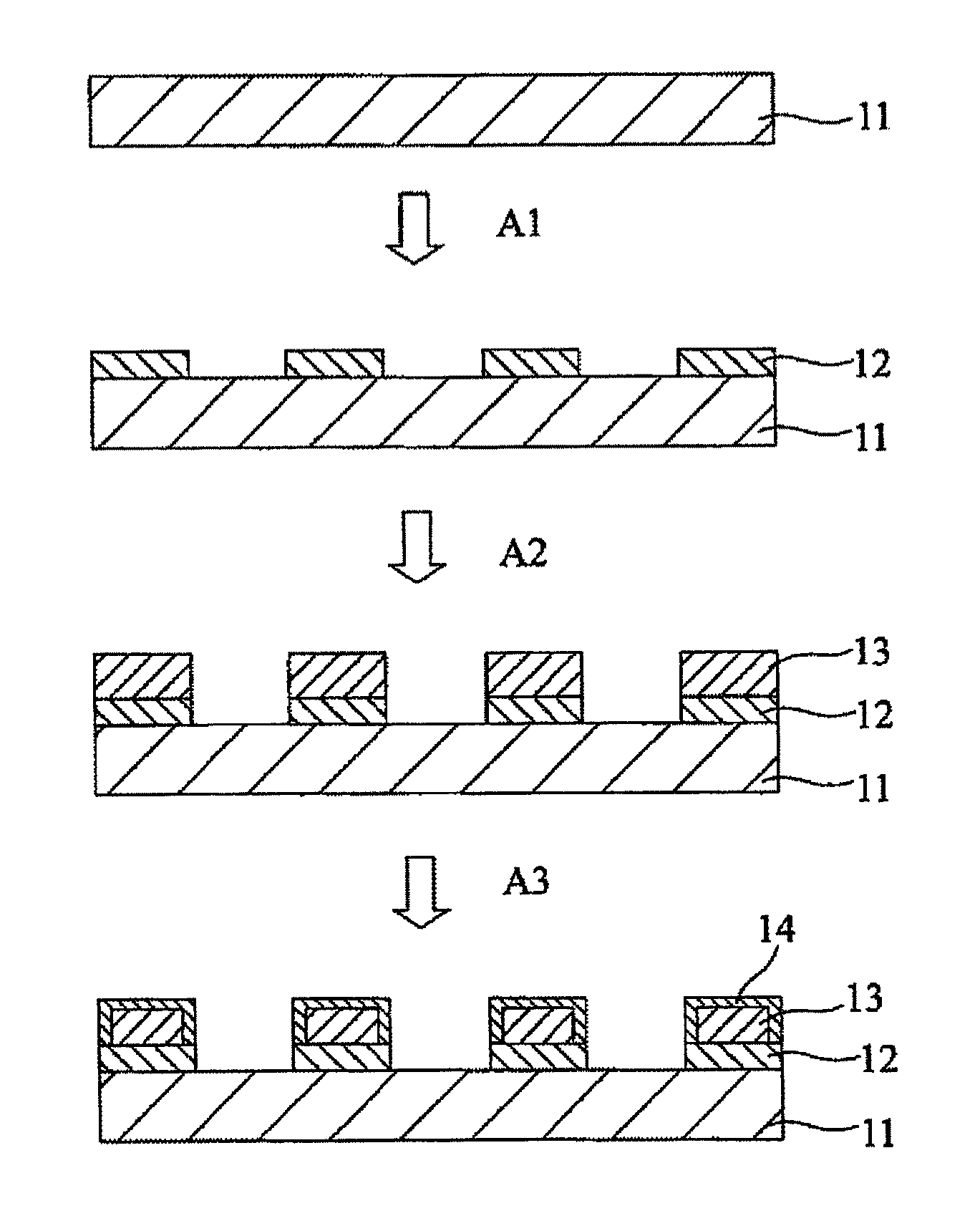
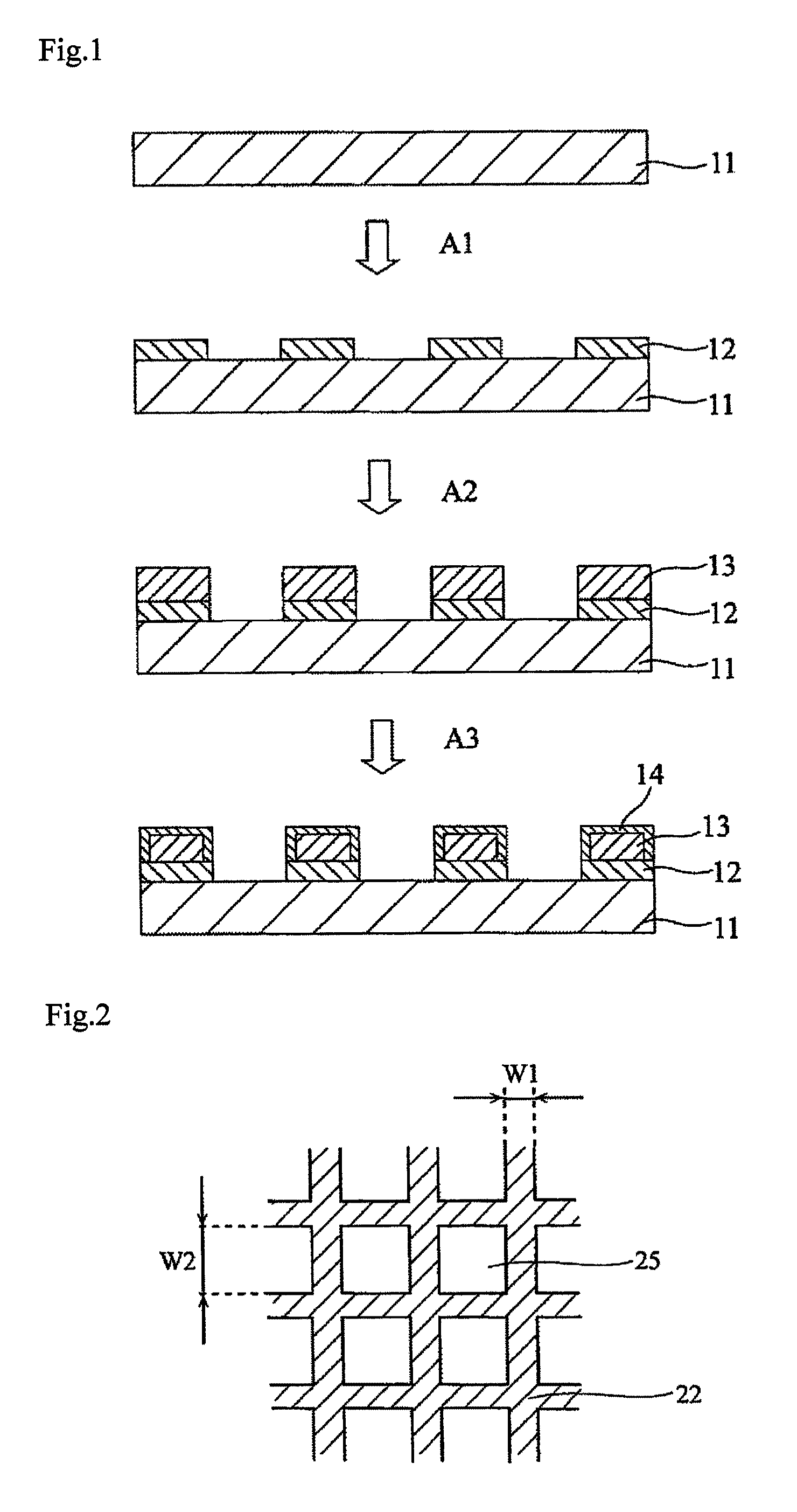
Examples
example 1-1
1. Preparation of a Pretreatment Agent
[0120]γ-Glycidoxypropyltrimethoxysilane was added to imidazole at a mole ratio of 1:1, and reacted for an hour and for 100 minutes, to prepare a reaction product. Palladium chloride was added to a 5 wt % aqueous solution of the reaction product with stirring at 25° C. to prepare a solution having palladium chloride concentration of 10 g / L. This solution was diluted with n-butanol by 100-fold by volume to prepare a pretreatment agent having palladium chloride concentration of 100 mg / L.
2. Formation of a Mesh-Shaped Preparation Layer
[0121]The pretreatment agent was printed in a mesh pattern on a PET film (the thickness of 100 μm) by gravure printing, and then dried at 120° C. for 5 minutes to form a mesh-shaped pretreatment layer. The pretreatment layer had a line width of 20 μm, a line pitch of 235 μm, an aperture ratio of 85% and a thickness of 0.15 μm.
3. Formation of the Metal Conductive Layer
[0122]The PET film on which the pretreatment layer ha...
example 1-2
[0131]The PET film on which the pretreatment layer had been formed by the same manner as the example 1-1 was immersed in an electroless plating copper solution (Melpate CU-5100 manufactured by Meltex Co., Ltd) and subjected to electroless plating treatment at 50° C. for 5 minutes to form a mesh-shaped metal conductive layer. Then the PET film was immersed in an aqueous solution of copper sulfate for electrolytic plating and applied electrical current (the current density of 2 A / dm2) to it by a rectifier for 5 minutes to form a mesh-shaped metal conductive layer. The metal conductive layer had a line width of 28 μm, a line pitch of 227 μm, an aperature ratio of 79% and a thickness of 4 μm.
[0132]Then the metal conductive layer was subjected to a blackening treatment by the same manner as the example 1-1 to provide a light transmissive electromagnetic wave shielding material having the metal conductive layer whose surface was subjected to the blackening treatment.
example 1-3
[0133]The PET film on which the pretreatment layer had been formed by the same manner as the example 1-1 was immersed in a nickel-boron alloy electroless plating solution (Top Chemialloy B-1 manufactured by OKU-NO CHEMICAL INDUSTRIES Co., Ltd) and subjected to electroless plating treatment to form a mesh-shaped metal conductive layer at 60° C. for 5 minutes. Then the PET film was immersed in an aqueous solution of copper sulfate for electrolytic plating and applied electrical current (the current density of 2 A / dm2) to it by a rectifier for 5 minutes to form a mesh-shaped metal conductive layer. The metal conductive layer had a line width of 28 μm, a line pitch of 227 μm, an aperature ratio of 79% and a thickness of 4 μm.
[0134]Then the metal conductive layer was subjected to a blackening treatment by the same manner as the example 1-1 to provide a light transmissive electromagnetic wave shielding material having the metal conductive layer whose surface was subjected to the blackenin...
PUM
| Property | Measurement | Unit |
|---|---|---|
| temperature | aaaaa | aaaaa |
| temperature | aaaaa | aaaaa |
| particle diameter | aaaaa | aaaaa |
Abstract
Description
Claims
Application Information
 Login to View More