
Golf club head
a golf club head and golf club technology, applied in golf clubs, golf accessories, racket sports, etc., can solve the problems of y-shaped metal being detached, not necessarily satisfactory, etc., and achieve the effect of high performance and favorable hitting sound
- Summary
- Abstract
- Description
- Claims
- Application Information
AI Technical Summary
Benefits of technology
Problems solved by technology
Method used
Image

Examples
example 1
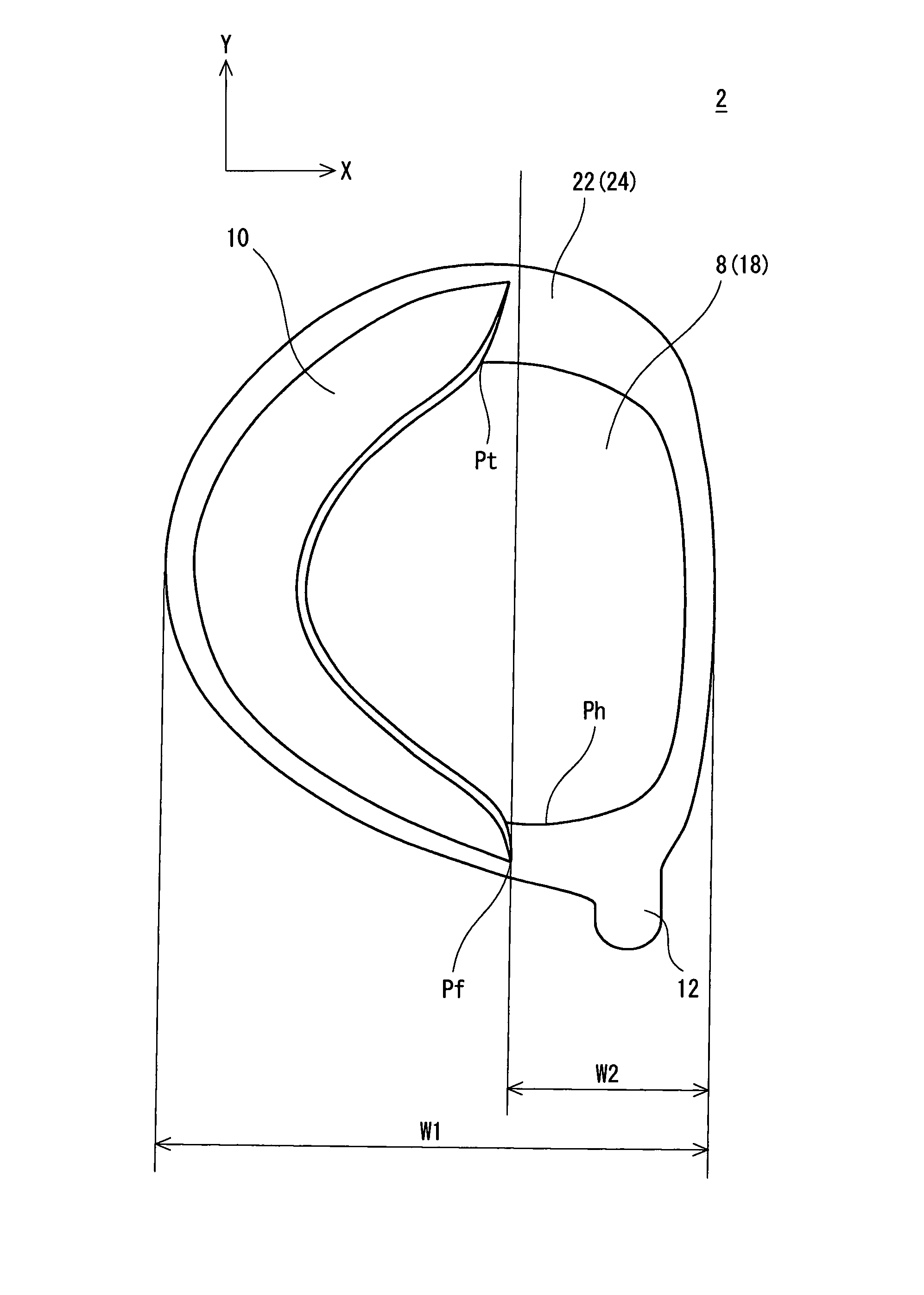
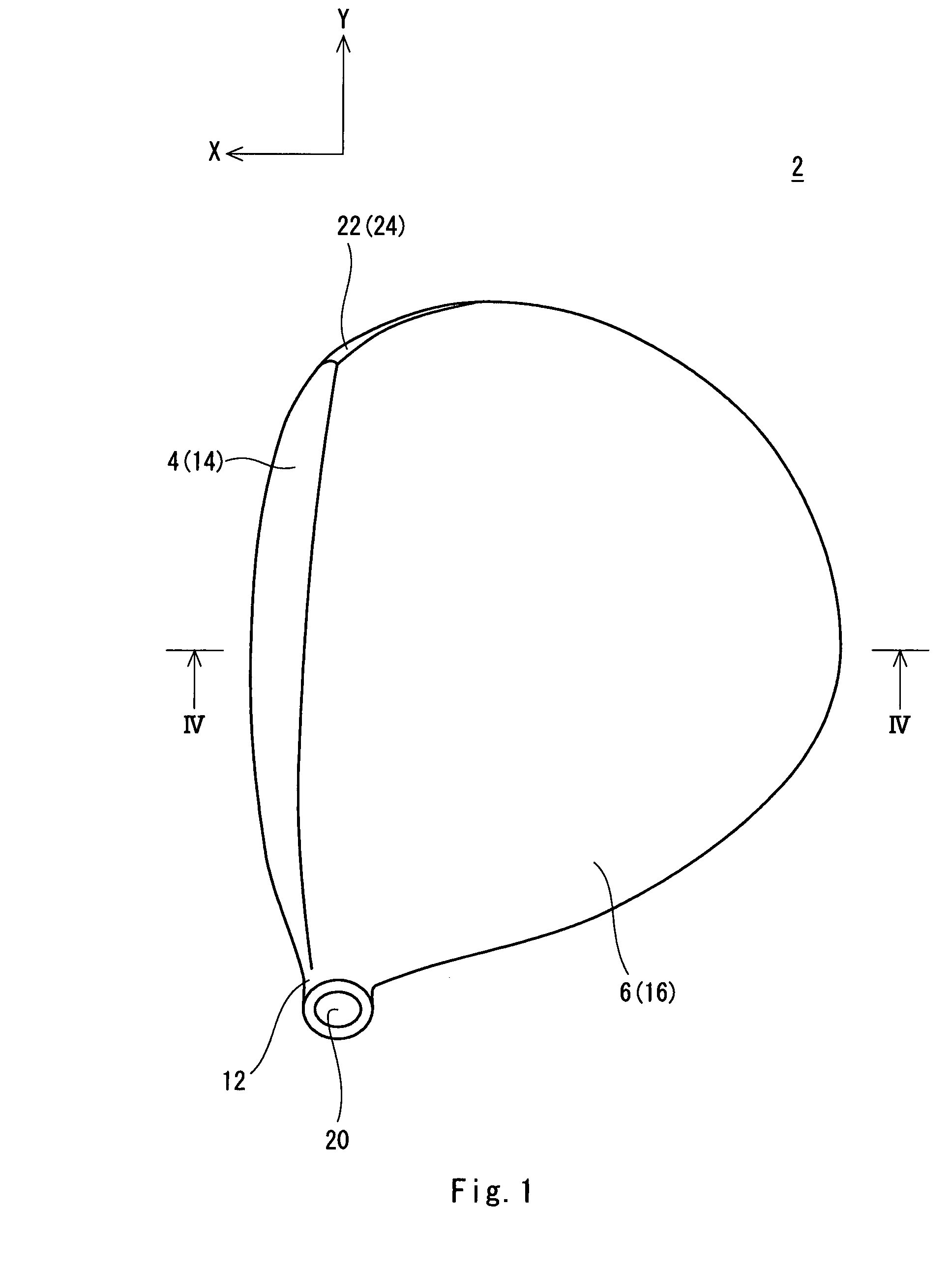
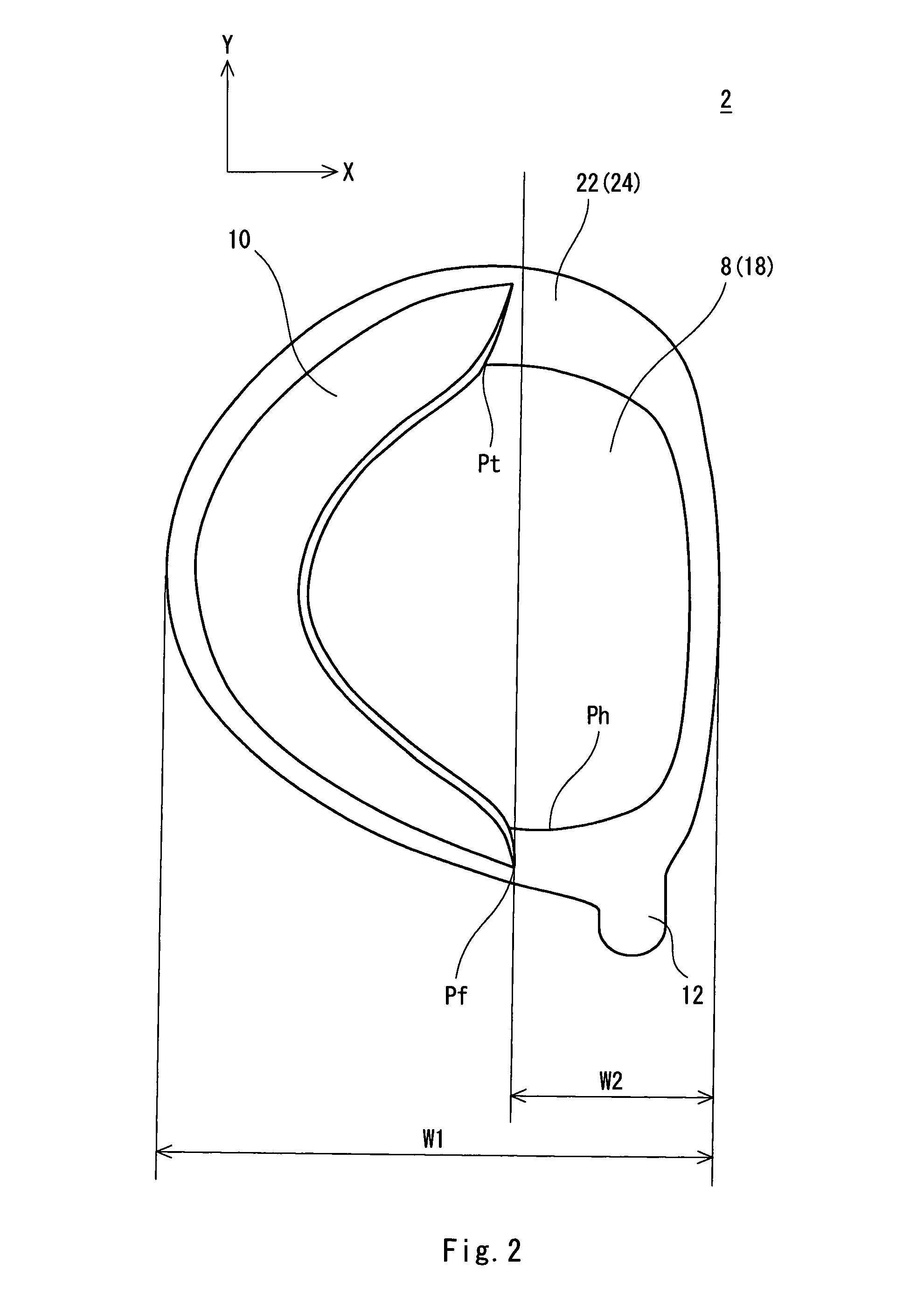
[0067]A face member was obtained by press molding of a plate material. The head main body was integrally molded by casting. The head main body includes a crown member, a sole member, a side member, a hosel part and a recessed part. The face member and the head main body were welded to obtain the head shown in from FIG. 1 to FIG. 4. The welding was carried out by plasma welding. The material of the face member was Ti-6Al-4V. The face member had a thickness of 3.3 mm at and in the vicinity of the sweet spot, and 2.5 mm at the surrounding area. The thickness of the crown member, and the thickness of the side member were 0.7 mm. The sole member had a thickness of 1.0 mm. The head volume was 460 cc; the head weight was 198 g; and the real loft was 10.5 degrees. Specifications and evaluation results of Example 1 are shown in the following Table 1.
example 6
[0069]The head of Example 6 was obtained in a similar manner to Example 1 except that the head shape was as shown in from FIG. 5 to FIG. 8, and the specifications were as shown in Table 1. Specifications and evaluation results of Example 6 are shown in the following Table 1. In Example 6, both the maximum heights Hm of the two recessed parts were 15 mm. In Example 6, both the maximum angles θm of the two recessed parts were 64 degrees.
PUM
 Login to View More
 Abstract
Description
Claims
Application Information
 Login to View More