Check patentability & draft patents in minutes with Patsnap Eureka AI!

Method of preparing polyorganosiloxane with functional groups in the presence of lithium silanolate

a technology of functional groups and polyorganosiloxane, which is applied in the field of preparing polyorganosiloxane with functional groups in the presence of lithium silanolate, can solve the problems of difficult replacement, serious drawbacks in hygiene and industrial safety, and difficulty in dispersing lithium hydroxide in powder form in silicone, so as to reduce the risk of loss of volatile matter and stabilize the fps prepared

Inactive Publication Date: 2011-07-05
BLUESTAR SILICONES FRANCE SAS
View PDF6 Cites 4 Cited by
  • Summary
  • Abstract
  • Description
  • Claims
  • Application Information

AI Technical Summary

Benefits of technology

This approach enhances productivity, controls the quality and composition of the polyorganosiloxane mastics, reduces volatile matter loss, and improves the stability of the final products compared to traditional methods.

Problems solved by technology

The reason for this is that it is very difficult to disperse lithium hydroxide in powder form in silicone.
The amount of methanol used, due to the physicochemical characteristics of this solvent, may give rise to serious drawbacks in terms of hygiene and industrial safety.
Moreover, it is particularly difficult to replace methanol with another solvent since it is necessary for that solvent to be:a solvent for lithium hydroxide,sufficiently soluble in the silicone,nontoxic and nondegrading for the mastic and inactive with respect to the application properties of the mastic (especially in terms of color, viscosity and adhesion).
Any solvent that does not have these three characteristics cannot replace methanol.

Method used

the structure of the environmentally friendly knitted fabric provided by the present invention; figure 2 Flow chart of the yarn wrapping machine for environmentally friendly knitted fabrics and storage devices; image 3 Is the parameter map of the yarn covering machine
View more

Image

Smart Image Click on the blue labels to locate them in the text.
Viewing Examples
Smart Image
  • Method of preparing polyorganosiloxane with functional groups in the presence of lithium silanolate
  • Method of preparing polyorganosiloxane with functional groups in the presence of lithium silanolate
  • Method of preparing polyorganosiloxane with functional groups in the presence of lithium silanolate

Examples

Experimental program
Comparison scheme
Effect test

example 1

1) Preparation of the Catalyst

[0136]19.25 g of vinyltrimethoxysilane (VTMO) and 0.80 g of lithium hydroxide (LiOH.H2O) are introduced into a 25 ml glass flask containing a magnetic bar. The flask is sealed and the medium is left stirring for 15 hours. A clear solution is obtained.

[0137]A spectrum is acquired by IR microscopy on a sample that has been devolatilized beforehand to remove the excess vinyltrimethoxysilane introduced. A solid is thus obtained. The spectrum obtained on the sample is compatible with the simultaneous presence of SiOMe functions (2843 cm−1), SiVi functions (3051 cm−1) and SiOLi functions (990, 758 and 667 cm−1).

2) Functionalization

[0138]The following are successively introduced at room temperature and with moderate stirring (80 rpm) into a 250 ml five-necked flask equipped with a mechanical stirrer, an ascending condenser and a temperature probe:[0139]polydimethylsiloxane oil blocked with hydroxysilyl groups HO[Me2SiO]45H, 100.73 g (60.2×10⁻³ mol of SiOH func...

example 2

1) Preparation of the Catalyst

[0148]18.57 g of tetraethoxysilane (TEO) and 0.79 g of lithium hydroxide (LiOH.H2O) are introduced into a 25 ml glass flask containing a magnetic bar. The flask is sealed and the medium is left stirring for 15 hours. A clear solution is obtained.

2) Functionalization

[0149]The following are successively introduced at room temperature and with moderate stirring (80 rpm) into a 250 ml five-necked flask equipped with a mechanical stirrer, an ascending condenser and a temperature probe:[0150]polydimethylsiloxane oil blocked with hydroxysilyl groups HO[Me2SiO]45H, 100.05 g (59.8×10⁻³ mol of SiOH function),[0151]tetraethoxysilane (TEO) (EtO)4Si, 34.19 g (164×10−3 mol).

[0152]The symbol Et denotes the ethyl radical.

[0153]The symbol Vi denotes the vinyl radical: CH2═CH—; the symbol Me denotes the methyl radical.

[0154]The lithium silanolate in solution in TEO (3.68 g of the solution prepared in paragraph 1, i.e. 3.58×10⁻³ mol of lithium silanolate, i.e. 0.06 mol of...

example 3

1) Preparation of the Catalyst

[0161]19.19 g of phenyltrimethoxysilane (PhTMO) and 0.81 g of lithium hydroxide (LiOH.H2O) are introduced into a 25 ml glass flask containing a magnetic bar. The flask is sealed and the medium is left stirring for 15 hours. A clear solution is obtained.

2) Functionalization

[0162]The following are successively introduced at room temperature and with moderate stirring (80 rpm) into a 250 ml five-necked flask equipped with a mechanical stirrer, an ascending condenser and a temperature probe:[0163]polydimethylsiloxane oil blocked with hydroxysilyl groups HO[Me2SiO]45H, 100.42 g (60.8×10⁻³ mol of SiOH function),[0164]phenyltrimethoxysilane (PhTMO), PhSi(OMe)3, 32.08 g (161.8×10⁻³ mol).

[0165]The symbol Ph denotes the phenyl radical.

[0166]The lithium silanolate in solution in PhTMO (3.66 g of the solution prepared above in paragraph 1, i.e. 3.54×10⁻³ mol of lithium silanolate, i.e. 0.06 mol of lithium silanolate per mole of silanol) is then introduced at 27° C....

the structure of the environmentally friendly knitted fabric provided by the present invention; figure 2 Flow chart of the yarn wrapping machine for environmentally friendly knitted fabrics and storage devices; image 3 Is the parameter map of the yarn covering machine
Login to View More

PUM

PropertyMeasurementUnit
viscosityaaaaaaaaaa
temperatureaaaaaaaaaa
timeaaaaaaaaaa
Login to View More

Abstract

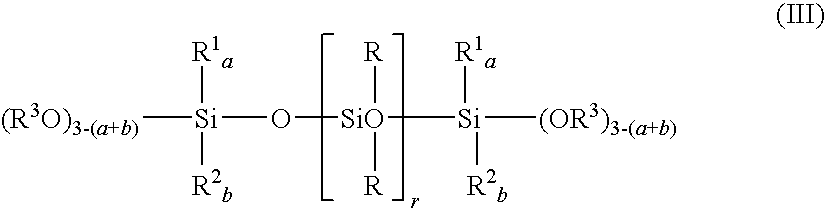
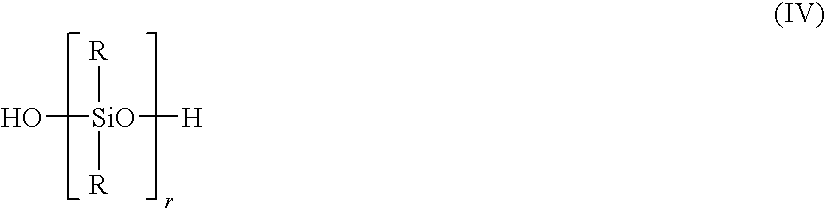
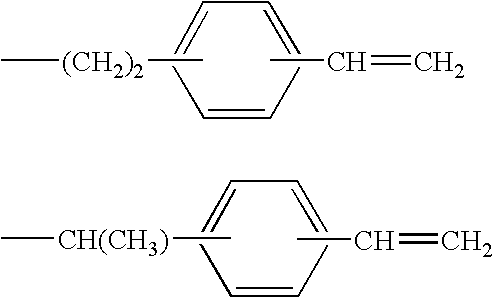
The invention relates to a method of preparing polyorganosiloxanes containing at least one functional group using a lithium silanolate catalyst. A polyorganosiloxane, having at least one hydroxyl group, is reacted with a polyalkoxysilane having the formula (R1)a(R2)bSi(OR3)4-(a+b) (I), where R1 is an alkyl radical, a cycloalkyl radical, or an aryl radical; R2 is —(Z)m-(X)n, wherein m=0 or 1, n=1 or 2; Z is a divalent hydrocarbon residue; X is an unsaturated hydrocarbon radical when m=0 and, when m=1, X is chlorine, bromine, iodine, —O—CO—CR4═CR5R6 (in which R4, R5 and R6 each represent a hydrogen atom, an alkyl radical and / or a phenyl radical), —RF (in which RF is a perfluorinated residue), —NHR7 (in which R7 is a hydrogen atom, an alkyl radical, or a radical-R8—NH2, wherein R8 is Z), or —SH; R3 is an alkyl radical; a=0, 1, 2 or 3; b=0 or 1 and a+b=0, 1, 2 or 3, with the additional condition that the sum a+b=3, symbol b cannot be equal to 0. The method is performed in the presence of an effective quantity of a lithium organosilanolate catalyst having formula (R1)a(R2)b(OR3)3-(a+b)SiO−Li+ (II), wherein R1, R2, R3, a and b have the meanings indicated above. The method is performed without the addition of an aliphatic alcohol having the formula R3OH to the reaction medium.

Description

CROSS-REFERENCE TO PRIORITY / PCT APPLICATIONS[0001]This application claims priority under 35 U.S.C. §119 of FR 0412977, filed Dec. 7, 2004, and is a continuation / national phase of PCT / FR 2005 / 003044, filed Dec. 6, 2005 and designating the United States (published in the French language on Jun. 15, 2006, as WO 2006 / 061503 A1; the title and abstract were also published in English), each hereby expressly incorporated by reference in its entirety and each assigned to the assignee hereof.TECHNICAL FIELD OF THE INVENTION[0002]The field of the invention, taken in its first subject, is that of the synthesis of polyorganosiloxane (oil and / or resin) containing in its structure at least one functional group, each functional group being linked to a silicon atom, polyorganosiloxane being referred to hereinbelow as FP (functionalized polymer).[0003]The invention relates especially to a process for preparing polyorganosiloxane (oil and / or resin) containing in its structure at least one alkoxy group...

Claims

the structure of the environmentally friendly knitted fabric provided by the present invention; figure 2 Flow chart of the yarn wrapping machine for environmentally friendly knitted fabrics and storage devices; image 3 Is the parameter map of the yarn covering machine
Login to View More

Application Information

Patent Timeline
no application Login to View More
Patent Type & Authority Patents(United States)
IPC IPC(8): C08G77/26
CPCC08G77/08C08G77/18C08K5/5415C08L83/04C08K5/54
Inventor CHAUSSADE, MARCGUENNOUNI, NATHALIE
Owner BLUESTAR SILICONES FRANCE SAS
Features
  • R&D
  • Intellectual Property
  • Life Sciences
  • Materials
  • Tech Scout
Why Patsnap Eureka
  • Unparalleled Data Quality
  • Higher Quality Content
  • 60% Fewer Hallucinations
Social media
Patsnap Eureka Blog
Learn More