Check patentability & draft patents in minutes with Patsnap Eureka AI!

Massively-parallel three-axis stabilization of focal plane data

a three-axis, focal plane data technology, applied in the field of image processing, can solve problems such as jitter, read-out and quantization noise, uncertainties in focal plane characteristics, etc., and achieve the effect of maximizing the signal-to-noise ratio and minimizing the overall throughput and logi

Inactive Publication Date: 2011-09-20
LOCKHEED MARTIN CORP
View PDF8 Cites 3 Cited by
  • Summary
  • Abstract
  • Description
  • Claims
  • Application Information

AI Technical Summary

Benefits of technology

This approach reduces mechanical and electronic complexity, enhances signal-to-noise ratio, and efficiently stabilizes focal plane data, enabling reliable target tracking with reduced noise and computational overhead.

Problems solved by technology

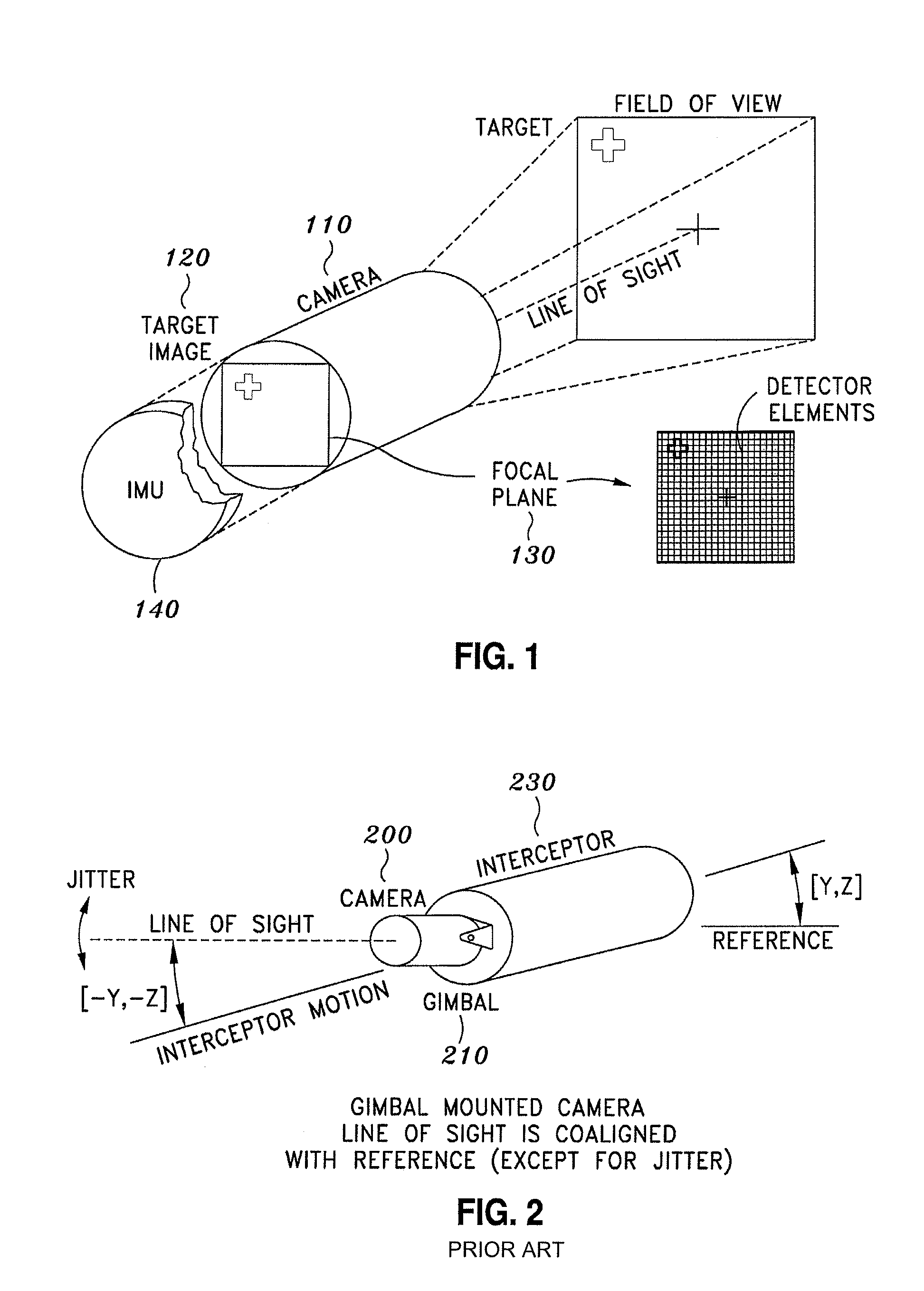
One such source of noise may be jitter due to unsteadiness of the camera.
Other sources of noise may be uncertainties in focal plane characteristics, or read-out and quantization noise.
Mechanical gimbal assemblies, such as the one shown, may suffer from shortcomings in that they may be heavy and bulky.
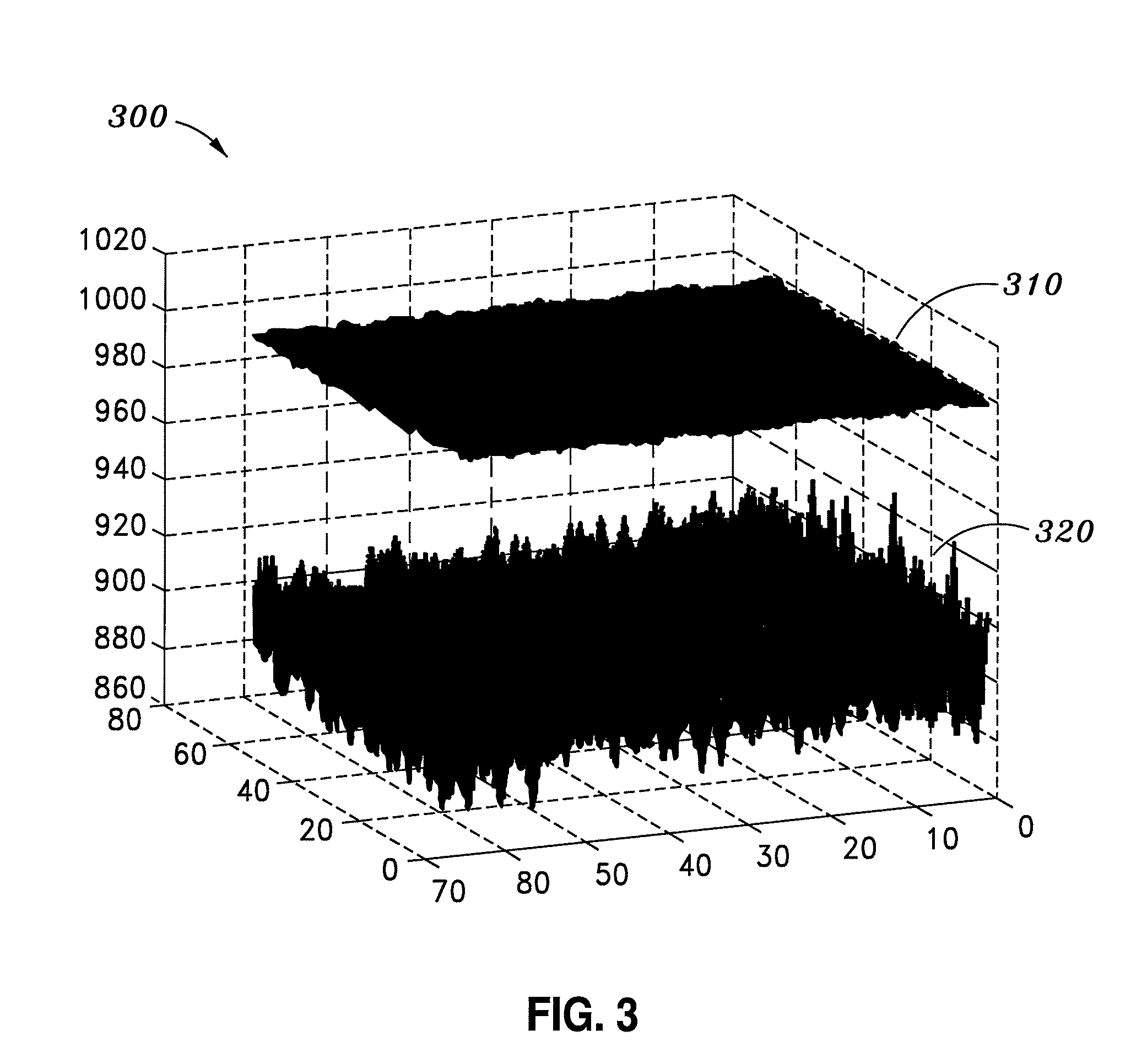
Nonuniformity in focal plane detectors may also be a source of noise.
Therefore, while focal plane detectors may be highly sensitive to incoming light, nonuniformity between detectors may counterbalance detector sensitivity.
This noise component may corrupt the signal as it moves across the detector array.
As illustrated, noise may be attributed to the non-uniformity of the detectors.
The device on which a camera having a focal plane array is mounted may also produce jitter through its motion.
Computationally, this may be a complicated irregular calculation.
Moreover, this computation combines data from multiple, imperfectly compensated real pixels.
The resultant virtual pixel will necessarily incorporate more noise.
Further, any direct implementation of computations such as those described may be impractically large using conventional computing techniques.
Detector arrays can have in the range of one million pixels and the sampling rates required for reproducing missile motion can be in the hundreds of hertz, making this a formidable computing challenge.

Method used

the structure of the environmentally friendly knitted fabric provided by the present invention; figure 2 Flow chart of the yarn wrapping machine for environmentally friendly knitted fabrics and storage devices; image 3 Is the parameter map of the yarn covering machine
View more

Image

Smart Image Click on the blue labels to locate them in the text.
Viewing Examples
Smart Image
  • Massively-parallel three-axis stabilization of focal plane data
  • Massively-parallel three-axis stabilization of focal plane data
  • Massively-parallel three-axis stabilization of focal plane data

Examples

Experimental program
Comparison scheme
Effect test

Embodiment Construction

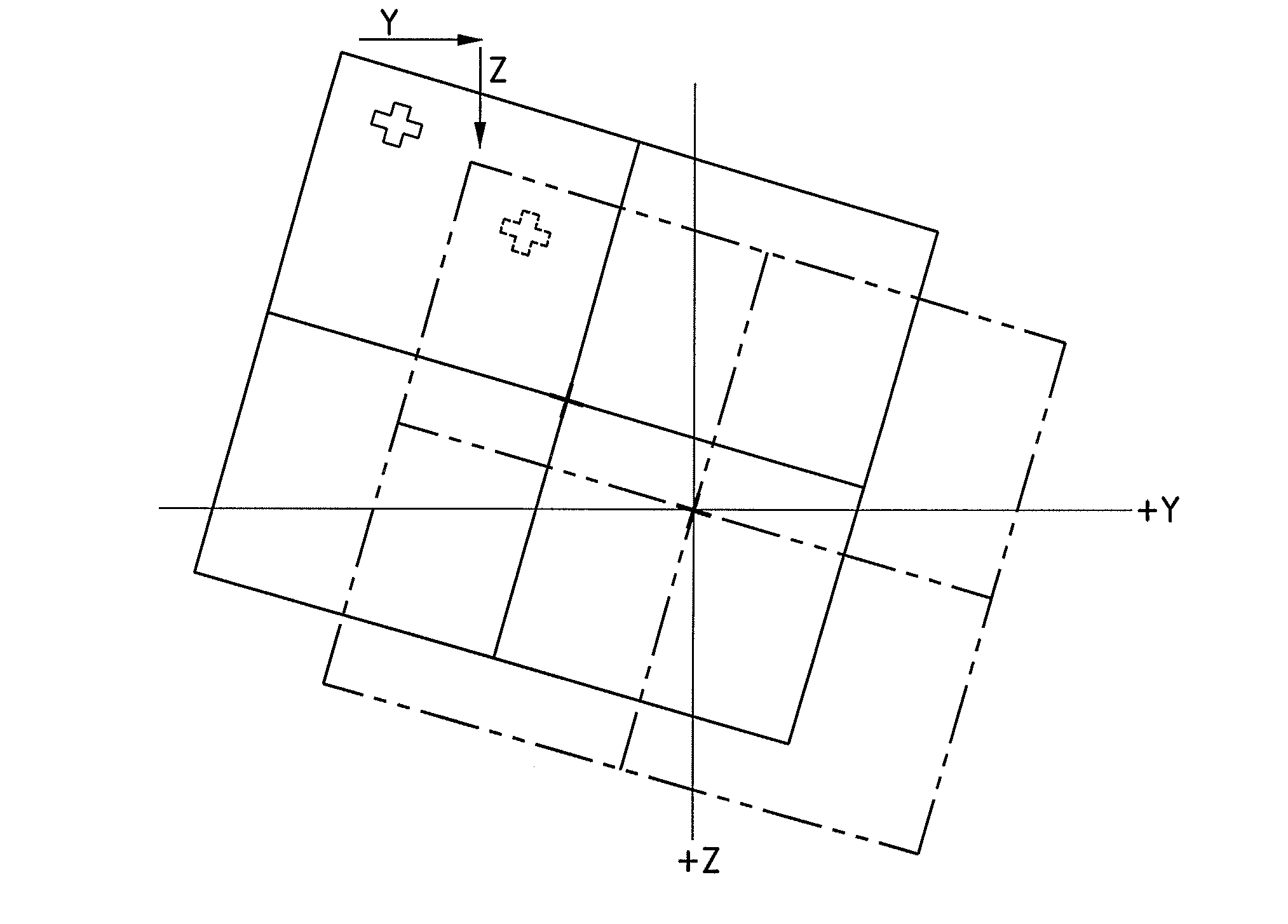
[0045]The present disclosure provides for massively parallel three-axis stabilization of focal plane data from focal plane detector arrays. The present disclosure provides a means of electronically stabilizing focal plane data and then reconstructing any targets in the scene. In accordance with the present disclosure, a massively parallel array of processing elements is designed to quickly locate targets in an interceptor's field-of-view. The target location may be followed by a more refined process of calculation to combine the collected data into an image without compromising the inherent signal-to-noise ratio of individual detector elements.

[0046]The computer architecture used in the present disclosure is a Single Instruction Multi-Data (SIMD) architecture. This architecture provides an efficient implementation of identical operations for arrays of large numbers, such as those acquired from focal planes.

[0047]Referring now to FIG. 6A, illustrated is a SIMD computer architecture 6...

the structure of the environmentally friendly knitted fabric provided by the present invention; figure 2 Flow chart of the yarn wrapping machine for environmentally friendly knitted fabrics and storage devices; image 3 Is the parameter map of the yarn covering machine
Login to View More

PUM

No PUM Login to View More

Abstract

A system and method for three-axis stabilization of focal plane data. The system and method include performing a two-dimensional vertical shear transformation and a two-dimensional horizontal shear transformation. The system and method further incorporate a SIMD computer architecture and an array of addressable processing elements that process the field-of-view for a target image received by a focal plane array of detector elements. Each processing element includes a calculation device that calculates the row and column address of virtual pixels for a virtual field-of-view. The system and method further include a plurality of memory modules configured to store data in a plurality of addressable storage locations by column and row, and each memory module is identified with a different processing element. A dedicated memory routing network for the processing elements and memory modules permits the exchange of information between processing elements and memory modules associated with each processing element.

Description

CROSS REFERENCE TO RELATED APPLICATIONS[0001]This application is a divisional of U.S. patent application Ser. No. 11 / 094,218 entitled “Massively-Parallel Three-Axis Stabilization Of Focal Plane Data,” filed on Mar. 31, 2005, which is hereby incorporated by reference in its entirety for all purposes.BACKGROUND[0002]1. Field[0003]The present disclosure relates generally to image processing and, more particularly, to stabilization of focal plane data.[0004]2. Related Art[0005]Focal plane arrays are used in a number of image processing applications. For example, missile interceptor guidance techniques may include acquiring and processing digital video data from the focal planes of cameras mounted on the interceptor. The camera optics may provide a way to focus light from distant sources onto the focal planes, which may be two-dimensional staring arrays of many thousands of detector elements. These detector elements may capture light in various wave bands to provide a signal for detectin...

Claims

the structure of the environmentally friendly knitted fabric provided by the present invention; figure 2 Flow chart of the yarn wrapping machine for environmentally friendly knitted fabrics and storage devices; image 3 Is the parameter map of the yarn covering machine
Login to View More

Application Information

Patent Timeline
no application Login to View More
Patent Type & Authority Patents(United States)
IPC IPC(8): H04N17/00H04N5/232G06K9/00G06T3/20H04N23/40H04N25/00
CPCG06T3/608H04N5/23248H04N5/23267H04N5/772H04N5/907H04N23/68H04N23/683
Inventor KANCLER, HENRY C.CHOONG, TSI-PINWEALAND, BARRY A.WOOD, LEON K.VAN HEUSEN, KATARINAREAGAN, JOHN T.MILLS, THEODORE J.LEVIN, MICHAEL A.
Owner LOCKHEED MARTIN CORP
Features
  • R&D
  • Intellectual Property
  • Life Sciences
  • Materials
  • Tech Scout
Why Patsnap Eureka
  • Unparalleled Data Quality
  • Higher Quality Content
  • 60% Fewer Hallucinations
Social media
Patsnap Eureka Blog
Learn More