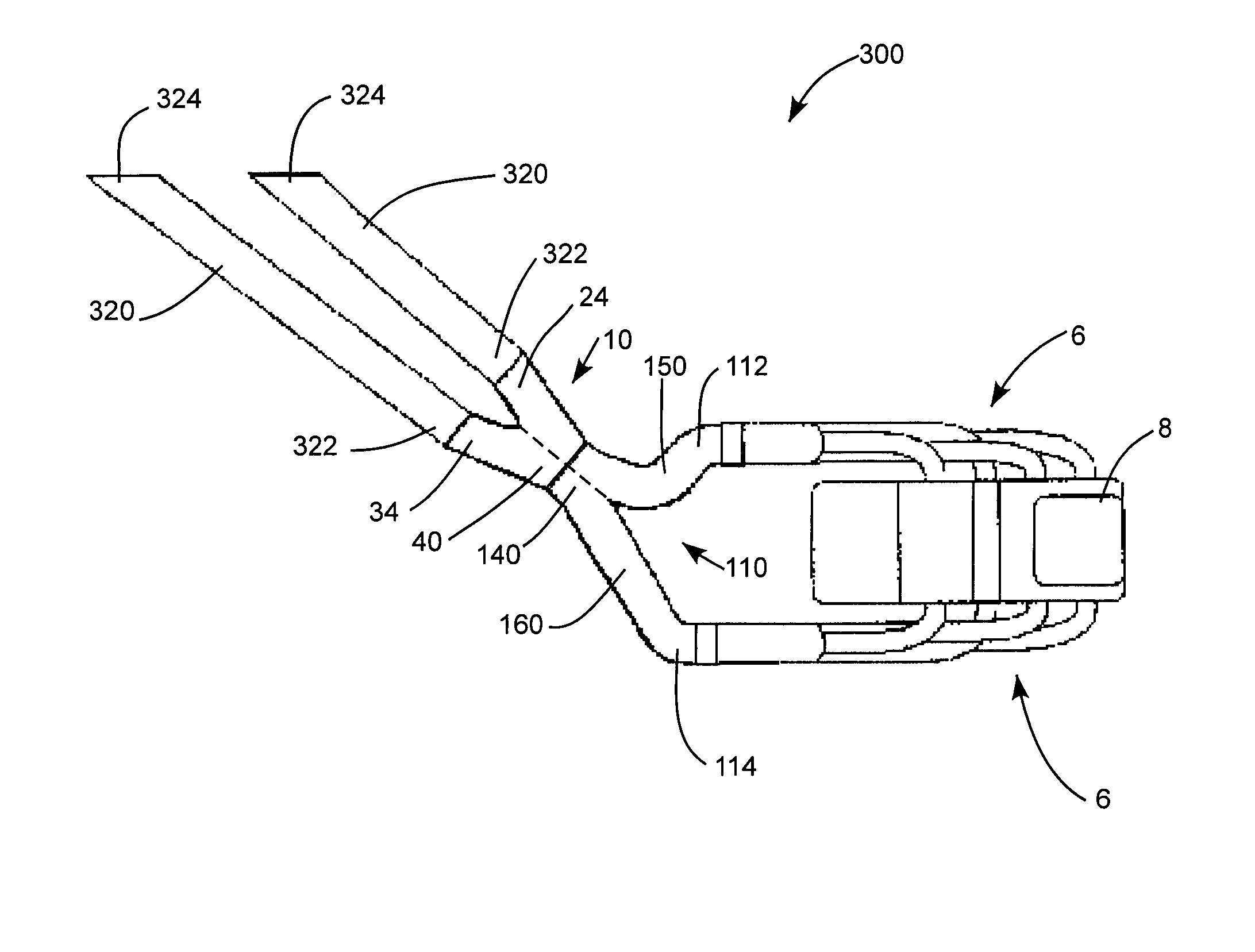
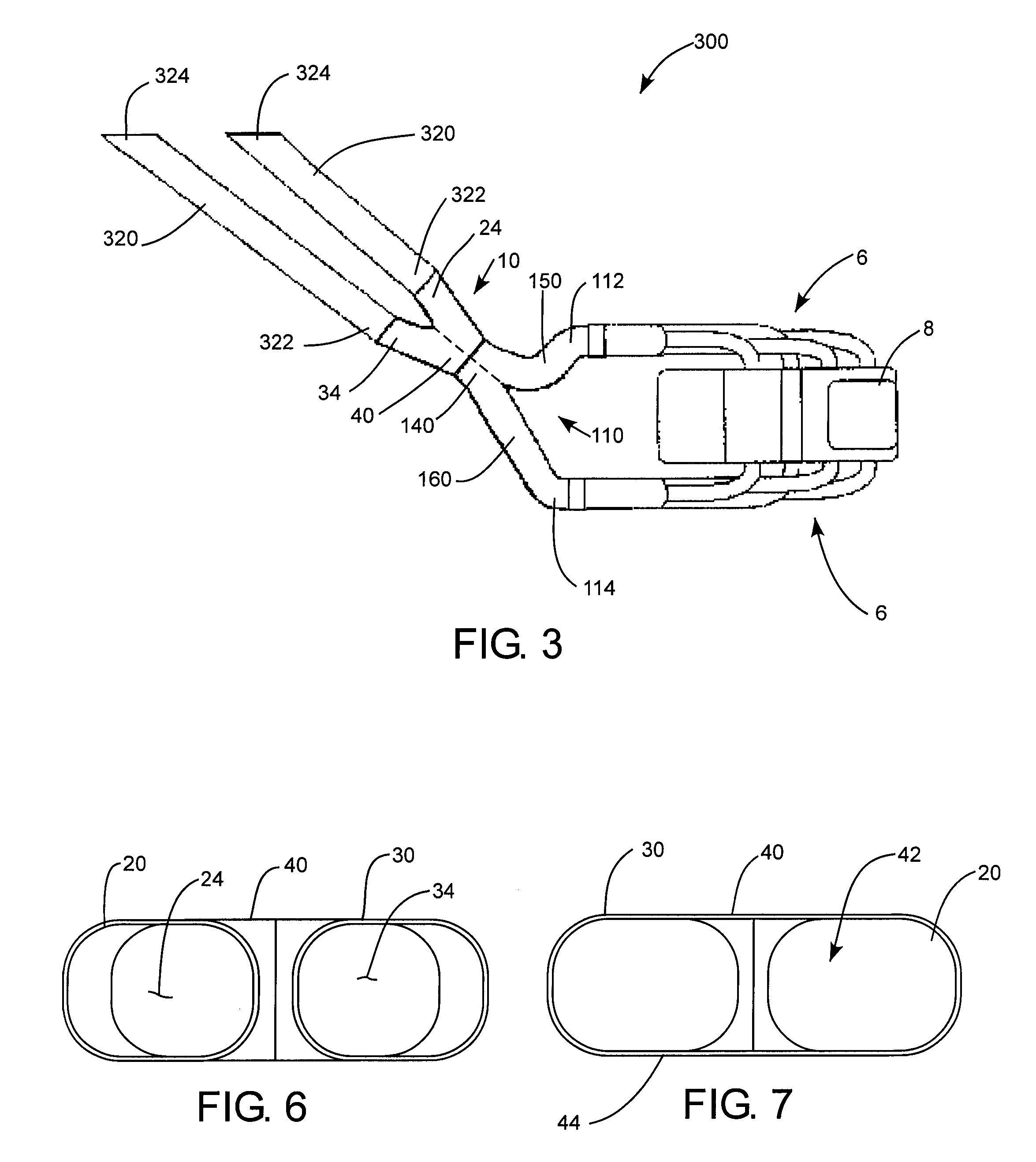
[0012]The present invention provides for the attachment of two tailpipes to a Y-pipe assembly to provide the advantages of the Y-pipe assembly to an exhaust system using two tailpipes such as two customary tailpipes or two boom tube
exhaust pipe tailpipes. The invention comprises a Y-pipe splitter having a single inlet for attachment to the single outlet of a Y-pipe assembly normally attached to a single tailpipe. However, rather than attaching a single tailpipe to the single outlet of the Y-pipe assembly, the single inlet of the Y-pipe splitter attaches to the single outlet of the Y-pipe assembly. The Y-pipe splitter has two outlets and a tailpipe, such as a customary tailpipe or a boom tube
exhaust pipe, is attached to each of the Y-pipe splitter outlets to provide an exhaust system having two tailpipes. The Y-pipe assembly is attached to the respective ends of a pair of primary exhaust pipes or header assemblies which lead exhaust gasses from the engine of a race car or other motor vehicle to the Y-pipe assembly. The Y-pipe assembly then takes the exhaust gases from the separate primary exhaust pipes and combines them in a flattened merged outlet portion to which a single boom tube type or other type tail
exhaust pipe is normally connected. With the current invention, rather than connecting a tailpipe to the single outlet of the Y-pipe assembly, the single inlet of the Y-pipe splitter of the present invention is attached to the single outlet end of the Y-pipe assembly. The Y-pipe splitter is configured to split into two outlet openings to attach to inlets of a pair of exhaust pipes which
mount to the bottom portion of the frame or
chassis of the motor vehicle as tailpipes. Thus, while the Y-pipe assembly takes the exhaust gases from the separate primary exhaust pipes and combines them in a flattened merged portion which reduces exhaust pressure peaks in the exhaust system and reduces
back pressure build up in the system, the Y-pipe splitter splits the exhaust from the flatten merged portion of the Y-pipe assembly and splits it again into two separate exhaust streams which exhaust to the
atmosphere through the two exhaust pipes attached to the two outlets of the Y-pipe splitter. The combination of the Y-pipe assembly, along with the Y-pipe splitter and two exhaust pipes can provide the same improved ground clearance for the motor vehicle as the Y-pipe assembly and single exhaust pipe of my prior U.S. Pat. No. 6,478,340, as well as the advantages of reduced exhaust pressure peaks and reduced
back pressure provided by the Y-pipe assembly and single exhaust pipe.
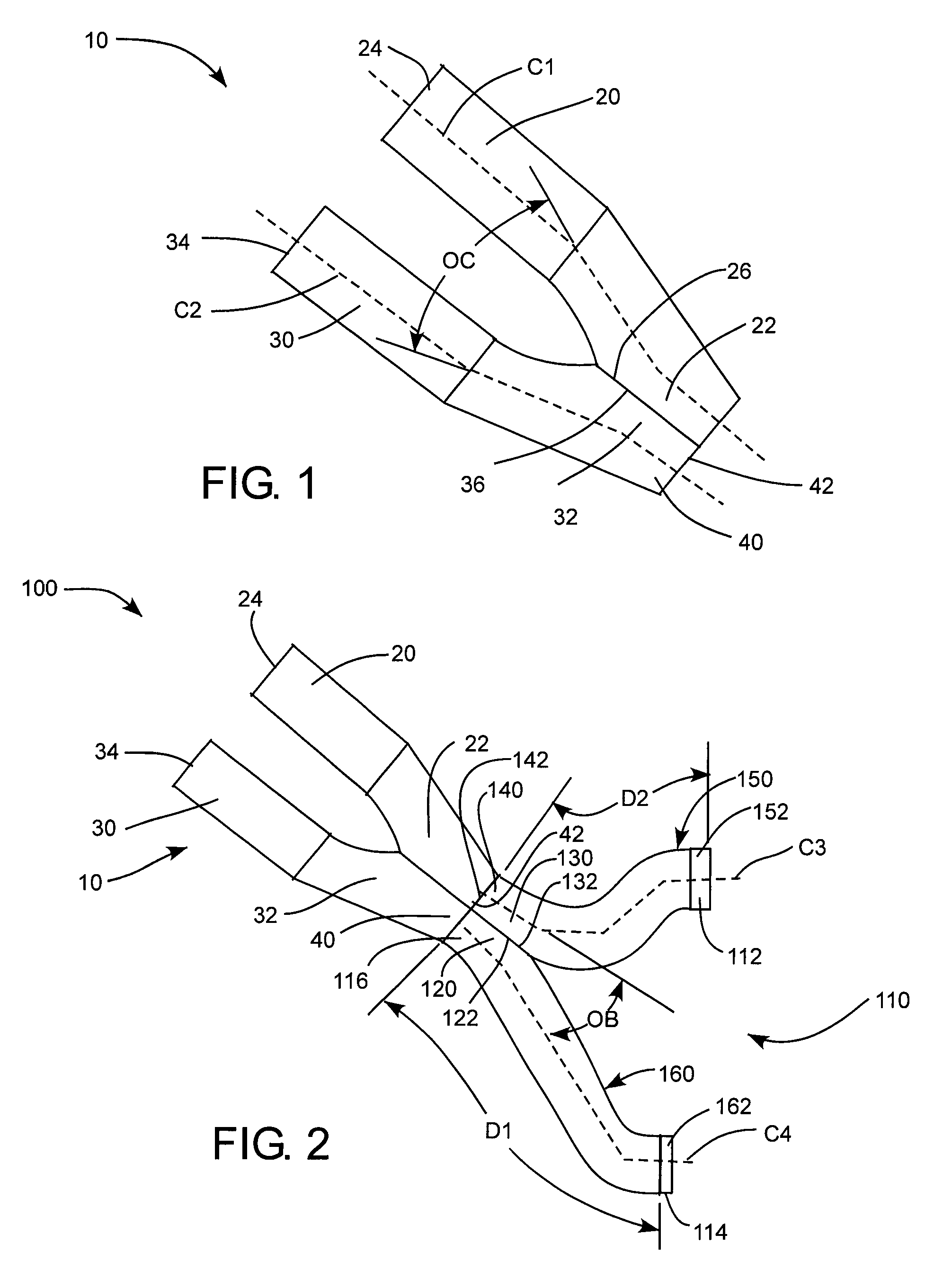
[0015]As a pressure pulse of exhaust gasses flows through one of the secondary exhaust pipes of the Y-pipe assembly and into the merged outlet portion, the
inertia of the accelerating flow of exhaust gasses passing the opening thereinto of the other secondary exhaust pipe, a partial vacuum or lower pressure is briefly created within such other secondary exhaust pipe. When the next cylinder exhausts into such other secondary exhaust pipe forming a pressure pulse of exhaust gasses, the flow thereof is accelerated due to the lower pressure therein created by the previous pressure pulse such that more exhaust is removed from the exhausting engine cylinder. This increased removal of exhaust gasses from the cylinders of the engine improves engine performance by allowing space for a larger amount of fresh fuel / air mixture to enter the cylinder for the next firing of the cylinder. The Y-pipe splitter works in conjunction with the Y-pipe assembly to provide a joined inlet portion into the Y-pipe splitter into which the exhaust gases flow from the outlet portion of the Y-pipe assembly as they would into a single boom tube type exhaust tailpipe from where the splitter tailpipe sections of the Y-pipe splitter direct the flow and control the expansion of exhaust gasses to direct the exhaust gases to the pair of separate tailpipes. The single outlet of the Y-pipe assembly and the single inlet of the Y-pipe splitter allow controlled mixing of the exhaust gasses therebetween for
fine tuning of the exhaust flows.


 Login to View More
  Login to View More