
Thermal management technology for polarizing xenon
a polarization and thermal management technology, applied in the field of xenon polarization, can solve the problems and reducing the polarization rate of sup>xe at increasingly high laser power, so as to increase the polarization rate and increase the laser power. , the effect of increasing the temperature of the gas mixtur
- Summary
- Abstract
- Description
- Claims
- Application Information
AI Technical Summary
Benefits of technology
Problems solved by technology
Method used
Image

Examples
Embodiment Construction
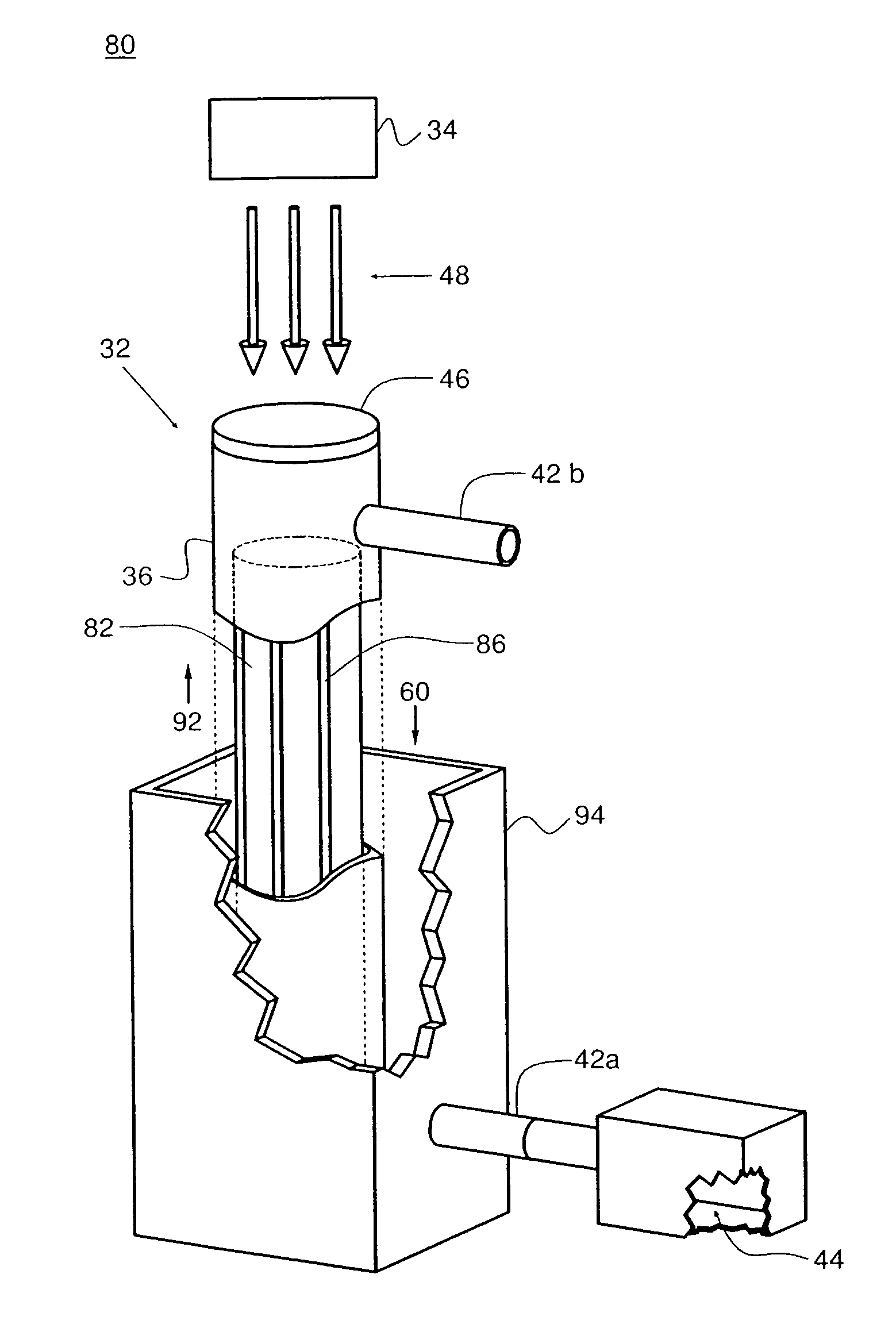
[0043]An improved polarizing apparatus having a polarizing cell with thermally conductive side walls and a thermally conductive partitioning device which serves to prevent the elevation of the temperature of the polarizing cell where laser light is maximally absorbed to perform the polarizing process. By employing this partitioning system, increases in laser power of factors of ten or more can be beneficially utilized to polarize xenon. Accordingly, conventional polarizing apparatus and the method of polarizing 129Xe fail to achieve rates of production achieved by the method described below.
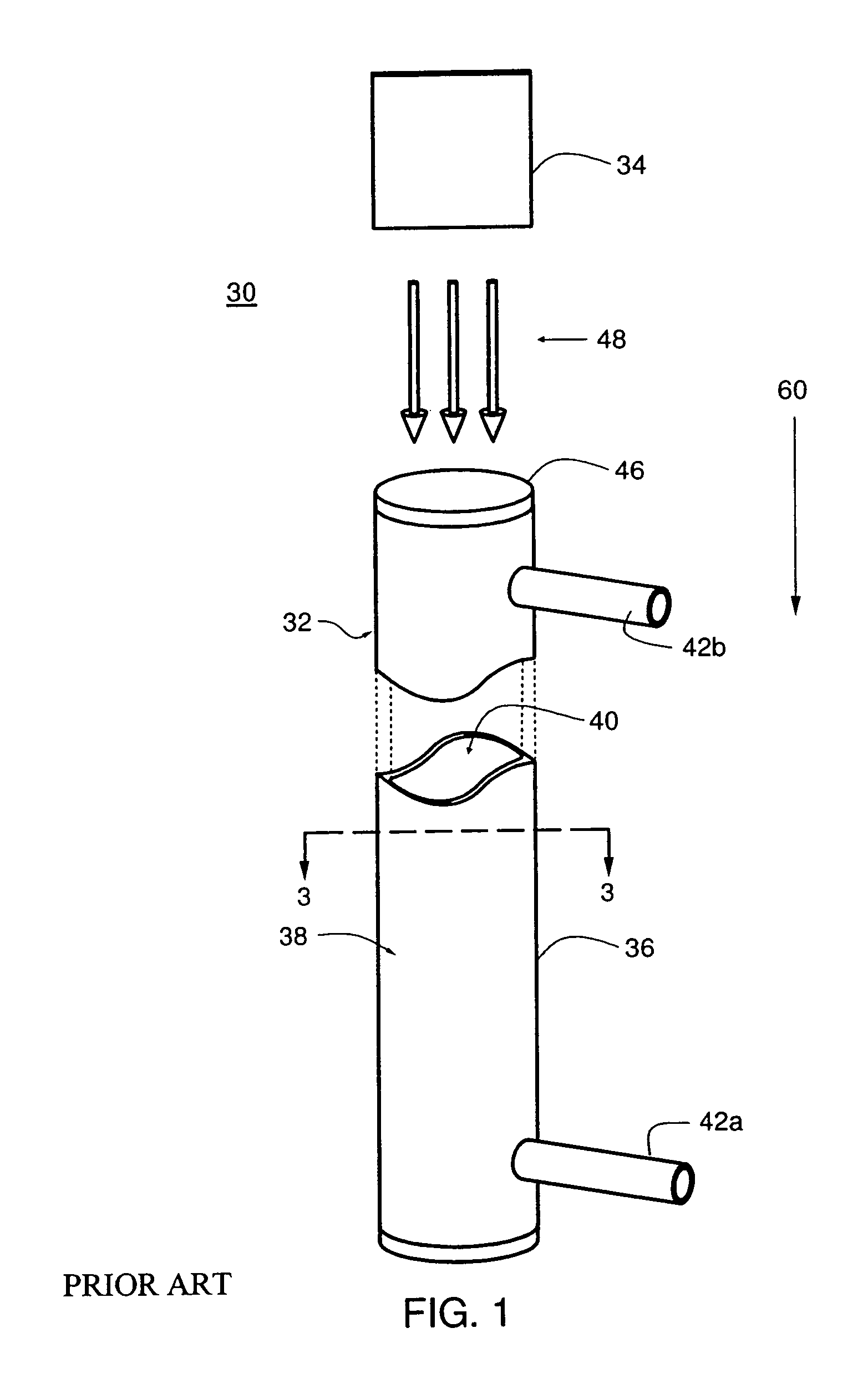
[0044]Referring to FIG. 1, a prior art polarizing apparatus 30 having a polarizing cell 32 and a laser 34 is shown. The polarizing cell 32 has a non-magnetic enclosure 36 having a circular side wall 38 defining an interior 40. The circular side wall 38 has at least two openings, an entrance 42a and an exit 42b for flowing a gas mixture 44 from the entrance 42a to the exit 42b. The polarizing cell...
PUM
 Login to View More
 Abstract
Description
Claims
Application Information
 Login to View More