Unlock instant, AI-driven research and patent intelligence for your innovation.

Method for switching an optical data stream, computer program product and corresponding storage means and node

a technology of optical data and node, applied in the field of optical communication networks, can solve the problems of high granularity, inability to meet the current bandwidth requirements in optimal manner, and flexibility in the occupancy of this bandwidth, so as to achieve precise temporal synchronization and reduce the electrical consumption of the nodes

Active Publication Date: 2015-10-27
FRANCE TELECOM SA
View PDF10 Cites 0 Cited by
  • Summary
  • Abstract
  • Description
  • Claims
  • Application Information

AI Technical Summary

Benefits of technology

This approach enhances bandwidth utilization by preventing collisions without the need for wavelength converters, reducing electrical consumption, and improving network transparency, allowing for more efficient data routing and management of optical data streams.

Problems solved by technology

The WDM (wavelength division multiplexing) optical systems used in classic optical communications networks are not able to process current bandwidth requirements in an optimal manner, especially because of the great increase in the number of optical-electronic-optical conversions and multiplexing / demultiplexing operations and also because of the lack of flexibility in the occupancy of this bandwidth (high granularity, poor bandwidth occupancy).
Indeed, the technique of optical circuit switching is relatively simple to implement but suffers from a lack of flexibility in the face of fluctuating data traffic and the change in state of communications channels.
The technique of optical packet switching is, for its part, conceptually ideal but highly complex to implement because it requires especially the presence of numerous delay lines and fast processing of the headers of the optical packets.
Now, the use of such wavelength converters requires the mobilizing of considerable electrical resources.
Besides, it limits the degree of transparency of the nodes that implement them, since the conversion mechanisms implemented are not transparent to the data modulation formats using especially phase modulation or polarization modulation.
In other words, there is no conversion technique at present (apart from optical-electronic-optical conversion) that enables functioning with phase-modulated and polarization-modulated data.
Consequently, the nodes comprising such wavelength converters are not totally transparent for the data.

Method used

the structure of the environmentally friendly knitted fabric provided by the present invention; figure 2 Flow chart of the yarn wrapping machine for environmentally friendly knitted fabrics and storage devices; image 3 Is the parameter map of the yarn covering machine
View more

Image

Smart Image Click on the blue labels to locate them in the text.
Viewing Examples
Smart Image
  • Method for switching an optical data stream, computer program product and corresponding storage means and node
  • Method for switching an optical data stream, computer program product and corresponding storage means and node
  • Method for switching an optical data stream, computer program product and corresponding storage means and node

Examples

Experimental program
Comparison scheme
Effect test

first embodiment

[0114]FIG. 3 represents an example of a graph illustrating a method for managing collisions in the time domain by the use of a table of occupancy of the output ports according to a first variant of the invention. In this first variant, the duration to be applied by the variable delay line can be chosen from a set of values which are multiples of a duration T representing the maximum duration of an optical data stream. By way of an illustration here below, the set of values corresponds to (0, T, 2T, 3T).

[0115]This table of occupancy of the output ports makes it possible to inform the node whether the output port determined for a given current optical data stream is free or occupied by one or more preceding optical data streams and, if it should be occupied, to indicate an end date (or limit date) of occupancy of this output port.

[0116]Here below, T(i,j) denotes the table of occupancy of the output port i for the wavelength j. In this example, the table of occupancy T(i,j) contains st...

second embodiment

[0149]FIG. 6 represents an example of a graph illustrating a method of management of collisions in the time domain by the use of a table of occupancy of delay lines according to the invention.

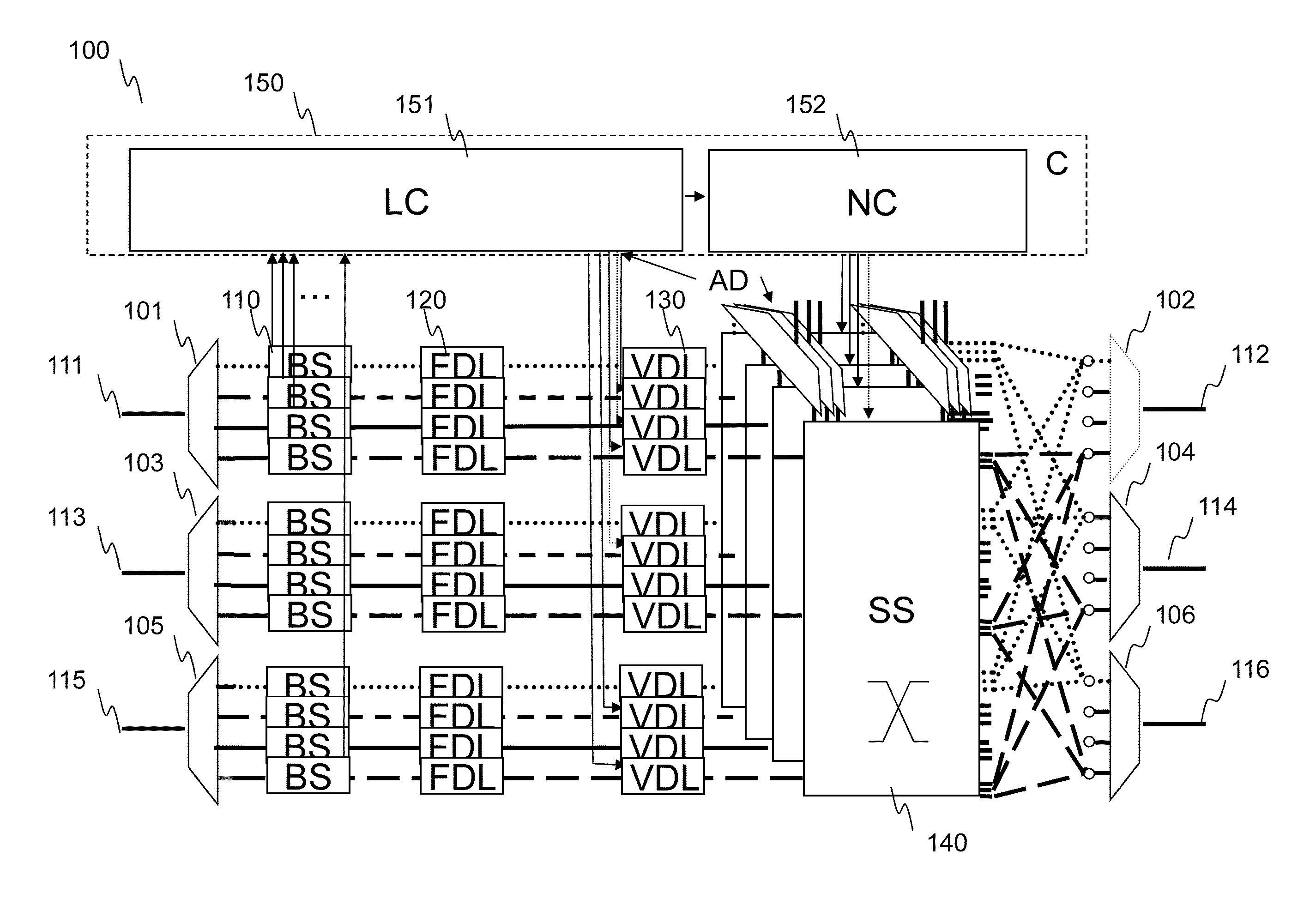
[0150]Unlike the particular embodiment described in FIGS. 3 to 5, which relies on a table of occupancy of the output ports of a node, the embodiment of FIG. 6 relies on a table of occupancy of delay lines corresponding to the input ports for each wavelength. The switching method then concerns the group of delay lines or input ports that belong to the same routing tree (in the example of the relay node 100, the occupancy of a delay line corresponds exactly to the occupancy of the input port for a given wavelength).

[0151]When the switching method is initialized, the table of occupancy is vacant by default (Te(i,j)={ }); the variable delay lines are configured with a zero duration VDL(i,j)=0; a delay variable R defined for the tree also contains a zero value R=0.

[0152]In this example, each optical...

the structure of the environmentally friendly knitted fabric provided by the present invention; figure 2 Flow chart of the yarn wrapping machine for environmentally friendly knitted fabrics and storage devices; image 3 Is the parameter map of the yarn covering machine
Login to View More

PUM

No PUM Login to View More

Abstract

A method and apparatus for switching an optical data stream via an optical network node, capable of switching optical data received at input ports to output ports. The method includes the following steps performed by a processing chain upon detection of a stream at a given wavelength by a given input port: determining a resource of the node based on a predetermined routing policy such that, for a given wavelength common to source and destination nodes of the stream, routing within the network is carried out according to a routing tree covering the network, a root of the tree being the destination node; consulting an occupancy table for the resource, indicating if at least one possible preceding stream is using the resource; determining a delay to be applied by the processing chain to prevent a collision between the stream and the possible preceding stream; and configuring the processing chain to apply the delay.

Description

CROSS-REFERENCE TO RELATED APPLICATIONS[0001]This application is a Section 371 National Stage Application of International Application No. PCT / FR2011 / 051787, filed Jul. 25, 2011, which is incorporated by reference in its entirety and published as WO 2012 / 022884 on Feb. 23, 2012, not in English.STATEMENT REGARDING FEDERALLY SPONSORED RESEARCH OR DEVELOPMENT[0002]None.THE NAMES OF PARTIES TO A JOINT RESEARCH AGREEMENT[0003]None.FIELD OF THE DISCLOSURE[0004]The field of the disclosure is that of optical communications networks.[0005]More specifically, the disclosure pertains to a technique for switching optical data by a node included in an optical communications network.[0006]The disclosure can be applied to numerous optical networks, such as for example ASON (Automatically Switched Optical Network), WSON (Wavelength-Switched Optical Network), OBS (Optical Burst Switching), OPS (Optical Packet Switching), as well as networks implementing the GMPLS (Generalized MultiProtocol Label Swit...

Claims

the structure of the environmentally friendly knitted fabric provided by the present invention; figure 2 Flow chart of the yarn wrapping machine for environmentally friendly knitted fabrics and storage devices; image 3 Is the parameter map of the yarn covering machine
Login to View More

Application Information

Patent Timeline
no application Login to View More
Patent Type & Authority Patents(United States)
IPC IPC(8): H04J14/00H04J14/02H04Q11/00H04B10/27
CPCH04B10/27H04J14/0212H04J14/0217H04J14/0257H04J14/0267H04J14/0269H04Q11/0005H04Q11/0066H04J14/0284H04J14/0258H04Q2011/002H04Q2011/005H04Q2011/0016H04Q2011/0039H04Q2011/0073
Inventor LE ROUZIC, ESTHERGAVIGNET, PAULETTE
Owner FRANCE TELECOM SA