
Elastomeric compositions and their use in articles
a technology of elastomeric compositions and compositions, which is applied in the field of thermoplastic elastomeric compositions, can solve the problems of low heat resistance of flexible materials of the type disclosed in them, unbound bbsa is known to volatilize out, and the inside surface of the tire may have defects, etc., and achieve the effect of increasing the amount of thermoplastic presen
- Summary
- Abstract
- Description
- Claims
- Application Information
AI Technical Summary
Benefits of technology
Problems solved by technology
Method used
Image

Examples
examples
[0090]Test methods are summarized in Table 3.
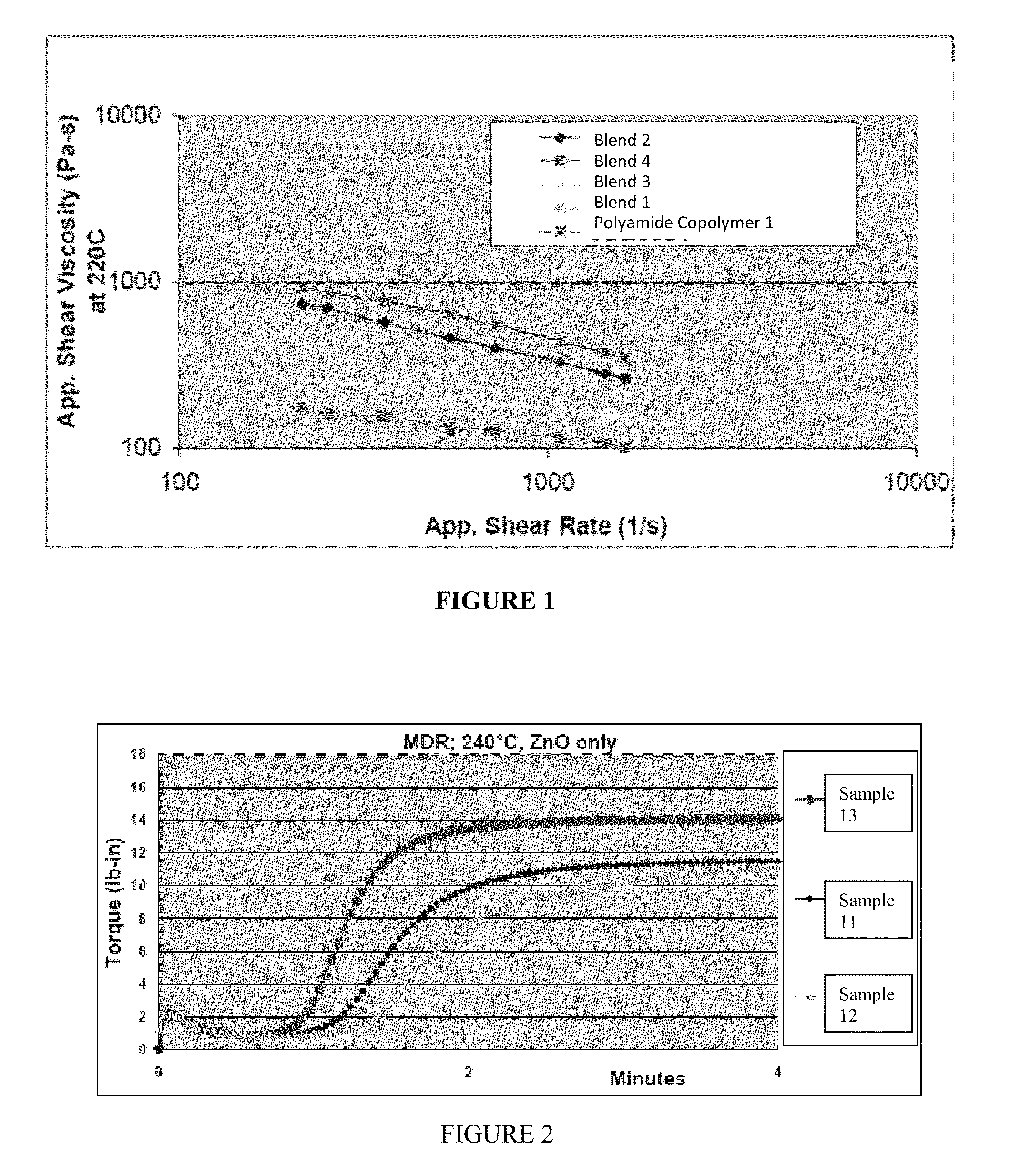
[0091]When possible, standard ASTM tests were used to determine the DVA physical properties (see Table 2). Stress / strain properties (tensile strength, elongation at break, modulus values, energy to break) were measured at room temperature using an Instron™ 4204. Tensile measurements were done at ambient temperature on specimens (dog-bone shaped) width of 0.16 inches (0.41 cm) and a length of 0.75 inches (1.91 cm) length (between two tabs) were used. The thickness of the specimens varied and was measured manually by A Mahr Federal Inc. thickness gauge. The specimens were pulled at a crosshead speed of 20 inches / min. (51 cm / min.) and the stress / strain data was recorded. The average stress / strain value of at least three specimens is reported. Shore A hardness was measured at room temperature by using a Zwick Durometer after 15 seconds indentation. LCR viscosity was measured with a Dynisco™ capillary rheometer at 30 / 1 L / D (length / diameter) at...
PUM
| Property | Measurement | Unit |
|---|---|---|
| weight percent | aaaaa | aaaaa |
| mol % | aaaaa | aaaaa |
| wt % | aaaaa | aaaaa |
Abstract
Description
Claims
Application Information
 Login to View More