
Optical A/D converter based on asymmetric Mach-Zehnder modulator
A digital converter, asymmetric technology, applied in the field of information optoelectronics, which can solve the problems of limited system bandwidth, reduced modulation rate, and complex implementation.
- Summary
- Abstract
- Description
- Claims
- Application Information
AI Technical Summary
Problems solved by technology
Method used
Image

Examples
Embodiment Construction
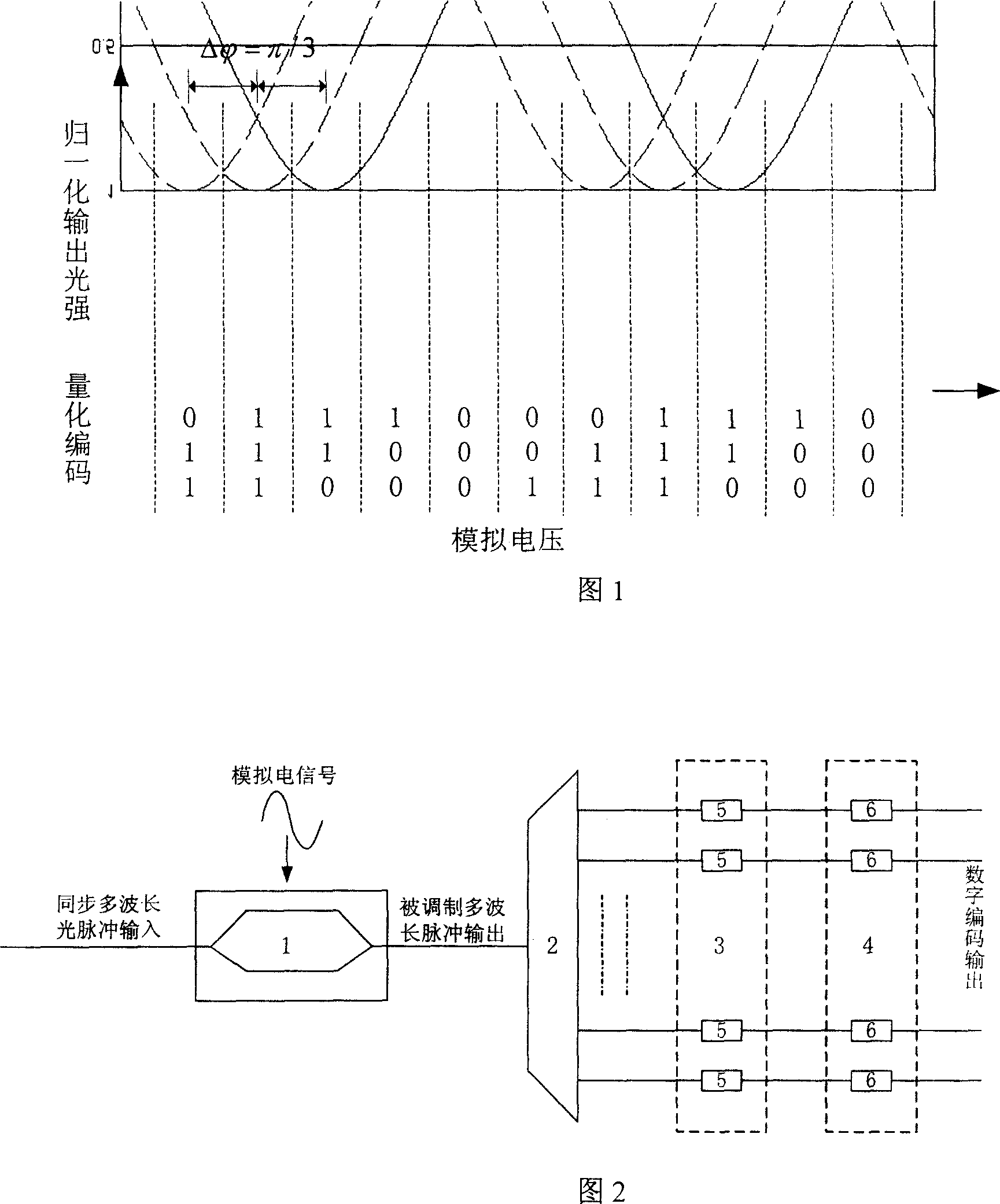
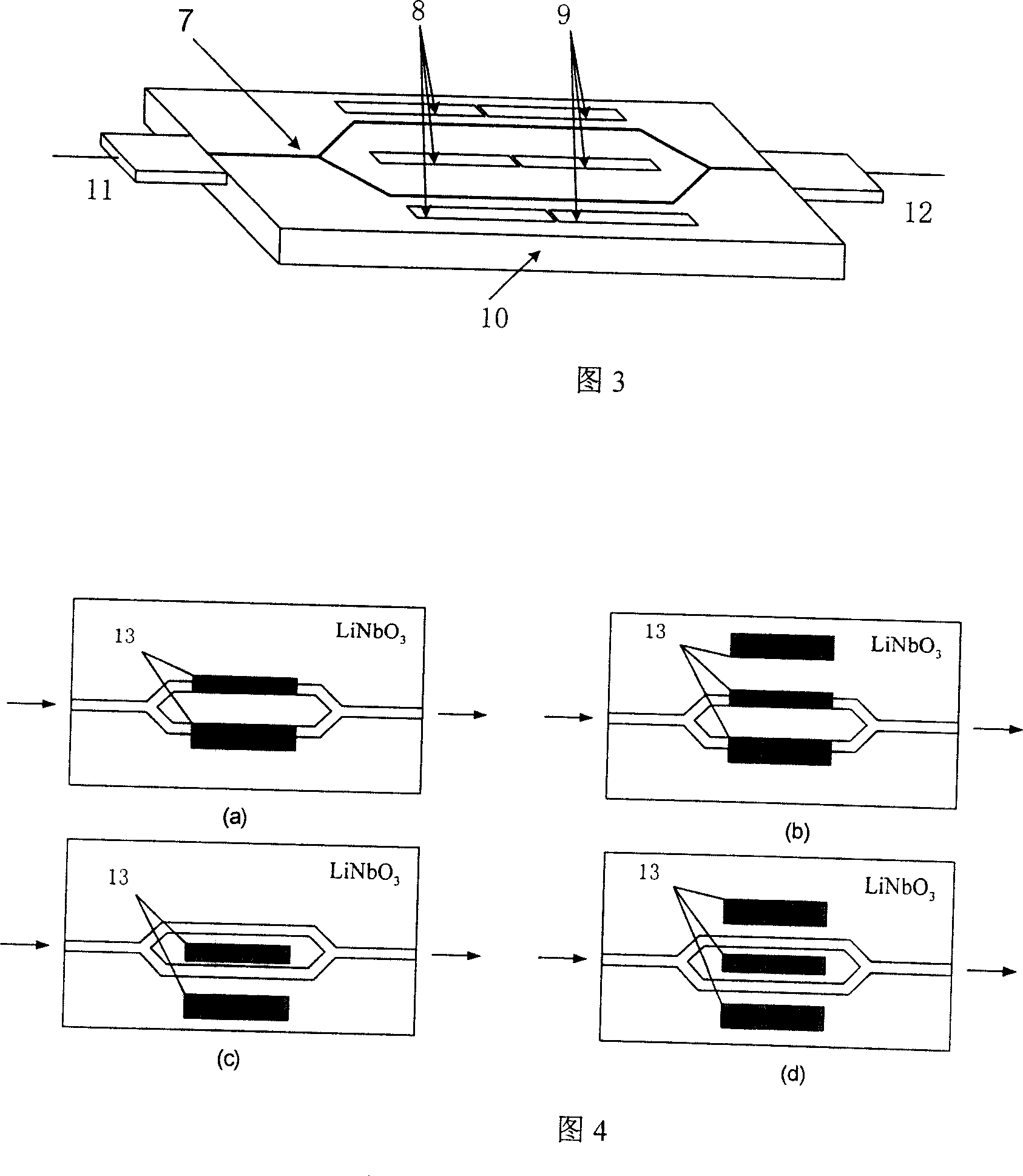
[0031] The block diagram of the present invention is as shown in Figure 2, by a kind of asymmetrical M-Z type modulator 1, the electric signal to be converted (this electric signal needs to carry out electric treatment, makes the peak-to-peak value equal to the full-scale value of this converter) modulated at multiple Regarding the wavelength pulse, what needs to be explained here is that pulses of different wavelengths need to be synchronized in time. The modulated multi-wavelength pulses are divided into multiple channels by the wavelength division multiplexer 2 corresponding to these wavelengths, and each channel has a photodetector 5 to detect the optical pulse of the channel, and the output signal of the photodetector 5 enters the comparator 6 Comparing with the pre-set decision level to obtain a binary digital signal 0 or 1, and combining multiple channels together to obtain a digital coded signal output corresponding to the analog signal, thereby realizing analog-to-digita...
PUM
 Login to View More
 Abstract
Description
Claims
Application Information
 Login to View More