Dynamic riding-driving circumstance human body physiological character and biomechanics testing platform

A technology of human physiology and biomechanics, applied in the field of ergonomics, can solve the important impact of human physiological characteristics and human biomechanical characteristics, that is, human fatigue and human comfort, which have not been considered, and the test of human physiological characteristics and human biomechanical characteristics To solve problems such as limited methods, achieve the effects of easy operation, high measurement and analysis efficiency, and accurate measurement data

CN101214143AInactive Publication Date: 2008-07-09XI AN JIAOTONG UNIV
0 Cites 45 Cited by

Patent Information

Authority / Receiving Office
CN · China
Current Assignee / Owner
Publication Date
2008-07-09
Estimated Expiration
Not applicable · inactive patent

Smart Images

  • Figure 1
    Figure 1
  • Figure 2
    Figure 2
  • Figure 3
    Figure 3
Patent Text Reader

Abstract

The invention discloses a dynamic driving environment human physiological characteristics and biomechanics test platform which mainly consists of a dynamic excitation system, a three-dimensional digital adjustable seat system, a three-dimensional adjustable driving mechanism and a human physiological characteristics and biomechanics test system. The invention can simulate the dynamic environment (vibration environment) of automobiles, which means to implement the stepless frequency conversion, the amplitude, the frequency fixation and frequency sweep vibration for the variable acceleration; simulate the posture operation of the automobiles in various driving environment; measure the human physiological character indexes of the human electromyography signals, the human arterial blood flow, the human blood pressure response, the human heartbeat number of a driver, etc., and the vibration response of every human part, the contact stress of a human-chair interface and the body pressure distribution of human buttock and back; study and comprehensively test the human physiological characteristics and the human biomechanics of the driving postures of different populations. Through the stimulation on a dynamic driving environment human physiological characteristics and biomechanics test system, scientific data required by the automobile human-machine interface design for populations with different shapes can be obtained.
Need to check novelty before this filing date? Find Prior Art

Description

technical field

[0001] The invention belongs to the technical field of ergonomics and relates to an experimental test device, in particular to a test platform for human physiological characteristics and biomechanics in a dynamic driving environment. Background technique

[0002] The automobile is one of the greatest inventions of the 20th century. Since Karl Benz successfully developed the world's first car in 1886, the car has experienced more than 120 years of development. During this hundred years of development, the automobile industry has grown from scratch and written an important chapter in the history of modern human civilization at an astonishing speed. As a product of social development, human civilization and scientific progress, automobiles have made great contributions to the progress of human civilization and social and economic development.

[0003] At present, the number of cars in the world has exceeded 600 million, with an average...

Examples

Embodiment Construction

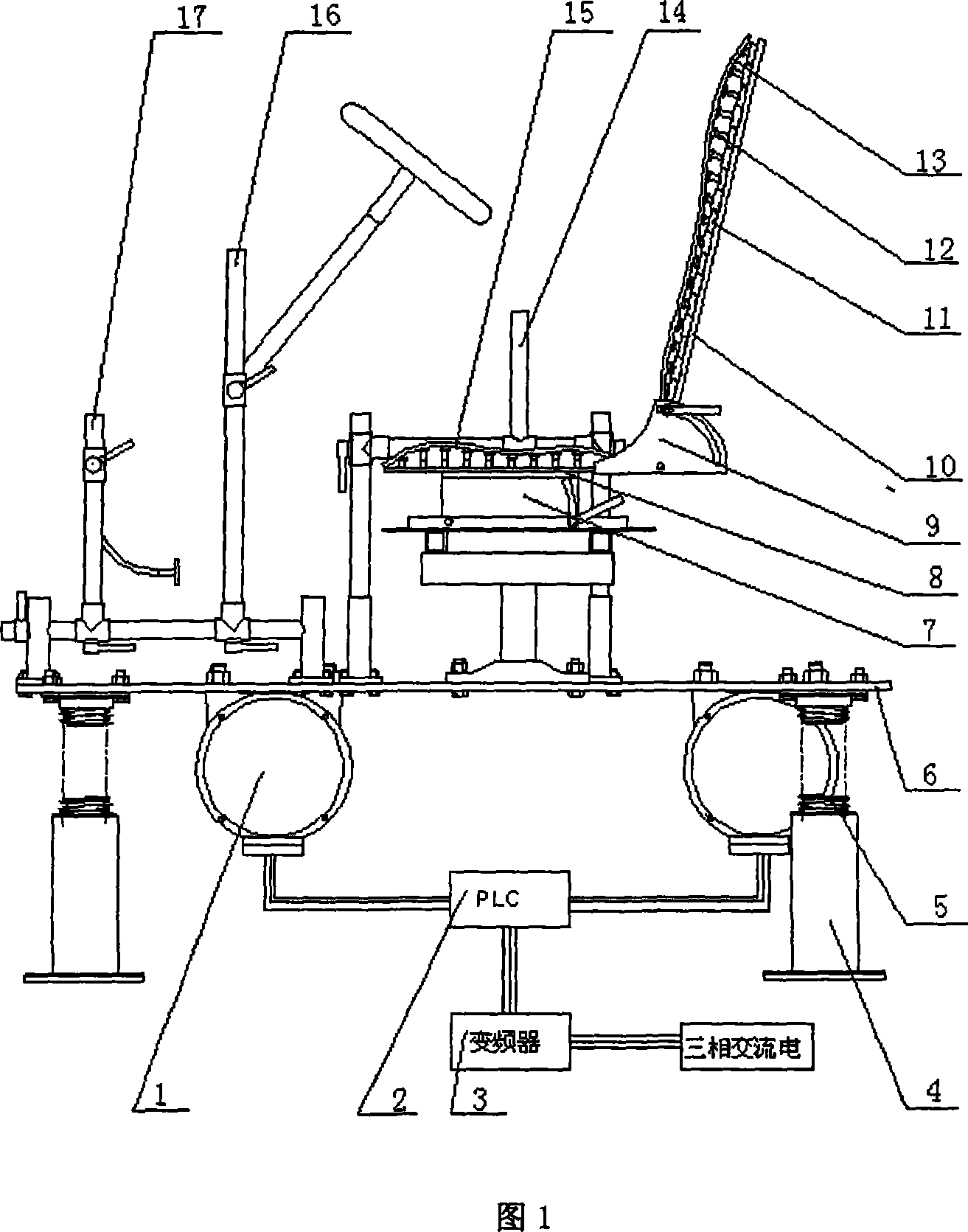
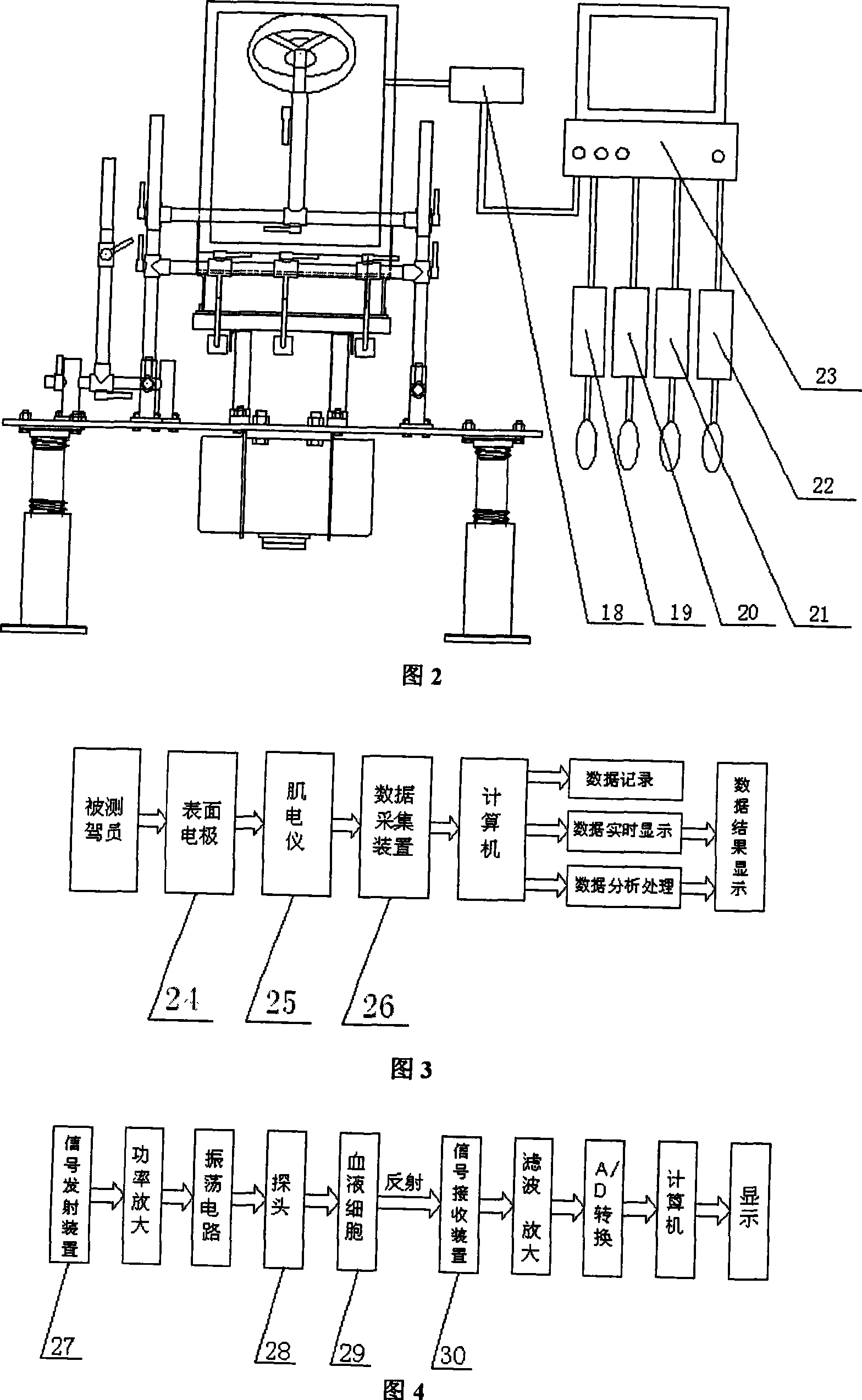
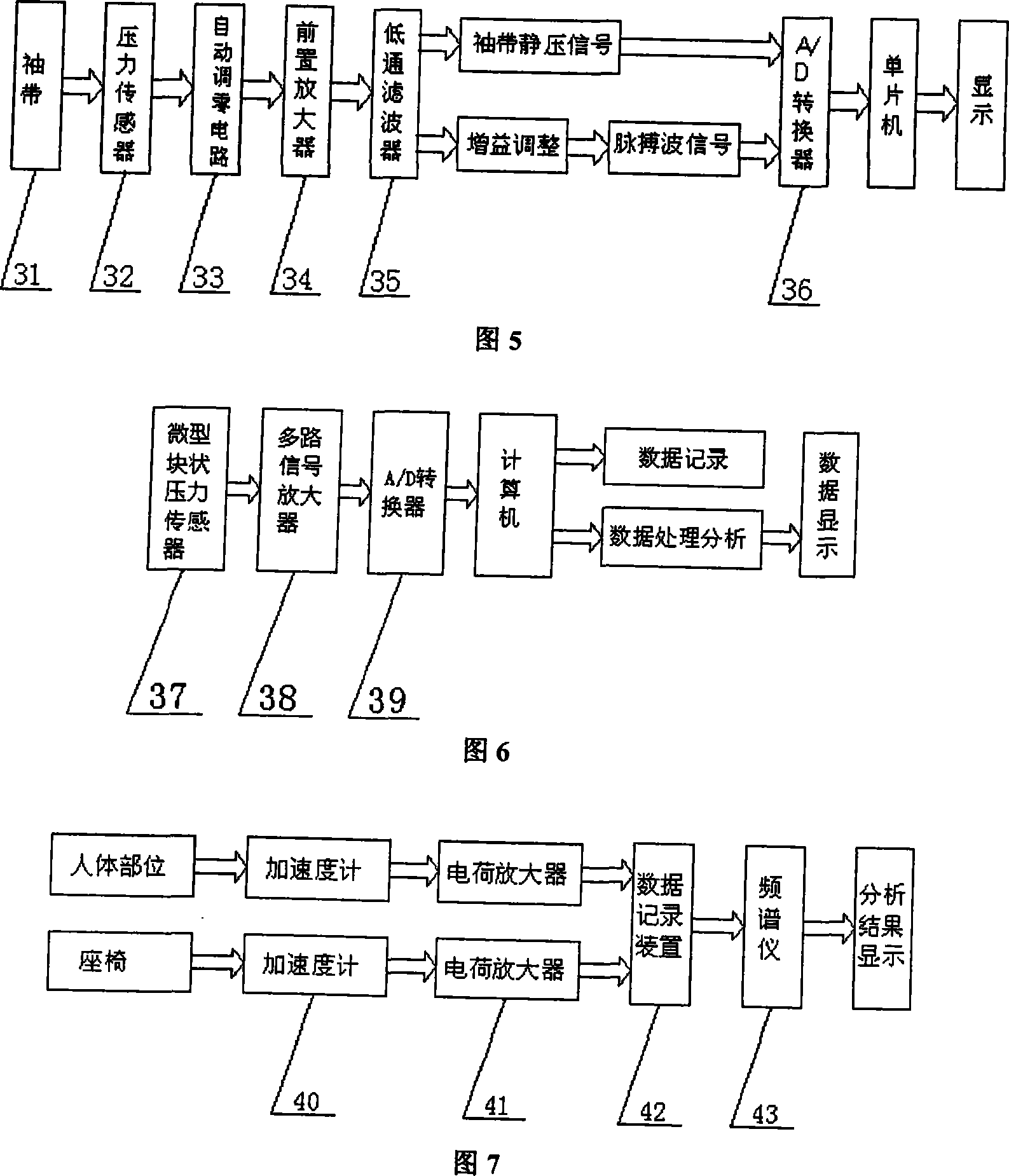
[0031] Referring to Fig. 1 and Fig. 2, the present invention mainly consists of four parts: a dynamic excitation system, a three-dimensional digital adjustable seat system, a three-dimensional adjustable riding mechanism and a human physiological characteristic (biomechanics) testing system.

[0032] The dynamic excitation system is mainly composed of an excitation motor 1 , a programmable logic controller (PLC) 2 , a frequency converter 3 and a supporting spring 5 . Among them, two excitation motors 1 are rigidly arranged under the base plate 6 of the test platform through screws, and by adjusting the angle of the eccentric block at the inner shaft end of the excitation motor 1, the excitation force can be adjusted steplessly within the range of its excitation force; the frequency conversion is adopted The device 3 realizes the stepless frequency modulation of the excitation motor; the programmable logic controller (PLC) 2 realizes the synchronous reverse rotation of the two e...