This helps you quickly interpret patents by identifying the three key elements:
Problems solved by technology
Method used
Benefits of technology
Problems solved by technology
This method mainly has the following technical problems: (1) the conversion rate of hexafluoroisopropanol is low, and the unreacted hexafluoroisopropanol needs to be recovered and purified after adjusting the pH value, which increases the manufacturing cost; (2) the reaction There are many impurities in the product, which are difficult to purify (such as P3), which eventually leads to more impurities in sevoflurane
Method used
the structure of the environmentally friendly knitted fabric provided by the present invention; figure 2 Flow chart of the yarn wrapping machine for environmentally friendly knitted fabrics and storage devices; image 3 Is the parameter map of the yarn covering machine
View more
Image
Smart Image Click on the blue labels to locate them in the text.
Viewing Examples
Smart Image
Click on the blue label to locate the original text in one second.
Reading with bidirectional positioning of images and text.
Smart Image
Examples
Experimental program
Comparison scheme
Effect test
Embodiment 1
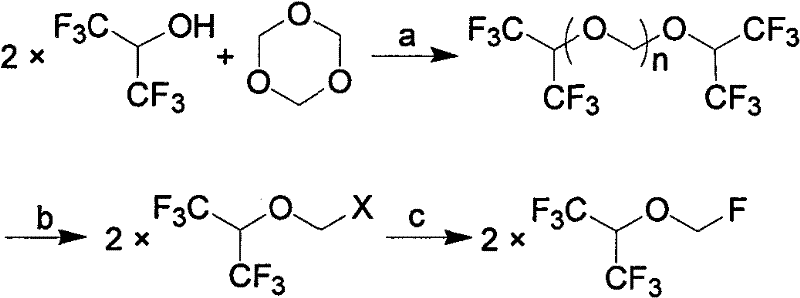
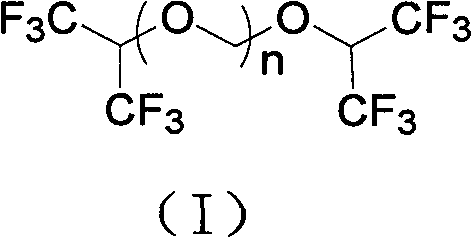
[0031] Add 336g of hexafluoroisopropanol, 90g of paraformaldehyde, and 15ml of concentrated sulfuric acid into the reaction flask, stir and heat to 40°C~80°C for 15 hours, let stand to separate layers, remove concentrated sulfuric acid, stir and cool down to 0°C for crystallization 3 hour, filter, and the filtrate is 159.6g, and this filtrate is detected by gas chromatography (GC), and is confirmed to be the mixture of hexafluoroisopropanol and paraformaldehyde, which can be directly used as the reaction stock solution after simple filtration; The dried solid weighed 247.2g. GC detected that in the retentate, the content of bis-hexafluoroisopropanol triformal (n=3) was 52%, and the content of bis-hexafluoroisopropanol triformal (n=2 ) content is 42%, and bis-hexafluoroisopropanol-formal (n=1) content is <0.5%.
Embodiment 2
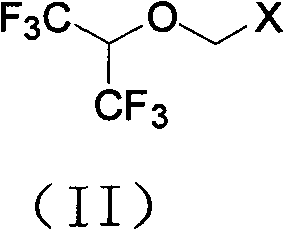
[0033] Take 123.6g of the solid obtained in Example 1 and add it to the reaction flask, heat to 40-45°C to dissolve, cool down to 20-25°C, add anhydrous aluminum trichloride (82.5g) in batches, and keep warm at 25-30°C for 24 Hours, cool down to 0°C, add 10% dilute hydrochloric acid (500ml) dropwise, let stand to separate layers, wash the organic layer successively with 5% NaOH aqueous solution (100ml×2), water (100ml×2), and dry over anhydrous sodium sulfate , to obtain 108.5 g of chloromethyl 2,2,2-trifluoro-1-(trifluoromethyl)ethyl ether, purity: 99.3% (GC method).
Embodiment 3
[0035]Get 123.6 g of the solid obtained in Example 1 and put it into the reaction flask, and add 100 ml of dichloromethane, add anhydrous aluminum trichloride (82.5 g) in batches at 0 ° C, keep warm at 25 ~ 30 ° C for 24 hours, and cool down to 0°C, add 10% dilute hydrochloric acid (500ml) dropwise, let stand to separate layers, wash the organic layer with 5% NaOH aqueous solution (100ml×2), water (100ml×2) successively, dry over anhydrous sodium sulfate, rectify The dichloromethane was removed to obtain 109.2 g of chloromethyl 2,2,2-trifluoro-1-(trifluoromethyl)ethyl ether with a purity of 97.3% (GC method).
the structure of the environmentally friendly knitted fabric provided by the present invention; figure 2 Flow chart of the yarn wrapping machine for environmentally friendly knitted fabrics and storage devices; image 3 Is the parameter map of the yarn covering machine
Login to View More
PUM
Login to View More
Abstract
The invention relates to a method for synthesizing sevoflurane. The method comprises the following steps that: hexafluoro isopropanol is utilized as a raw material and reacted with trioxymethylene (or paraformaldehyde) in the presence of acids to generate di-hexafluoro isopropanol formal derivatives; halomethyl 2, 2, 2-trichloro-1-(trifluoromethyl) ethyl ether is generated from the di-hexafluoro isopropanol formal derivatives in the presence of anhydrous aluminum trihalides; and the halomethyl 2, 2, 2-trichloro-1-(trifluoromethyl) ethyl ether is reacted with metal fluoride to synthesize the sevoflurane. The method has low cost and easily realized reaction conditions, and is suitable for industrialized mass production of the sevoflurane.
Description
technical field [0001] The invention relates to a method for synthesizing fluoromethyl-2,2,2-trifluoro-1-(trifluoromethyl)ethyl ether (commonly known as sevoflurane). Background technique [0002] In recent years it has been discovered that fluorinated ethers are effective inhalational anesthetics. Included among these anesthetics is desflurane (CF 3 CHFOCHF 2 ), isoflurane (CF 3 CHClOCHF 2 ), enflurane (ClFCHCF 2 OCHF 2 ) and sevoflurane ((CF 3 ) 2 CHOCH 2 F). Sevoflurane is a particularly advantageous inhalational anesthetic because of its rapid loss of consciousness and rapid recovery—ideal properties of contemporary inhalational anesthetics. Sevoflurane is delivered by the inhalation route to an air-breathing warm-blooded animal in approximately 1% to 5% by volume in admixture with oxygen or in a gaseous mixture containing sufficient oxygen to maintain respiration. [0003] U.S. Patent 3683092 and 3689571 disclose the use of sevoflurane as an inhalation anesth...
Claims
the structure of the environmentally friendly knitted fabric provided by the present invention; figure 2 Flow chart of the yarn wrapping machine for environmentally friendly knitted fabrics and storage devices; image 3 Is the parameter map of the yarn covering machine
Login to View More
Application Information
Patent Timeline
Application Date:The date an application was filed.
Publication Date:The date a patent or application was officially published.
First Publication Date:The earliest publication date of a patent with the same application number.
Issue Date:Publication date of the patent grant document.
PCT Entry Date:The Entry date of PCT National Phase.
Estimated Expiry Date:The statutory expiry date of a patent right according to the Patent Law, and it is the longest term of protection that the patent right can achieve without the termination of the patent right due to other reasons(Term extension factor has been taken into account ).
Invalid Date:Actual expiry date is based on effective date or publication date of legal transaction data of invalid patent.



 Login to View More
  Login to View More