Radio broadcasting and multicasting transmission method
A technology of wireless broadcasting and transmission method, which is applied in the field of wireless communication, and can solve the problems of high throughput of enhanced streams, etc.
- Summary
- Abstract
- Description
- Claims
- Application Information
AI Technical Summary
Problems solved by technology
Method used
Image



Examples
no. 1 example
[0051] For broadcast services, consider the following two extreme cases.
[0052] The first extreme case is broadcasting. In order to ensure that all UEs can receive the broadcast service, the base station determines the transmission rate according to the channel condition of the UE with the worst channel in the cell. Therefore, when the number of UEs in the cell is large, the The transmission rate of the base station signal is very small. In this case, all user terminals can receive the message broadcast by the base station (abbreviated as broadcast message) after only one base station signal transmission. However, due to the low signal transmission rate, the system delay is very large.
[0053] The second extreme case is opportunistic unicast. The base station determines the transmission rate according to the channel condition of the user terminal with the best channel. Therefore, the signal transmission rate of the base station will be very high. In this case, since only o...
no. 2 example
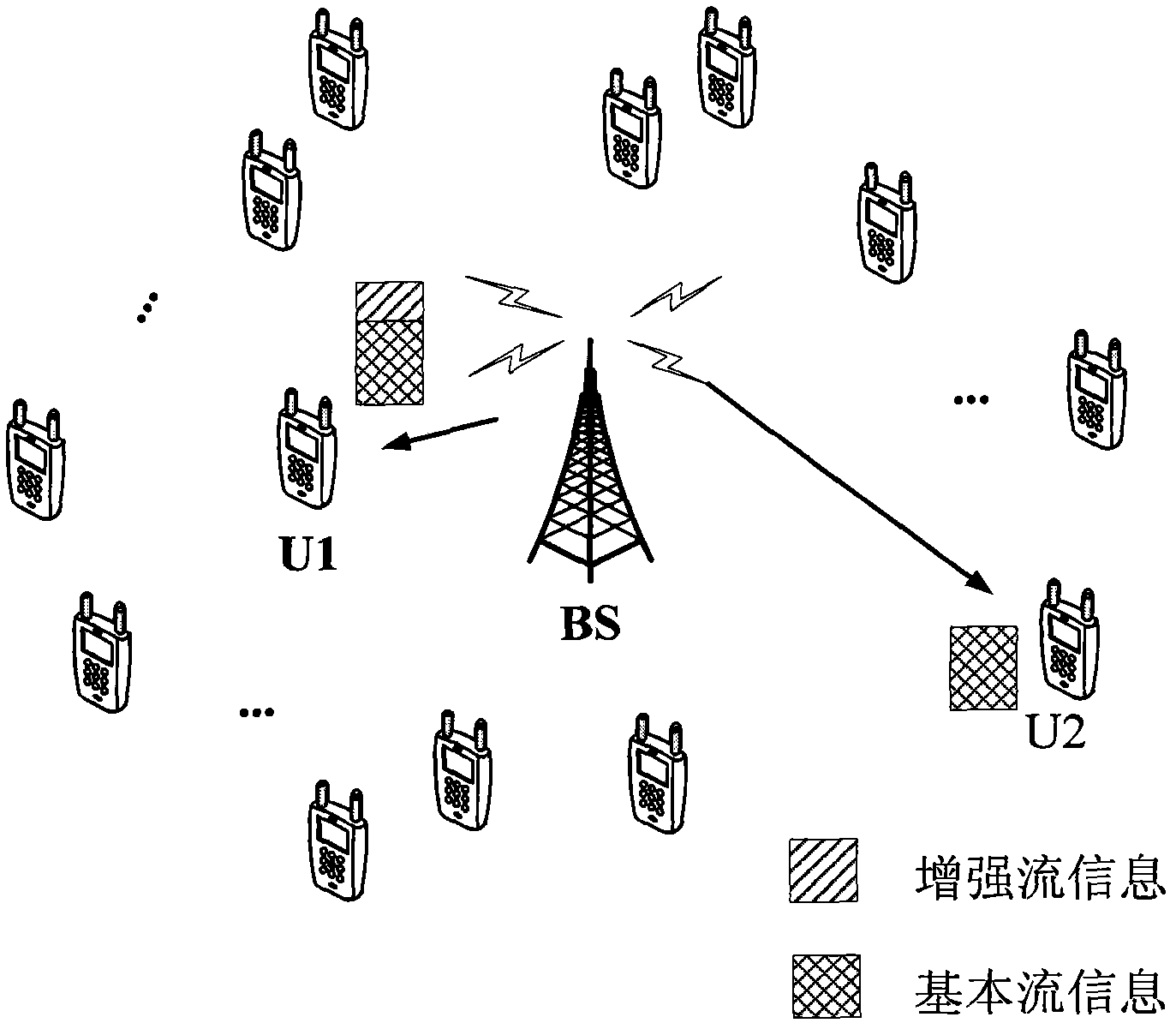
[0067] According to the concept of layered modulation, the sender sends two different information streams: basic stream (also called basic layer) and enhanced stream (also called added layer or superimposed stream). The sender superimposes these two types of messages and sends them in a sending form. Generally, the transmit power of the basic stream is relatively large, and that of the enhanced stream is relatively small.
[0068] At the receiving end (user end), the elementary stream information is decoded first. In the process of decoding the elementary stream information, the superimposed stream information is used as interference. When decoding the enhanced stream information, the decoded and reconstructed elementary stream signal is subtracted from the total received signal to obtain the enhanced stream information and decode it, so as to obtain the decoded superimposed stream message. Generally, a receiver with better channel quality can decode both types of messages, ...
PUM
 Login to View More
 Abstract
Description
Claims
Application Information
 Login to View More