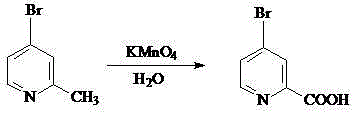
Preparation method for 5-bromine-2-picolinic acid

A technology of picolinic acid and picolinic acid, which is applied in the field of preparation of 5-bromo-2-picolinic acid, can solve the problems of long process route and low yield, and achieve simple post-processing, high yield and cheap raw material price Effect

CN104987308AInactive Publication Date: 2015-10-21林达钦
4 Cites 2 Cited by

Patent Information

Authority / Receiving Office
CN · China
Current Assignee / Owner
Publication Date
2015-10-21
Estimated Expiration
Not applicable · inactive patent

Smart Images

  • Figure 1
    Figure 1
Patent Text Reader

Abstract

The invention belongs to the field of organic synthesis, and particularly relates to a preparation method for 5-bromine-2-picolinic acid. The preparation method for the 5-bromine-2-picolinic acid comprises the following steps that 5-bromine-2-picoline is used as raw material, water is used as solvent, the temperature is raised to 80 DEG C by heating, potassium permanganate is added in batches, the reaction temperature is maintained to be 85 to 90 DEG C, the heating time is 60 to 100 min, and distilling, filtering, pH value adjusting and cooling crystallization are conducted on reactant. The preparation method for the 5-bromine-2-picolinic acid has the advantages that the reaction condition is mild, the operation is easy, aftertreatment is simple, large-scale production is easy, and the preparation method for the 5-bromine-2-picoline is especially suitable for industrial production; the yield rate is high, the price of raw materials is low, and the production cost is low.
Need to check novelty before this filing date? Find Prior Art

Description

technical field

[0001] The invention belongs to the field of organic synthesis, and in particular relates to a preparation method of 5-bromo-2-pyridinecarboxylic acid. Background technique

[0002] Pyridine and its derivatives are widely distributed in nature. Many plant components such as alkaloids contain pyridine ring compounds in their structures, which are the basis for the production of many important compounds, such as medicines, pesticides, dyes, surfactants, rubber additives, feed additives, food additives, adhesives, etc. Indispensable raw material in production. 5-Bromo-2-pyridinecarboxylic acid is an important organic intermediate, which plays an irreplaceable role in the chemical and pharmaceutical fields.

[0003] The existing methods for preparing 5-bromo-2-pyridinecarboxylic acid have disadvantages such as low yield and long process route. Contents of the invention

[0004] The purpose of the present invention is to overcome the technical deficiencies of...

Examples

Embodiment 1

[0018] Add 5-bromo-2-methylpyridine (17.1g, 0.1mol) into a 250ml three-necked flask, add 100ml of water, insert a thermometer and a condenser, raise the temperature to 80°C, and add potassium permanganate (31.6g, 0.2mol), then maintain the reaction temperature at 85°C for 60 minutes, then distill, filter, adjust the pH to 3-4 with 6mol / l hydrochloric acid, cool to room temperature, and recrystallize with ethanol to obtain the product with a molar yield of 75%.

Embodiment 2

[0020] Add 5-bromo-2-methylpyridine (17.1g, 0.1mol) into a 250ml three-necked flask, add 100ml of water, insert a thermometer and a condenser, raise the temperature to 80°C, and add potassium permanganate (31.6g, 0.2mol), then maintain the reaction temperature at 85°C for 90min, then distill, filter, adjust the pH to 3-4 with 6mol / l hydrochloric acid, cool to room temperature, and recrystallize with ethanol to obtain the product with a molar yield of 77%.

Embodiment 3

[0022] Add 5-bromo-2-methylpyridine (17.1g, 0.1mol) into a 250ml three-necked flask, add 100ml of water, insert a thermometer and a condenser, raise the temperature to 80°C, and add potassium permanganate (31.6g, 0.2mol), then maintain the reaction temperature at 90°C for 90min, then distill, filter, adjust the pH to 3-4 with 6mol / l hydrochloric acid, cool to room temperature, and recrystallize with ethanol to obtain the product with a molar yield of 78%.