Time sequence forecast method based on quantum gravity algorithm
A technology of time series and prediction methods, applied in computing, special data processing applications, instruments, etc., can solve the problems of insufficient model training, affecting model prediction performance, local minima, etc.
- Summary
- Abstract
- Description
- Claims
- Application Information
AI Technical Summary
Problems solved by technology
Method used
Image



Examples
Embodiment
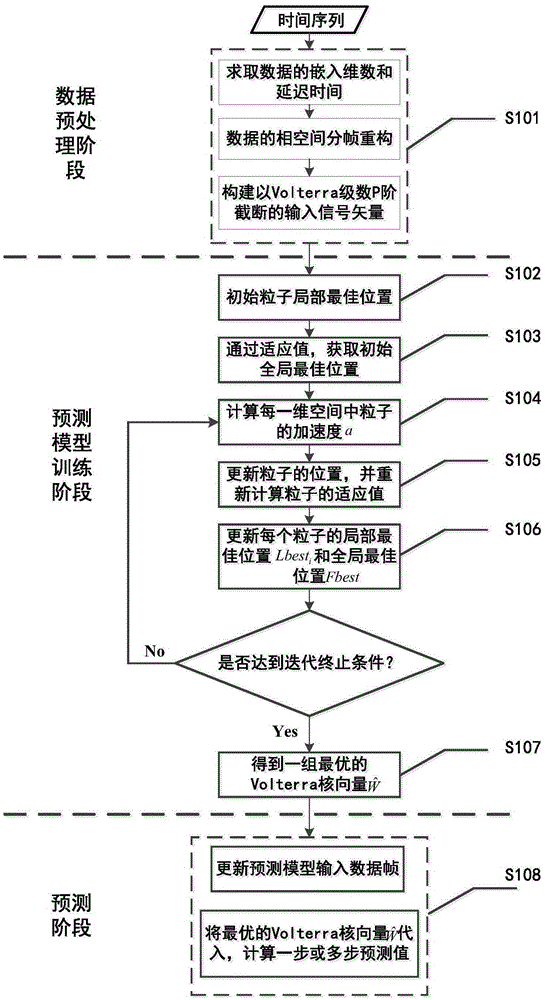
[0055] figure 1 It is a flow chart of a specific embodiment of the time series prediction method based on the quantum gravity algorithm of the present invention.
[0056] In this example, if figure 1 As shown, the time series prediction method based on the quantum gravity algorithm of the present invention can be divided into three stages: data preprocessing stage, prediction model training stage and prediction stage. Each stage is described in detail below:
[0057] (1) Data preprocessing stage
[0058] S101: Suppose the preselected data set DS={x(1), x(2),...,x(D)}, where D is the number of data;
[0059] First, determine the optimal embedding dimension d and delay time τ of the data set DS according to the method of differential entropy rate;
[0060] Secondly, use the function windowize in Matlab to reconstruct the data set DS in frames, and map each frame data to the d-dimensional feature space, and use Volterra series to p(p≥1) order truncation, so as to get N 0 (N ...
example
[0098] In order to illustrate the technical effects of the present invention, the present invention will conduct experimental analysis from simulation and actual chaotic time series to measure the validity of the prediction model. Among them, the simulation sequence is the famous Mackey-Glass (MG) data, and the actual sequence is several sets of data sets provided by the TimeSeriesPredictionGroup group: Laser, DailyMinimumTemperatures (DMT), Electricity_Demand (ED), CATS_Benchmark (CATS_B), SunspotNumber (SN), PolandElectricity ( PE), Dslp. At the same time, the present invention also uses a set of degradation measurement data (RDD) generated by the random degradation model to verify the method proposed by the present invention.
[0099] For these 9 different simulated and actual chaotic time series, they are first normalized, and then 2 / 3 of the data are used as training data, and 1 / 3 of the data are used as test data. In the parameter setting of the prediction model, the me...
PUM
 Login to View More
 Abstract
Description
Claims
Application Information
 Login to View More