Pome organic fertilizer

An organic fertilizer and organic technology, applied in the field of organic fertilizer for pear fruit, can solve problems such as difficulty in survival, long time to function, difficulty in gene transfer, etc., and achieve the effects of increasing efficiency, improving structure and texture, and improving yield and quality

CN105347860AInactive Publication Date: 2016-02-24杨建斌 +2
1 Cites 4 Cited by

Patent Information

Authority / Receiving Office
CN · China
Current Assignee / Owner
Publication Date
2016-02-24
Estimated Expiration
Not applicable · inactive patent

Smart Images

  • Figure 1
    Figure 1
Patent Text Reader

Abstract

A pome organic fertilizer is prepared by cooperation of a biotechnology and an electrolysis technology. According to the pome organic fertilizer, microbes and mineralization materials are used as additives, and a nutrition formula (nitrogen, phosphor, potassium, sulfur, magnesium, calcium, silicon, boron, zinc, iron, molybdenum and mycoprotein, amino acid, humus, plant nucleic acid, B vitamins, active enzymes and unknown factors for promoting crop growth) are added. The pome organic fertilizer can supply sufficient nutrients to crops, and even soil can be improved to be beneficial to plantation of organic crops. Through the biotechnology, microbes in the dormant state are injected into the fertilizer. The microbes are activated under favorable environmental conditions so as to decompose animal and plant residual bodies, pesticides, chemical fertilizers, heavy metal residual hazards and mineral substances in soil and change contents of nitrogen, phosphor and potassium. Through the electrolysis technology, the mineralization material additives create a soil chain reaction on water and supplying oxygen so as to gradually change charges of ions in soil, increase oxygen supply rate of soil, improve water percolating capacity and enhance conditions of microbial.
Need to check novelty before this filing date? Find Prior Art

Description

technical field

[0001] The invention relates to an organic fertilizer, more specifically, an organic fertilizer suitable for pear fruit. Background technique

[0002] As early as Roman times, farmers were noticing that bacteria could enrich agricultural soils with nutrients as they discovered improved yields of cereal crops when planted in large fields that had previously been legumes. Until the 19th century, alfalfa growers in Germany and some soybean growers in the United States used soil from alfalfa or soybean fields to transfer and inoculate to new farmland, thereby increasing crop yield. In 1838, French agricultural chemist J.B. Boussingault discovered that leguminous plants can fix nitrogen. In 1843, the first agricultural experiment station was established, and the yield and composition of crops in various crop rotations were analyzed more accurately.

[0003] From 1886 to 1888, German scientist H. Hellriegal (H. Hellriegal) proved under sand culture conditions tha...

Examples

Embodiment Construction

[0048] The invention relates to an organic fertilizer containing microorganisms, which is characterized in that it consists of microorganism populations and organic matter.

[0049] The microbial population includes yeast, actinomycetes, photosynthetic bacteria, nitrogen-fixing bacteria, phosphorus and potassium solubilizing bacteria. Each gram of fertilizer contains 20 million effective viable bacteria.

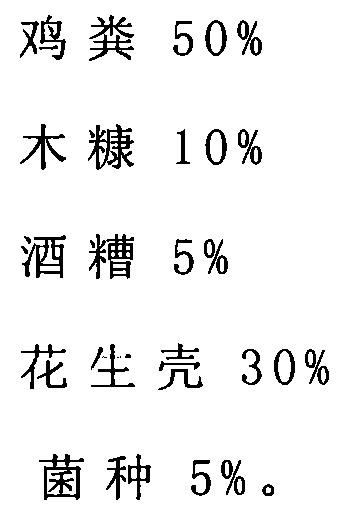
[0050] The organic matter is derived from livestock and poultry manure, wood chaff, distiller's grains, crop straw, brown sugar, raw flour, vermicelli residue, peanuts, and peanut shells. Organic matter accounts for 42 percent by weight of fertilizer.

[0051] The nutrient comes from livestock and poultry manure, wood chaff, distiller's grains, crop stalks, brown sugar, raw flour, vermicelli slag, peanuts, and peanut shells. Total nutrients account for 6 percent by weight of fertilizer.

[0052] The present invention relates to the production process of organic fertilizer...