Unlock instant, AI-driven research and patent intelligence for your innovation.
Chinese herbal preparation for treating post-anesthesia nerve injury
What is Al technical title?
Al technical title is built by PatSnap Al team. It summarizes the technical point description of the patent document.
A traditional Chinese medicine preparation, nerve injury technology, applied in nervous system diseases, medical preparations containing active ingredients, drug combinations, etc.
Inactive Publication Date: 2016-07-06
刘俊英
View PDF1 Cites 1 Cited by
Summary
Abstract
Description
Claims
Application Information
AI Technical Summary
This helps you quickly interpret patents by identifying the three key elements:
Problems solved by technology
Method used
Benefits of technology
Problems solved by technology
Since there is no mature and available solution at present, we start with Chinese herbal medicine with less toxic and side effects, and according to the theory of traditional Chinese medicine, prescribe the right medicine to the case, and develop a Chinese medicine preparation for treating nerve injury after anesthesia
Method used
the structure of the environmentally friendly knitted fabric provided by the present invention; figure 2 Flow chart of the yarn wrapping machine for environmentally friendly knitted fabrics and storage devices; image 3 Is the parameter map of the yarn covering machine
View more
Image
Smart Image Click on the blue labels to locate them in the text.
Viewing Examples
Smart Image
Click on the blue label to locate the original text in one second.
Reading with bidirectional positioning of images and text.
Smart Image
Examples
Experimental program
Comparison scheme
Effect test
Embodiment approach 1
[0008] Embodiment 1: Weigh 1 gram of adult blood seven, 12 grams of santa vine, 20 grams of Guanyin amaranth root, 8 grams of begonia root, 7 grams of fake grape, 8 grams of privet root, 8 grams of staghorn vine, and 7 grams of vine root gram, 5 grams of benzoin, 3 grams of acacia root bark, 3 grams of Heyemohu, 6 grams of lentil vine, 4 grams of nine lion grass, 10 grams of castor root, and 4 grams of white mustard seed, made into a decoction according to the traditional method.
Embodiment approach 2
[0009] Embodiment 2: Weigh 2 grams of Darenxueqi, 15 grams of Rhododendron, 24 grams of Guanyin amaranthus root, 10 grams of begonia root, 9 grams of fake grape, 11 grams of privet root, 11 grams of staghorn vine, and 9 grams of vine root 6 grams, 7 grams of benzoin, 6 grams of acacia root bark, 5 grams of Heyemohu, 9 grams of lentil vine, 6 grams of nine-headed lion grass, 13 grams of castor root, and 6 grams of white mustard seed, made into a decoction according to the traditional method.
Embodiment approach 3
[0010] Embodiment 3: Weigh 3 grams of adult blood seven, 18 grams of santa vine, 28 grams of Guanyin amaranth root, 12 grams of begonia root, 11 grams of fake grape, 14 grams of privet root, 14 grams of staghorn vine, and 11 grams of vine root gram, 9 grams of benzoin, 9 grams of acacia root bark, 7 grams of Heyemohu, 12 grams of lentil vine, 9 grams of nine-headed lion grass, 16 grams of castor root, and 8 grams of white mustard seed, made into a decoction according to the traditional method.
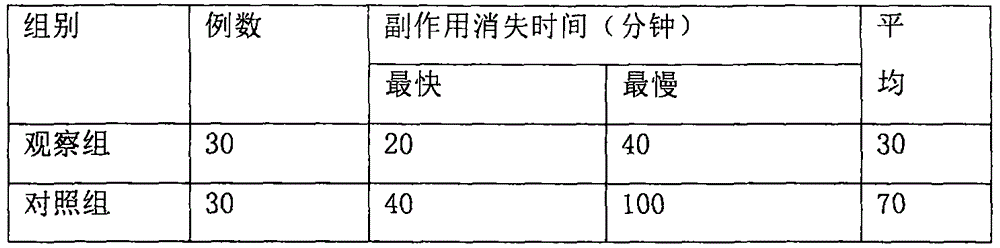
[0012] 1. Observation subjects A total of 60 cases were randomly divided into an observation group and a control group of 30 cases each. They were all patients after caesarean section. The anesthesia method used local infiltration anesthesia + ketamine, aged 23-36 years. Observation group patients began to take the Chinese medicine preparation for the treatment of nerve injury after anesthesia of the present invention when drug side effects occurred, and o...
the structure of the environmentally friendly knitted fabric provided by the present invention; figure 2 Flow chart of the yarn wrapping machine for environmentally friendly knitted fabrics and storage devices; image 3 Is the parameter map of the yarn covering machine
Login to View More
PUM
Login to View More
Abstract
The invention discloses Chinese herbal preparation for treating post-anesthesianerve injury, and belongs to the technical field of Chinese herbal medicine.According to traditional Chinese medicine theory, based on pathogenesis of post-anesthesianerve injury, the Chinese herbal preparation is made of stylophorum lasiocarpum, mucuna macrocarpa wallich, gynurbicolor root, begonia grandis root, wild grapes, ligustrum lucidum ait, chonemorpha megacalyx pierre, grossdentate clematis root, benzoin, honeylocust root peel, eria graminifolia lindl, stem of hyacinth dolichos, japanese peristropheherb, castor root, and semen brassicae.Through clinical practice, the Chinese herbal preparation has excellent effect.
Description
technical field [0001] The invention relates to the technical field of traditional Chinese medicine, in particular to a traditional Chinese medicine preparation for treating nerve injury after anesthesia. Background technique [0002] In clinical practice, anesthesia is often used in order to relieve pain and ensure patient safety during surgery or diagnostic inspection. According to the way anesthetics enter the human body, anesthesia is clinically divided into inhalation anesthesia, intravenous anesthesia and basic anesthesia; surgical methods include spinal anesthesia, nerve block anesthesia, regional anesthesia, local infiltration anesthesia and surface anesthesia, etc., these anesthesia The basic principle of the operation is the same, that is, to use anesthetics to anesthetize the patient's whole body or part of the nerves to achieve pain relief. Due to the limitations of anesthetics and the stimulation of surgical instruments during anesthesia, the current anesthesia...
Claims
the structure of the environmentally friendly knitted fabric provided by the present invention; figure 2 Flow chart of the yarn wrapping machine for environmentally friendly knitted fabrics and storage devices; image 3 Is the parameter map of the yarn covering machine
Login to View More
Application Information
Patent Timeline
Application Date:The date an application was filed.
Publication Date:The date a patent or application was officially published.
First Publication Date:The earliest publication date of a patent with the same application number.
Issue Date:Publication date of the patent grant document.
PCT Entry Date:The Entry date of PCT National Phase.
Estimated Expiry Date:The statutory expiry date of a patent right according to the Patent Law, and it is the longest term of protection that the patent right can achieve without the termination of the patent right due to other reasons(Term extension factor has been taken into account ).
Invalid Date:Actual expiry date is based on effective date or publication date of legal transaction data of invalid patent.

 Login to View More
  Login to View More