
Aquatic product culture water quality prediction method based on deep learning
A technology for water quality prediction and aquaculture, applied in neural learning methods, testing water, biological neural network models, etc., can solve problems that cannot satisfy complex nonlinearities
- Summary
- Abstract
- Description
- Claims
- Application Information
AI Technical Summary
Problems solved by technology
Method used
Image


Examples
Embodiment Construction
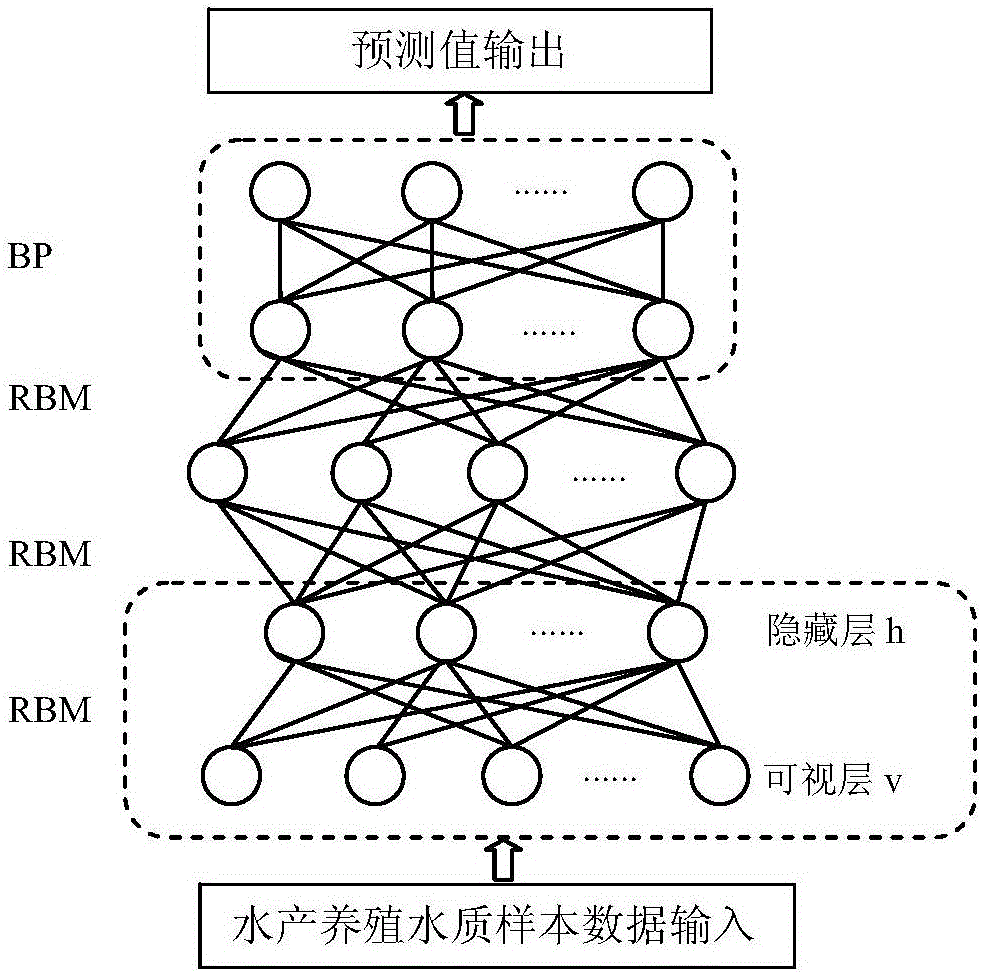
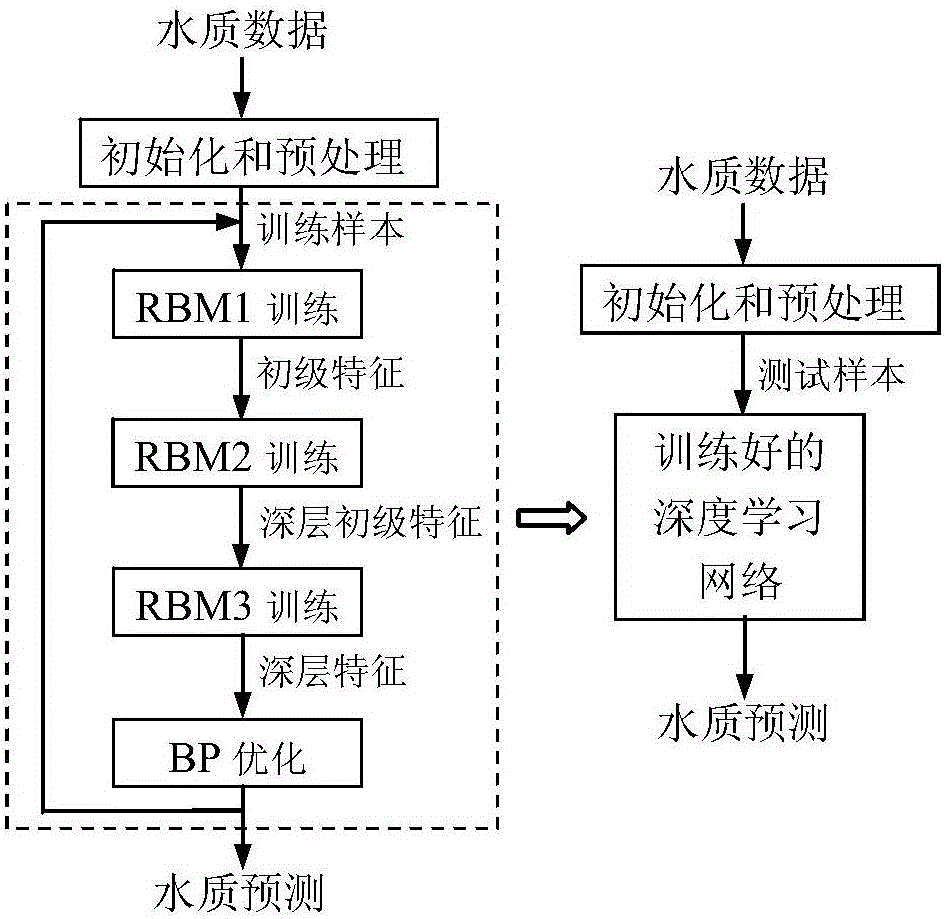
[0036] see figure 1 , figure 2 , the following embodiments illustrate the implementation process of the present invention from the two steps of training and prediction of specific examples.
[0037] (1) Training steps:
[0038] Step 1: Obtain water quality factors in aquaculture ponds through wireless sensor network nodes, including dissolved oxygen, pH, ammonia nitrogen, and temperature. Through the wireless transmission protocol, the data is transmitted to the server. The water quality evaluation data is obtained by using the water quality detector as the water quality marking data. At the same time, record the water depth, pond area, number of fish, and fish species of the pond on the server side. Use the above recorded data as training samples to train and study the deep learning network.
[0039] Step 2: Initialize the deep learning network. The input layer of the network (the visible layer of the first layer RBM) has 8 nodes, corresponding to the factor input in s...
PUM
 Login to View More
 Abstract
Description
Claims
Application Information
 Login to View More