
A kind of cold fresh pork nano fresh-keeping agent and its preparation method and fresh-keeping method
A preservative and nanotechnology, applied in the field of preparation technology of natural preservatives, can solve problems such as lack of technology, and achieve the effects of abundant resources, simple processing equipment and low cost
- Summary
- Abstract
- Description
- Claims
- Application Information
AI Technical Summary
Problems solved by technology
Method used
Image


Examples
Embodiment 1
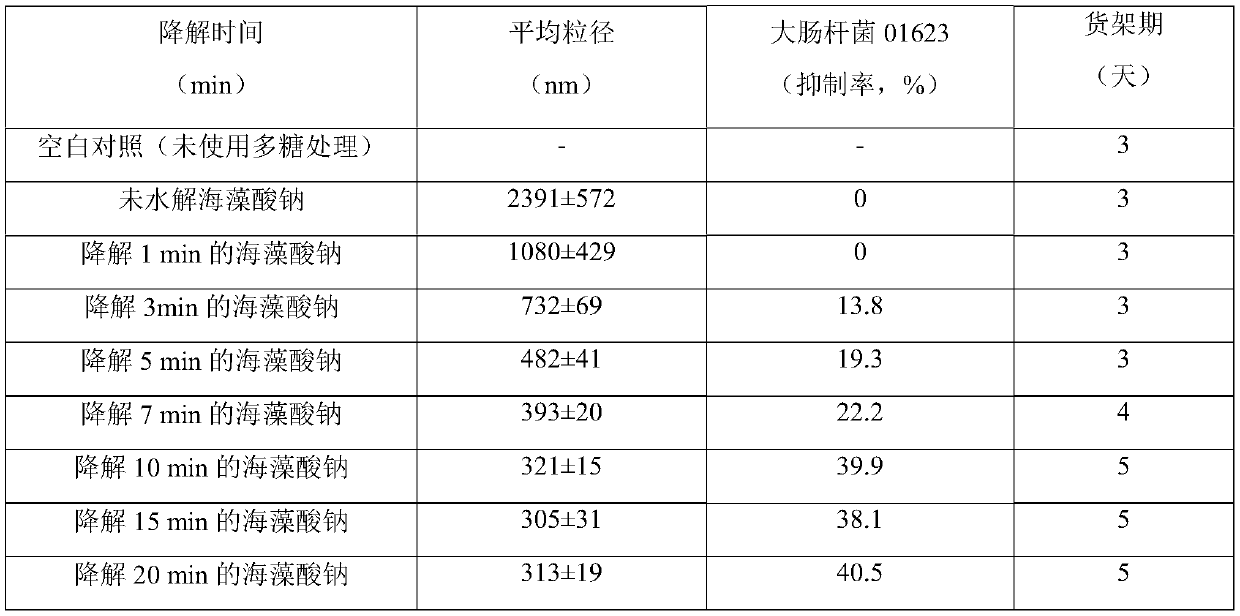
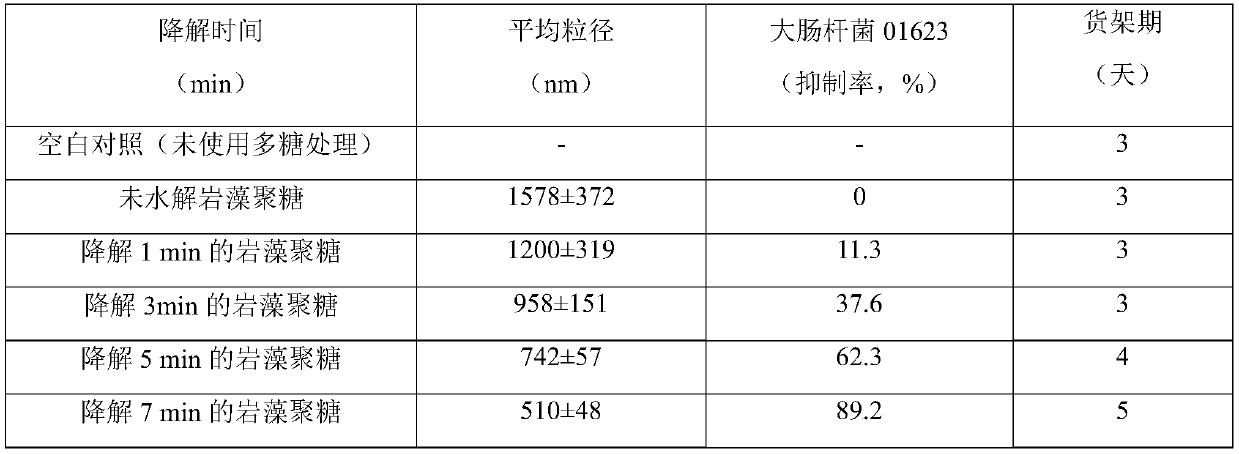
[0021] A nano-preservative for cold fresh pork, comprising mixing sodium alginate dry powder and fucoidan dry powder at a ratio of 80% by mass of sodium alginate dry powder and 20% by mass of fucoidan dry powder; then adding deionized water, The final concentration of the composite polysaccharide aqueous solution is 1.0% by mass; the above-mentioned composite polysaccharide aqueous solution is degraded in a high-pressure steam cooker with a temperature of 121°C and a pressure of 102.9kPa for 10min, and after cooling to room temperature, the composite polysaccharide nano-liquid is obtained, and the Malvern nanoparticle size is used. Instrument analysis showed that the average particle diameter of the composite polysaccharide was 350nm; the composite polysaccharide nano-liquid was spray-dried to obtain the dry powder of the cold-fresh pork nano-preservative.
[0022] To use, follow the steps below:
[0023] Step 1: dissolving the dry powder of the above-mentioned nano-preservati...
Embodiment 2
[0027] A nano-preservative for cold fresh pork, comprising mixing sodium alginate dry powder and fucoidan dry powder at a ratio of 90% by mass of sodium alginate dry powder and 10% by mass of fucoidan dry powder; then adding deionized water, The final concentration of the composite polysaccharide aqueous solution is 1.0% by mass; the above-mentioned composite polysaccharide aqueous solution is degraded in a high-pressure steam cooker with a temperature of 121°C and a pressure of 102.9kPa for 10min, and after cooling to room temperature, the composite polysaccharide nano-liquid is obtained, and the Malvern nanoparticle size is used. Instrument analysis showed that the average particle diameter of the composite polysaccharide was 350nm; the composite polysaccharide nano-liquid was spray-dried to obtain the dry powder of the cold-fresh pork nano-preservative.
[0028] To use, follow the steps below:
[0029] Step 1: dissolving the dry powder of the above-mentioned nano-preservati...
Embodiment 3
[0033] A nano-preservative for cold fresh pork, comprising mixing sodium alginate dry powder and fucoidan dry powder at a ratio of 95% by mass of sodium alginate dry powder and 5% by mass of fucoidan dry powder; then adding deionized water, The final concentration of the composite polysaccharide aqueous solution is 1.0% by mass; the above-mentioned composite polysaccharide aqueous solution is degraded in a high-pressure steam cooker with a temperature of 121°C and a pressure of 102.9kPa for 10min, and after cooling to room temperature, the composite polysaccharide nano-liquid is obtained, and the Malvern nanoparticle size is used. Instrument analysis showed that the average particle diameter of the composite polysaccharide was 350nm; the composite polysaccharide nano-liquid was spray-dried to obtain the dry powder of the cold-fresh pork nano-preservative.
[0034] To use, follow the steps below:
[0035] Step 1: dissolving the dry powder of the above-mentioned nano-preservativ...
PUM
 Login to View More
 Abstract
Description
Claims
Application Information
 Login to View More