
An artificial intelligence-based electromagnetic simulation method and its electromagnetic brain
A technology of electromagnetic simulation and artificial intelligence, applied in design optimization/simulation, biological neural network model, neural architecture, etc., to achieve high precision
- Summary
- Abstract
- Description
- Claims
- Application Information
AI Technical Summary
Problems solved by technology
Method used
Image

Examples
Embodiment Construction
[0028] The technology will be further described in detail below in conjunction with the accompanying drawings and examples of implementation.
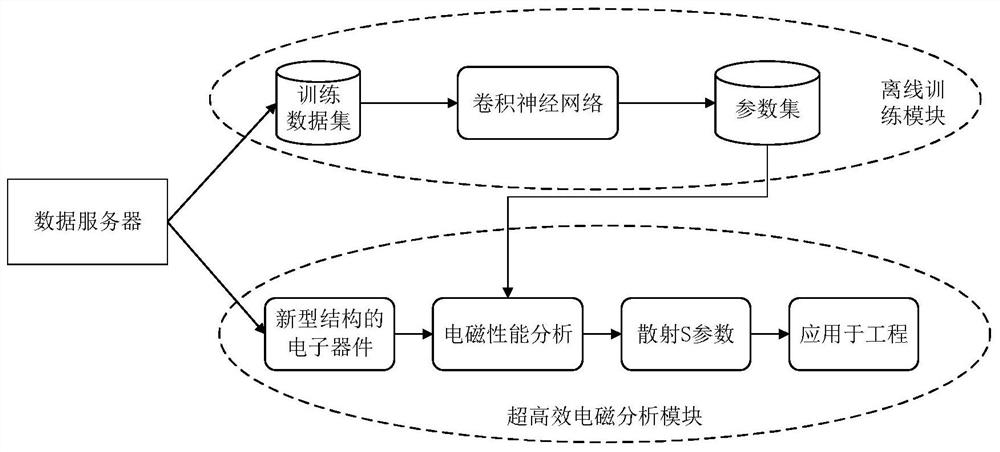
[0029] Such as figure 1 As shown, the artificial intelligence-based electromagnetic simulation system of the present invention includes: an offline training module and an ultra-efficient electromagnetic analysis module.
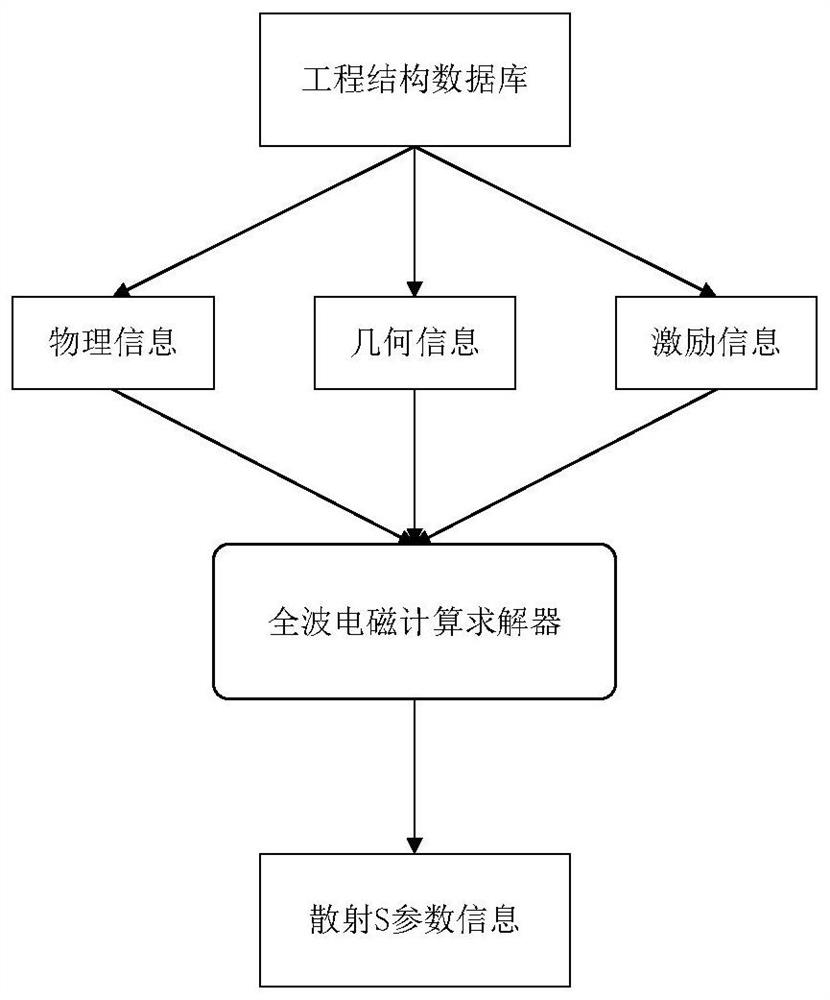
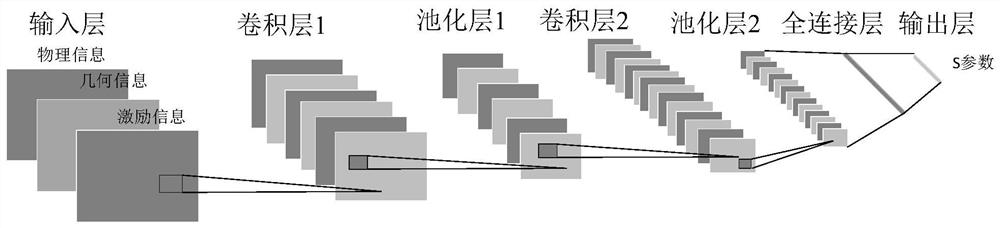
[0030] The offline training module imports the training data set obtained from the data server into the convolutional neural network for offline training. After training, the optimal set of weights and bias parameters of the neural network is saved to provide the scattering S parameters for predicting the new structure. . The training data set includes geometry, physics, excitation information data and scattering S-parameter data, where the scattering S-parameters are obtained by calculating the full-wave electromagnetic calculation solver through three types of data: geometry, physics, and excitation.
[0031] The ...
PUM
 Login to View More
 Abstract
Description
Claims
Application Information
 Login to View More