Finite element stiffness matrix simulation method based on GPU terminal

A stiffness matrix, simulation method technology, applied in special data processing applications, instruments, electrical digital data processing and other directions, can solve the problem of reducing the computational complexity of the conjugate gradient algorithm, reducing the threshold for accelerated computing, good portability, and good The effect of the acceleration strategy

CN109753682AActive Publication Date: 2019-05-14ZHEJIANG UNIV
6 Cites 2 Cited by

Patent Information

Authority / Receiving Office
CN · China
Patent Type
Applications(China)
Current Assignee / Owner
Publication Date
2019-05-14

Smart Images

  • Figure 1
    Figure 1
  • Figure 2
    Figure 2
  • Figure 3
    Figure 3
Patent Text Reader

Abstract

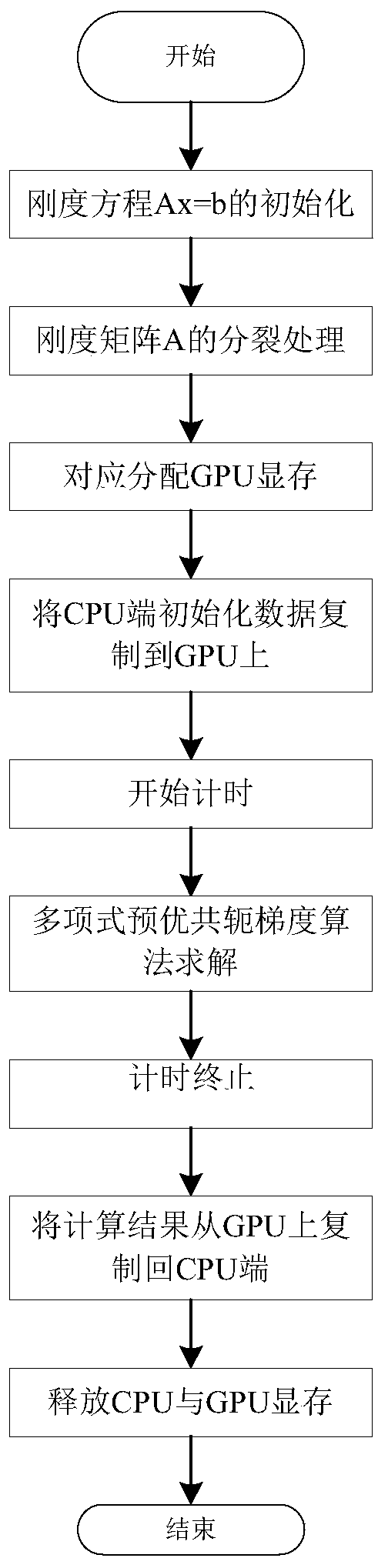
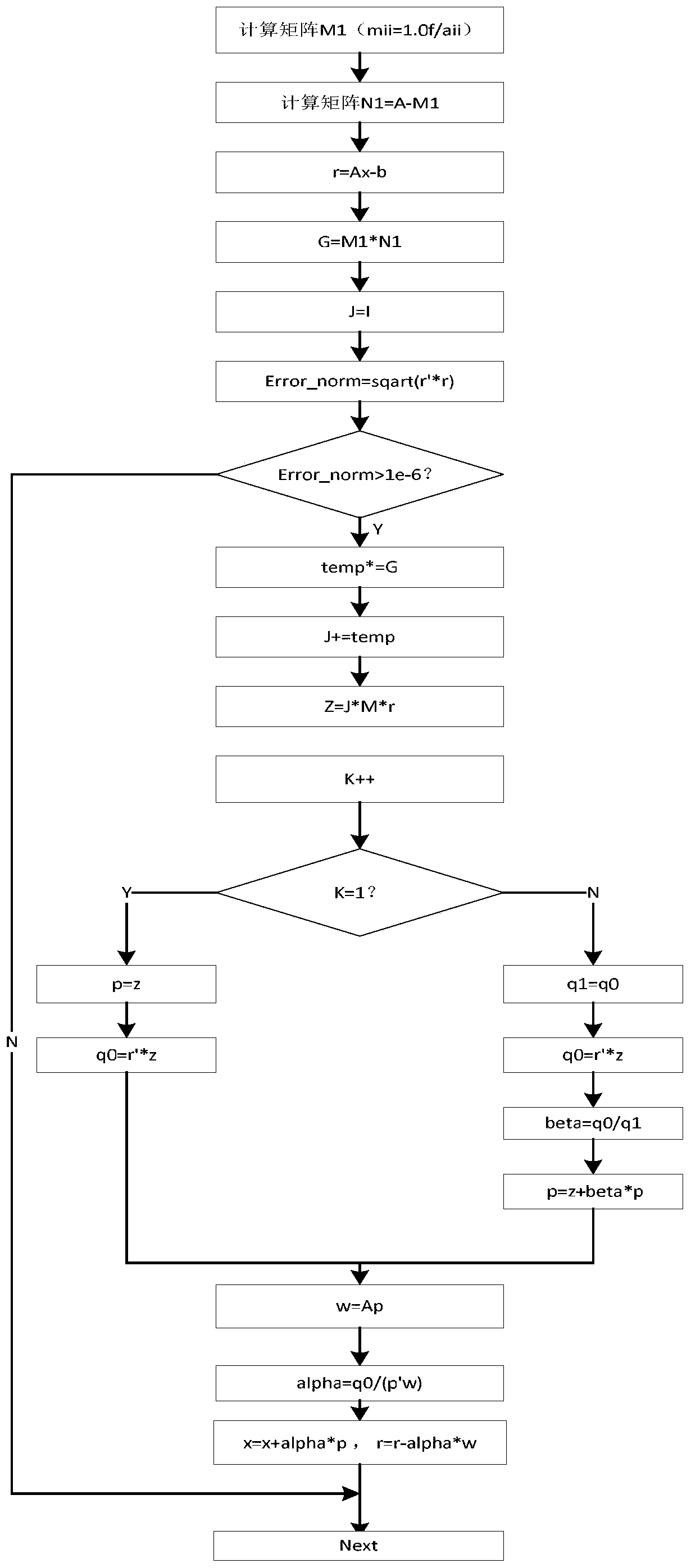
The invention provides a finite element stiffness matrix simulation method based on a GPU terminal. The method comprises: a stiffness equation Ax = b is established and initialized; splitting the stiffness matrix A; correspondingly allocating a GPU video memory; copying the initialized data of the CPU end to the GPU; calling a timing function to start timing; calling an equipment end polynomial pre-optimal conjugate gradient algorithm for calculation; copying the calculation result from the GPU to the CPU end; and releasing the CPU and the GPU video memory. The method is based on an NVIDIA CUBLAS library and a CUDA language. According to the method, the advantages of a diagonal pre-optimization preprocessing method are combined, the three-diagonal rigidity matrix is split well, inverse operation on the matrix is avoided, and therefore the operation amount of a conjugate gradient algorithm is greatly reduced, and polynomial preprocessing of the rigidity matrix is achieved on a GPU.
Need to check novelty before this filing date? Find Prior Art

Description

technical field

[0001] The invention belongs to the field of finite element numerical simulation calculation and computer application, and relates to the accelerated solution realization of pre-optimized finite element stiffness matrix. Background technique

[0002] There are more and more researches on the application of computer graphics processing unit (GPU) in general computing, especially in the field of large-scale science and computing. Because it was originally designed for graphics and image processing, GPU is inherently a computer with a large number of calculations. Unit's parallel processors, and the same computing power provided by the GPU, requires less cost and less power consumption than a CPU-based system.

[0003] As a basic method of numerical simulation and simulation, the finite element method has become one of the important methods of modern engineering design and structural analysis due to its high adaptability. It is widely used in many fields such a...

Examples

Embodiment Construction

[0046] First, some technical terms in the present invention are explained.

[0047] Computer Graphics Processing Unit (GPU): Graphics Processing Unit (English: Graphics Processing Unit, abbreviation: GPU), also known as display core, visual processor, display chip, is a special graphics processing unit in personal computers, workstations, game consoles and some mobile devices. Microprocessors that work on image calculations on devices (such as tablets, smartphones, etc.).

[0048]Central processing unit (CPU): The central processing unit (CPU, Central Processing Unit) is a very large-scale integrated circuit, which is the computing core (Core) and control core (Control Unit) of a computer. Its function is mainly to interpret computer instructions and process data in computer software.

[0049] Finite element method: The finite element method (finite element method) is a high-efficiency, commonly used numerical calculation method. In the field of scientific computing, it is o...