Novel three-dimensional cellular metamaterial with local tension-torsion coupling effect
A technology of coupling effects and metamaterials, applied in the direction of layered products, etc., can solve problems such as structural instability and damage
- Summary
- Abstract
- Description
- Claims
- Application Information
AI Technical Summary
Problems solved by technology
Method used
Image



Examples
Embodiment 1
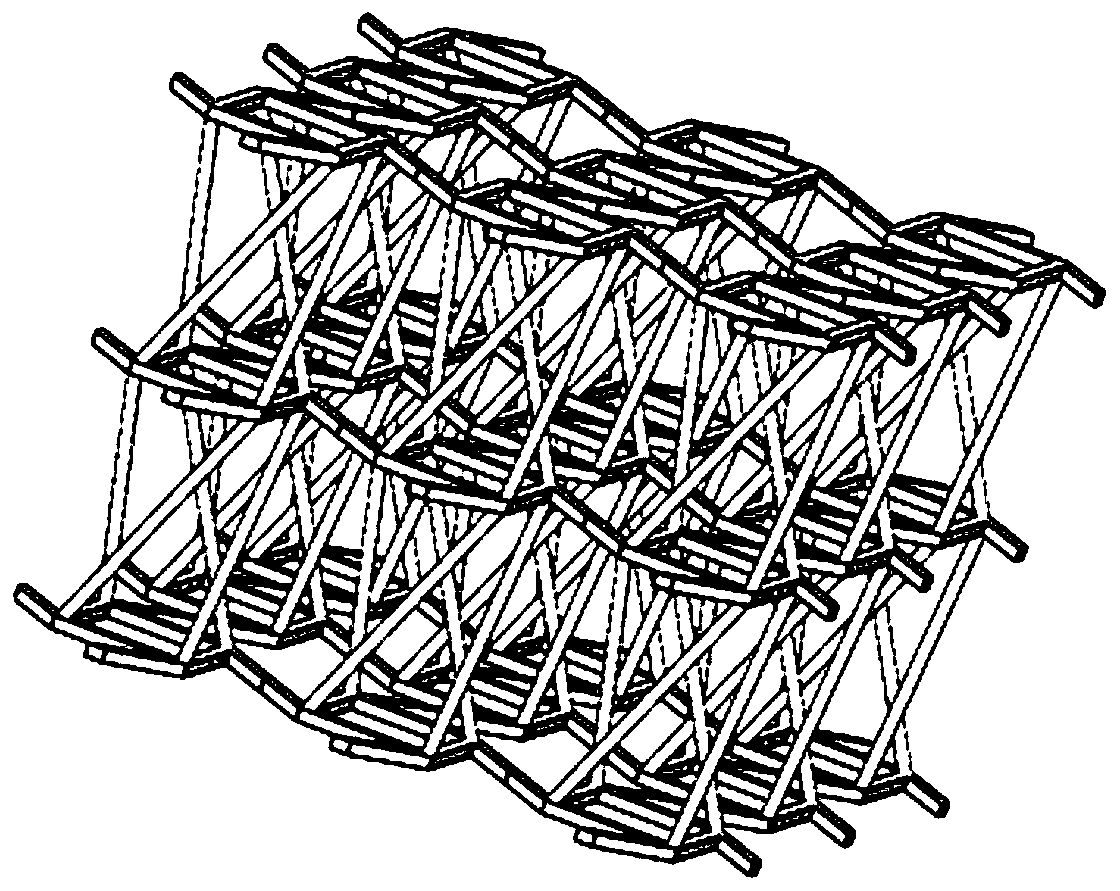
[0026] Such as figure 1 A new type of three-dimensional multicellular metamaterial with local tension-torsion coupling effect is shown, which is obtained from the three-dimensional structure of the unit cell through a spatial array. The straight bars that increase the slope between the rings are realized, and the three-dimensional structure of the unit cell (such as figure 2 ), two adjacent layers of identical four-ligament chiral honeycomb units are arranged in parallel and equidistantly, and the square rings of the chiral honeycomb units are aligned along the centroid, and the inclined straight rods connect the vertices of the aligned square rings in two adjacent layers , so as to form a three-dimensional space structure, in which four identical straight bars with inclined equal sections are connected between each square ring. These four straight rods form a group and form a rotation direction, and the rotation direction formed by each group of straight rods is exactly the...
Embodiment 2
[0029] Referring to Example 1, the difference is that the four-ligament chiral honeycomb unit can be replaced by a three-ligament chiral honeycomb unit (such as image 3 ), correspondingly, the square ring is replaced by a triangular ring or a hexagonal ring, and the number of inclined straight rods connected between layers is replaced by three. In the three-dimensional structure of the unit cell, two adjacent layers of completely identical triligament chiral honeycomb units are arranged in parallel and equidistantly, and the triangular rings of the chiral honeycomb units are aligned along the centroid, and the inclined straight rods align the triangles of the adjacent two layers The vertices of the rings are connected in pairs to form a three-dimensional space structure, in which three identical straight bars with inclined equal sections are connected between each pair of triangular rings. These three straight rods form a group and form a rotation direction, and the rotation ...
Embodiment 3
[0031] Referring to Example 1, the difference is that the four-ligament chiral honeycomb unit is replaced by a six-ligament chiral honeycomb unit (such as Figure 4 ), the corresponding place ring is replaced by a hexagonal ring, and the number of inclined straight rods connected between layers is replaced by six. In the unit cell three-dimensional structure, two adjacent layers of completely identical six-ligament chiral honeycomb units are arranged in parallel and equidistantly, and the hexagonal rings of the chiral honeycomb units are aligned along the centroid, and the inclined straight rods align the two adjacent layers. The vertices of the hexagonal rings are connected in pairs to form a three-dimensional space structure, in which six identical straight rods with inclined and equal cross-sections are connected between each pair of hexagonal rings. These six straight rods form a group and form a rotation direction, and the rotation direction formed by each group of straig...
PUM
| Property | Measurement | Unit |
|---|---|---|
| Elastic modulus | aaaaa | aaaaa |
Abstract
Description
Claims
Application Information
 Login to View More
PatSnap Eureka turns technology decisions into work you can execute. Powered by our Innovation Knowledge Graph, it runs expert workflows across engineering, life sciences, materials and intellectual property. Get your review-ready output in minutes.


