Three-level traction inverter control method through consideration of potential balance and harmonic suppression,

A technology of three-level inverters and traction inverters, which is applied to electrical components, output power conversion devices, and conversion of AC power input to DC power output. It can solve problems such as non-convergence and dependence on initial value selection. Achieve the effects of reducing the amplitude of midpoint potential fluctuations, increasing control costs, and improving dynamic and steady-state performance

CN109980971AActive Publication Date: 2019-07-05TONGJI UNIV
6 Cites 4 Cited by

Patent Information

Authority / Receiving Office
CN · China
Patent Type
Applications(China)
Current Assignee / Owner
Publication Date
2019-07-05

Smart Images

  • Figure 1
    Figure 1
  • Figure 2
    Figure 2
  • Figure 3
    Figure 3
Patent Text Reader

Abstract

The invention relates to a three-level traction inverter control method through consideration of potential balance and harmonic suppression. The method comprises the following steps of: 1) constructing a mathematical model of a three-level inverter according to the working state of the three-level inverter; 2) calculating the output harmonic distortion rate of the three-level inverter; 3) calculating the potential fluctuation of the middle point of the three-level inverter; 4) establishing constraint conditions by adopting a penalty function method, and constructing a multi-objective optimization model according to the harmonic distortion rate and potential fluctuation of the middle point; and 5) and solving the multi-objective optimization model by adopting a PSO algorithm to finally obtain an optimal switching angle sequence. Compared with the prior art, the method has high applicability, practicability, safety and the like.
Need to check novelty before this filing date? Find Prior Art

Description

technical field

[0001] The invention relates to the field of three-level traction inverter control, in particular to a three-level traction inverter control method considering potential balance and harmonic suppression. Background technique

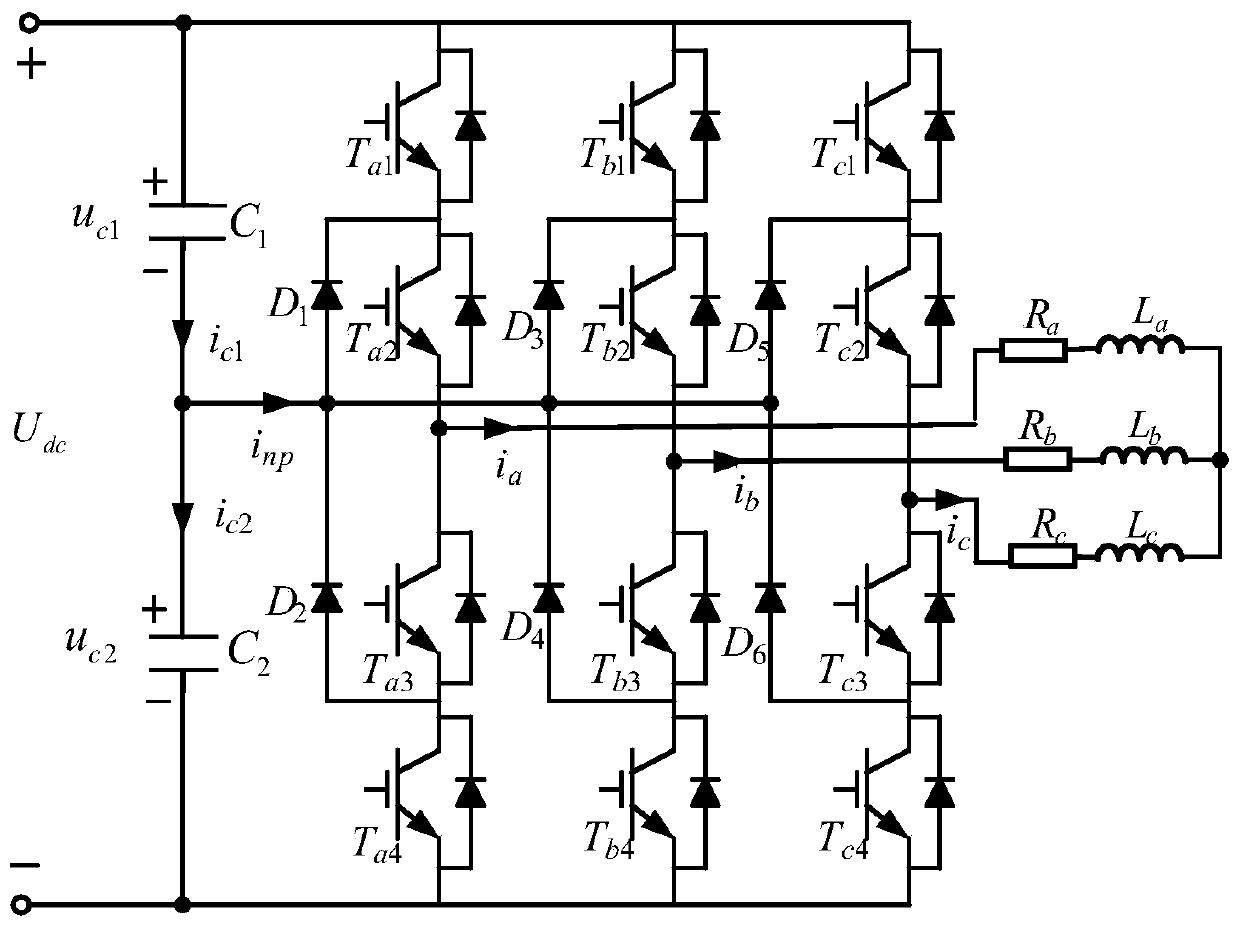
[0002] Compared with the two-level topology, the diode-clamped three-level traction inverter has been widely used in high-speed EMUs due to its advantages of flexible control, high output voltage level, and low output harmonic content, and is gradually being used in Attention has been paid to the application of subway vehicles. However, due to the characteristics of its own topological structure, when this type of inverter is working, there will be an imbalance in the voltage of the upper and lower voltage dividing capacitors on the DC side, resulting in fluctuations in the midpoint potential, which will cause distortion of the output voltage and increase in harmonic content, seriously affect the performance of the inverter. Therefore...

Examples

Embodiment

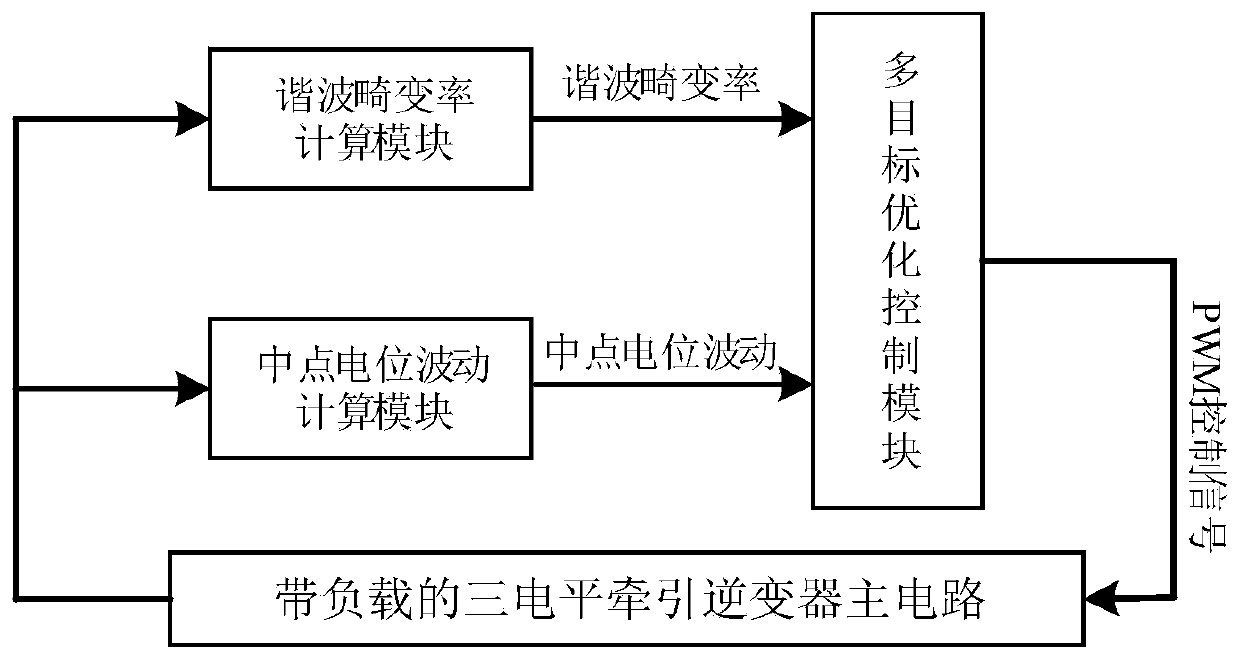
[0049] like figure 1 As shown, this example mentions an optimal control system for a three-level traction inverter that takes into account both midpoint potential balance control and harmonic suppression. The system mainly includes: the main circuit of the three-level traction inverter with load, Harmonic distortion rate calculation module, midpoint potential fluctuation calculation module, multi-objective optimization control module. The output end of the main circuit of the inverter is connected to the harmonic distortion rate calculation module and the midpoint potential fluctuation calculation module, and outputs the switching time angle sequence in real time. The harmonic distortion rate calculation module and the midpoint potential fluctuation calculation module controller calculate the corresponding harmonic distortion rate and midpoint potential fluctuation in real time, and input them to the multi-objective optimization control module. The multi-objective optimizatio...