Low-dose CT imaging method, device and system based on deep dense network

A CT imaging and low-dose technology, applied in the field of devices and systems, CT imaging, and low-dose CT imaging methods, can solve problems such as high noise, low processing dose, inability to distinguish star-streaked artifacts and organ tissue details, etc.

CN110009613AInactive Publication Date: 2019-07-12SOUTHEAST UNIV
5 Cites 5 Cited by

Patent Information

Authority / Receiving Office
CN · China
Patent Type
Applications(China)
Current Assignee / Owner
Publication Date
2019-07-12
Estimated Expiration
Not applicable · inactive patent

Smart Images

  • Figure 1
    Figure 1
  • Figure 2
    Figure 2
  • Figure 3
    Figure 3
Patent Text Reader

Abstract

The invention provides a low-dose CT imaging method, device and system based on a deep dense network. A deep dense network DenseNet is innovatively applied to two processing methods of projection space pre-processing and image space post-processing, and the convolutional residual neural network is utilized to fully understand the information of CT image data and CT projection data. According to the method, the difference between star-strip-shaped artifacts and human tissues and organs is effectively distinguished through full utilization of the image features by the DenseNet, and the star-strip-shaped artifacts, noise and tissue and organ feature structure components are effectively separated, so that the image quality is greatly improved. Compared with other networks with the same scale,the DenseNet has the advantages that the parameter quantity is reduced to a certain extent, so that the requirement of the storage space is greatly reduced. The operation speed is remarkably improved,and the processing effect is superior to that of other traditional image denoising algorithms and deep learning methods.
Need to check novelty before this filing date? Find Prior Art

Description

technical field

[0001] The invention belongs to the technical field of computer tomography and relates to CT imaging technology, in particular to a low-dose CT imaging method, device and system based on a deep dense network. Background technique

[0002] X-ray computer tomography (X-ray Computer Tomography, CT) technology is an imaging technology that obtains accurate and non-destructive cross-sectional ray attenuation information through X-ray projection measurement of the human body. It is currently the most widely used routine and effective clinical medical diagnosis. One of the tools, it can provide detailed and rich human organ tissue information for clinicians' detection and diagnosis, and has become an indispensable inspection and diagnosis method in the field of medical imaging. However, with the popularity of CT tomography in clinical diagnosis, especially in routine examination, the radiation dose in CT scanning has gradually attracted people's attention. A large ...

Examples

Embodiment Construction

[0047] The technical solutions provided by the present invention will be described in detail below in conjunction with specific examples. It should be understood that the following specific embodiments are only used to illustrate the present invention and are not intended to limit the scope of the present invention.

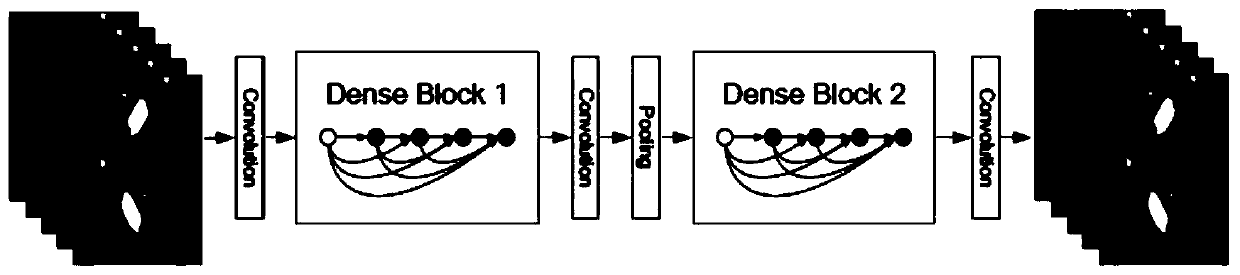
[0048] Such as figure 1 As shown, a low-dose CT imaging method based on a deep dense network disclosed in the embodiment of the present invention utilizes the powerful feature representation capability of DenseNet and the fast computing capability of low parameter quantity and low storage space, and is applied to projection space preprocessing and image processing. Spatial postprocessing in two tasks. Specifically include the following steps:

[0049] Step 1. Acquisition and preprocessing of projection space data: simulate and obtain multiple sets of corresponding low-dose CT projection data P ld and normal dose CT projection data P hd (both are three-dimensio...