Check patentability & draft patents in minutes with Patsnap Eureka AI!

A method for realizing complete debromination of polybrominated aromatic compounds by photoreduction

A technology of aromatic compounds and bromination, applied in the field of photochemical synthesis, can solve problems such as strong toxicity

Active Publication Date: 2020-11-24
INST OF CHEM CHINESE ACAD OF SCI +1
View PDF2 Cites 0 Cited by
  • Summary
  • Abstract
  • Description
  • Claims
  • Application Information

AI Technical Summary

Problems solved by technology

However, certain low-brominated aromatic compounds are more toxic than their parent compounds, and therefore, there is an urgent need for degradation methods for polybrominated aromatic compounds that avoid the production of these toxic intermediates

Method used

the structure of the environmentally friendly knitted fabric provided by the present invention; figure 2 Flow chart of the yarn wrapping machine for environmentally friendly knitted fabrics and storage devices; image 3 Is the parameter map of the yarn covering machine
View more

Image

Smart Image Click on the blue labels to locate them in the text.
Viewing Examples
Smart Image
  • A method for realizing complete debromination of polybrominated aromatic compounds by photoreduction
  • A method for realizing complete debromination of polybrominated aromatic compounds by photoreduction
  • A method for realizing complete debromination of polybrominated aromatic compounds by photoreduction

Examples

Experimental program
Comparison scheme
Effect test

Embodiment 1

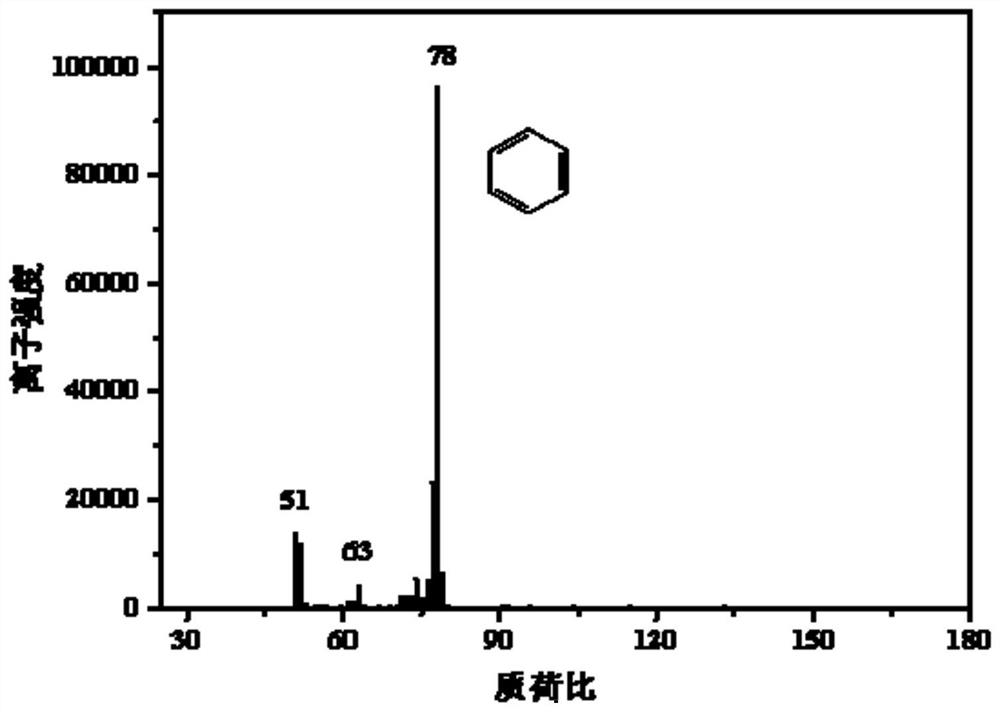
[0040] Add N,N-dimethylacetamide:hexabromobenzene in a molar ratio of 50:1 into the photochemical reactor filled with acetonitrile solvent. Then, the photoreactor was sealed, and the solution was ultrasonically mixed for 10 minutes, and the photochemical reactor was deoxygenated with high-purity argon, and stirred while deoxygenating. After deoxygenation was completed, the reaction was stopped after continuing to stir under the same conditions and irradiating with ultraviolet light for 2 hours. The main product of the reaction is benzene.

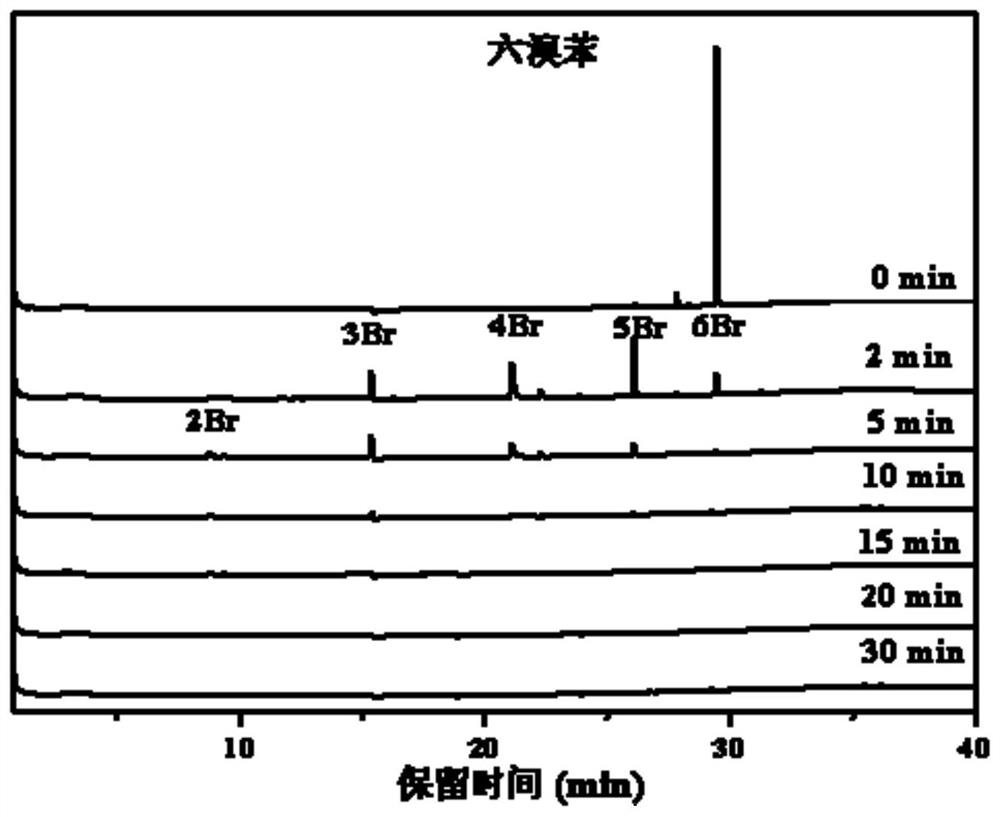
[0041] GC-μECD was used to detect the degradation products of hexabromobenzene (HBB) at different irradiation times, such as figure 1 As shown in the figure, it can be seen from the figure that with the illumination, a large amount of pentabromobenzene, tetrabromobenzene and tribromobenzene appeared in the gas spectrum detection in two minutes, and in five minutes, hexabromobenzene was completely transformed, and dibromobenzene appeared B...

Embodiment 2

[0044] Add N,N-dimethylaniline:decabromobiphenyl in a molar ratio of 50:1 into the photochemical reactor filled with acetonitrile solvent. Then, the photoreactor was sealed, and the solution was ultrasonically mixed for 10 minutes, and the photochemical reactor was deoxygenated with high-purity argon, and stirred while deoxygenating. After the deoxygenation is completed, continue to stir under the same conditions and stop the reaction after irradiating with ultraviolet light for 4 hours. The main product of the reaction is biphenyl.

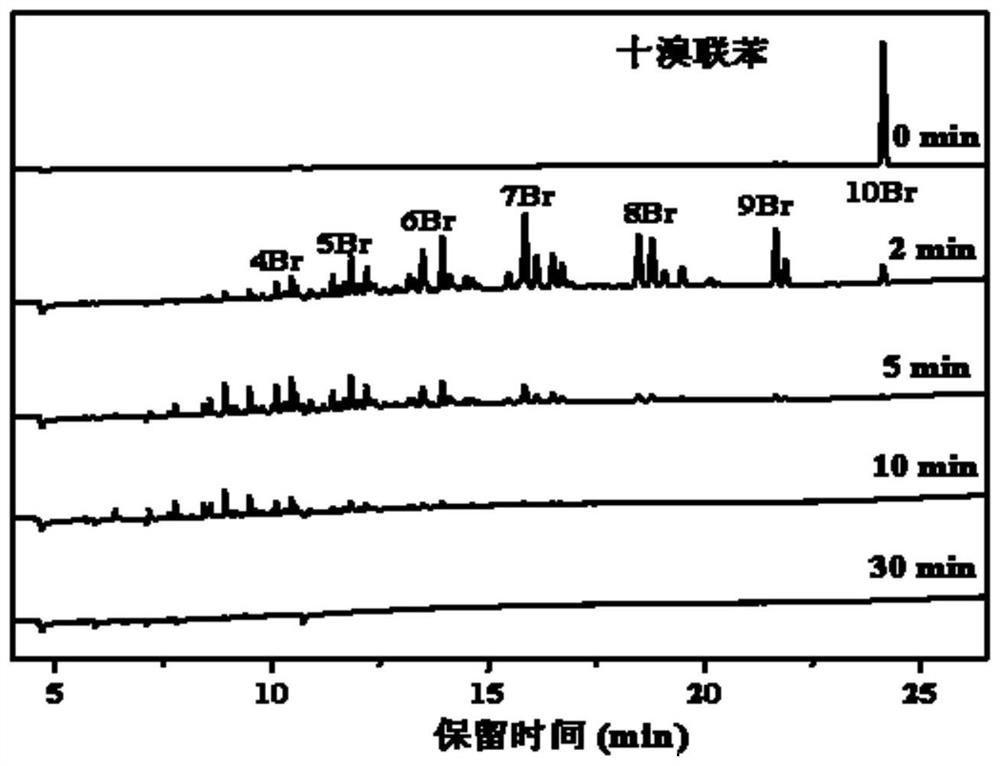
[0045] GC-μECD was used to detect the degradation products of decabromobiphenyl (DBB) at different irradiation times, such as image 3 As shown, it can be seen from the figure that as the light is carried out, in two minutes, decabromobiphenyl is converted in a large amount to generate a series of low brominated products (4-9 bromine). Continue to illuminate, and the low-brominated products continue to be converted. In five minutes, the decabro...

Embodiment 3

[0048] Add N,N,N',N'-tetramethyl-p-phenylenediamine:tetrabromodiphenyl ether in a molar ratio of 50:1 into a photochemical reactor filled with methanol solvent. Then, the photoreactor was sealed, and the solution was ultrasonically mixed for 10 minutes, and the photochemical reactor was deoxygenated with high-purity argon, and stirred while deoxygenating. After deoxygenation, continue to stir under the same conditions and stop the reaction after irradiating with visible light for 4 hours. The main product of the reaction is biphenyl. The conversion rate of the reactant tetrabromodiphenyl ether is 100%, and the yield of diphenyl ether is 48%.

the structure of the environmentally friendly knitted fabric provided by the present invention; figure 2 Flow chart of the yarn wrapping machine for environmentally friendly knitted fabrics and storage devices; image 3 Is the parameter map of the yarn covering machine
Login to View More

PUM

No PUM Login to View More

Abstract

The invention provides a debromination method of a polybrominated aromatic compound. The debromination method comprises the following steps of mixing the polybrominated aromatic compound and a photoreductant, and reacting under the light radiation condition, so as to obtain the completely debrominated aromatic compound. The polybrominated aromatic compound is selected from the compound of which the site is substituted by at least one bromine and other sites are not substituted and / or are substituted by inert groups, such as the compound which is substituted by 10 bromines, namely the compoundwhich is substituted by 1, 2, 3, 4, 5, 6, 7, 8, 9 or 10 bromines. The debromination method has the advantages that the reaction condition is mild, the operation is simple, the reaction efficiency is high, the production of toxic intermediate with higher toxicity can be effectively avoided, and the complete debromination of the polybrominated aromatic compound is realized.

Description

technical field [0001] The invention belongs to the technical field of photochemical synthesis, and in particular relates to a method for realizing complete debromination of polybrominated aromatic compounds by photoreduction. Background technique [0002] Polybrominated aromatic compounds are stable in chemical properties, easy to accumulate in organisms, and have "carcinogenic, teratogenic, and mutagenic" effects. Once discharged into the environment, they are difficult to be degraded and can spread to humans in the food chain, posing a great threat. Reductive debromination is a common way to deal with polybrominated aromatic compounds. In the reported reduction system, the reduction of polybrominated aromatic compounds follows a step-by-step debromination process. The reduction of aromatic compounds is more difficult, and the reaction usually generates low-brominated aromatic compounds. However, some low-brominated aromatic compounds are more toxic than their parent comp...

Claims

the structure of the environmentally friendly knitted fabric provided by the present invention; figure 2 Flow chart of the yarn wrapping machine for environmentally friendly knitted fabrics and storage devices; image 3 Is the parameter map of the yarn covering machine
Login to View More

Application Information

Patent Timeline
no application Login to View More
Patent Type & Authority Patents(China)
IPC IPC(8): C07C1/26C07C15/04C07C15/14C07C41/24C07C43/275
CPCC07C1/26C07C41/24C07C15/04C07C15/14C07C43/275
Inventor 赵进才魏燕朱倩宋文静籍宏伟陈春城马万红
Owner INST OF CHEM CHINESE ACAD OF SCI
Features
  • R&D
  • Intellectual Property
  • Life Sciences
  • Materials
  • Tech Scout
Why Patsnap Eureka
  • Unparalleled Data Quality
  • Higher Quality Content
  • 60% Fewer Hallucinations
Social media
Patsnap Eureka Blog
Learn More