

Anti-wild lysobacter drug and application thereof
The invention relates to a technology of wild Rongbacillus and medicine, which is applied to the antibacterial Rongbacillus wilde and its application field, can solve the problems of red blood cell membrane rupture, low antibacterial activity, poor stability and the like, and achieves the effect of improving antibacterial activity and enhancing antibacterial effect.
- Summary
- Abstract
- Description
- Claims
- Application Information
AI Technical Summary
Problems solved by technology
Method used
Image

Examples
Embodiment Construction
[0016] In order to make the object, technical solution and advantages of the present invention more clear, the present invention will be further described in detail below in conjunction with the examples. It should be understood that the specific embodiments described here are only used to explain the present invention, not to limit the present invention.
[0017] Aiming at the problems existing in the prior art, the present invention provides a drug and its application against wild roebacteria. The present invention will be described in detail below in conjunction with the accompanying drawings.
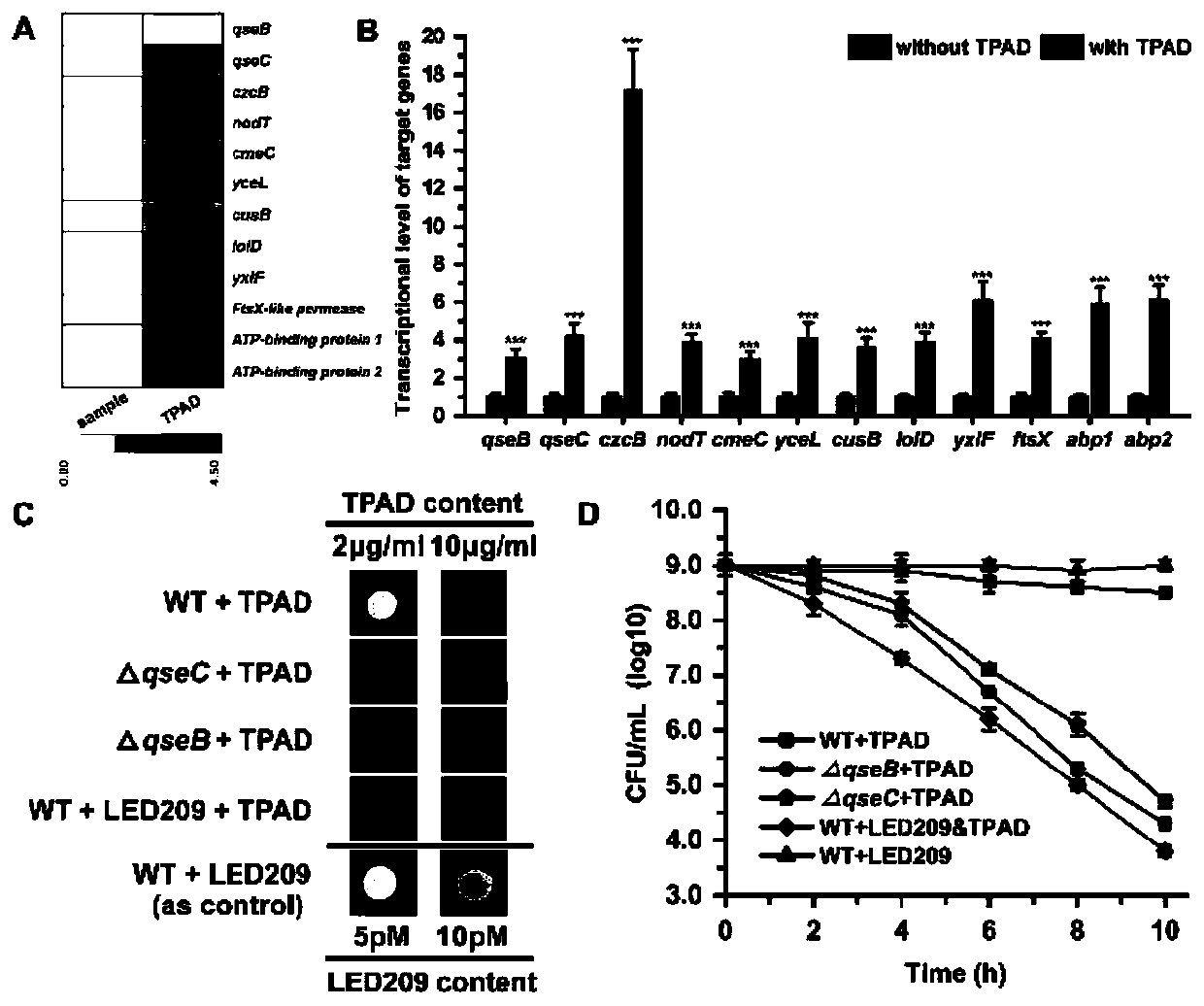
[0018] The anti-Wildrobacter bacterium drug provided in the embodiment of the present invention is 2 μg / mL TPAD and 5pM LED209.
[0019] In the present invention, 2μg / mL TPAD and 5pM LED209 are used in combination, which can completely kill wild Rongella. The combination of TPAD and LED209 can inhibit Pseudoalteromonas which is resistant to multiple antibiotics. The combination of...
PUM
 Login to View More
 Abstract
Description
Claims
Application Information
 Login to View More