Generative adversarial network oversampling method and device based on simulated annealing genetic algorithm

A technology of simulated annealing and genetic algorithm, applied in the field of generative adversarial network oversampling methods and devices, can solve the problems of limited number of samples, unstable training, hindering good training of GAN, etc., to solve the imbalance problem and overcome limitations.

CN111401528APending Publication Date: 2020-07-10SUN YAT SEN UNIV
0 Cites 2 Cited by

Patent Information

Authority / Receiving Office
CN · China
Current Assignee / Owner
Publication Date
2020-07-10

Smart Images

  • Figure 1
    Figure 1
  • Figure 2
    Figure 2
  • Figure 3
    Figure 3
Patent Text Reader

Abstract

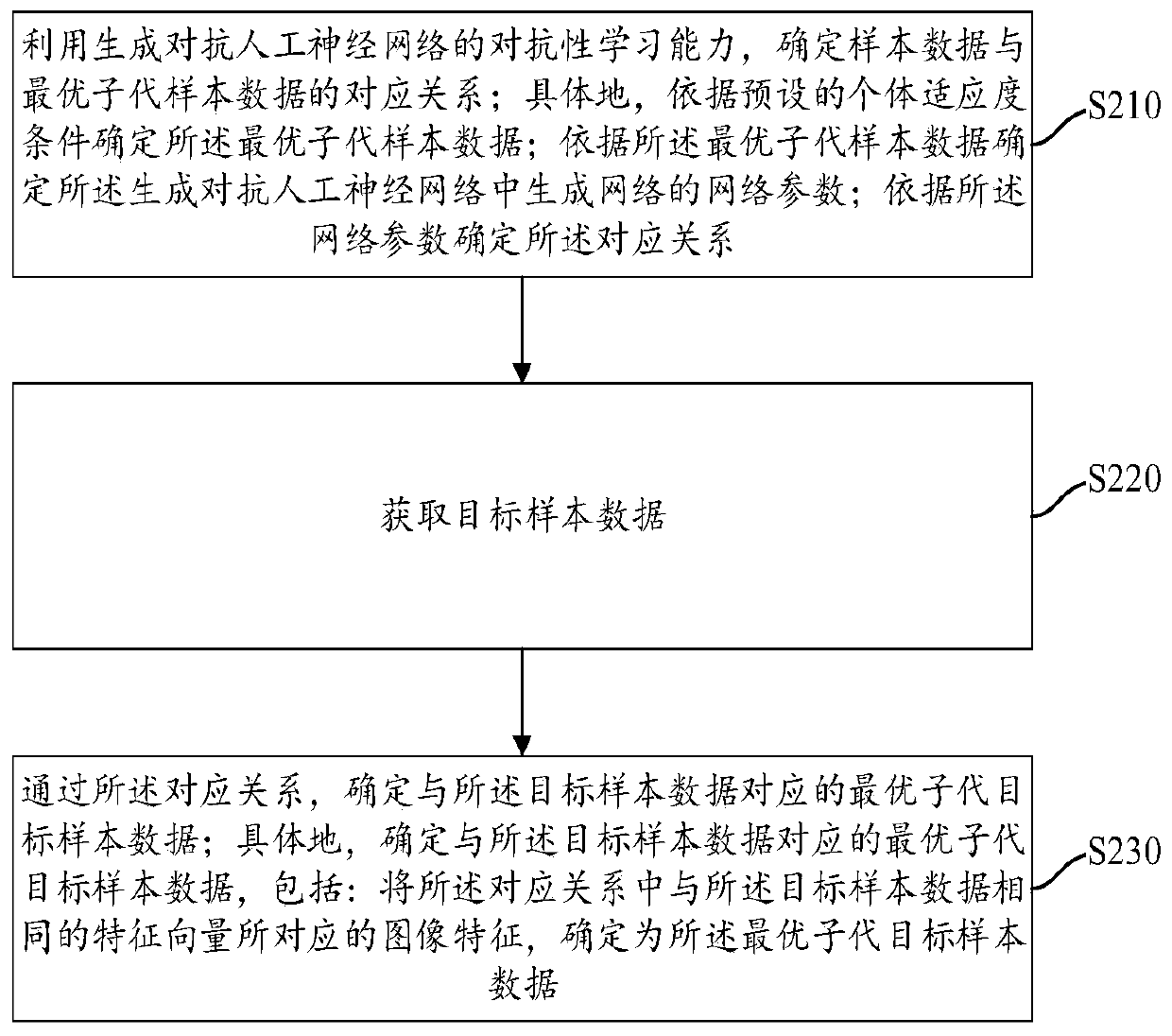
The invention provides a generative adversarial network oversampling method and device based on a simulated annealing genetic algorithm, and the method comprises the steps: determining the corresponding relation between sample data and optimal filial generation sample data through the adversarial learning capability of a generative adversarial artificial neural network; specifically, determining the optimal filial generation sample data according to a preset individual fitness condition; determining network parameters of a generative adversarial artificial neural network according to the optimal filial generation sample data; determining the corresponding relation according to the network parameters; acquiring target sample data; and determining optimal filial generation target sample datacorresponding to the target sample data through the corresponding relationship. A plurality of adversarial learning targets are used simultaneously to train a generative network, so the limitation ofa single adversarial learning target is overcome; whether the generative network is updated or not is selected by using a simulated annealing algorithm, so the model is prevented from falling into alocal optimal solution, and the model is converged to global optimum.
Need to check novelty before this filing date? Find Prior Art

Description

technical field

[0001] The present application relates to the field of medical detection, in particular to an oversampling method and device for a generative adversarial network based on a simulated annealing genetic algorithm. Background technique

[0002] The class imbalance problem exists widely in machine learning applications. The performance of many standard classifiers degrades significantly when the data used for classification suffers from class imbalance. This is because most classification algorithms assume a balanced distribution of training data, applying the same misclassification cost to data of different classes. When the data is imbalanced, the key to improving the data performance of the classifier is to accurately capture the distribution of the minority class data. However, learning an accurate distribution from very few examples of the minority class is difficult.

[0003] A common method to solve the problem of class imbalance is to increase the samp...

Examples

Embodiment Construction

[0060] In order to make the purpose, features and advantages of the present application more obvious and understandable, the present application will be further described in detail below in conjunction with the accompanying drawings and specific implementation methods. Apparently, the described embodiments are some of the embodiments of the present application, but not all of them. Based on the embodiments in this application, all other embodiments obtained by persons of ordinary skill in the art without creative efforts fall within the protection scope of this application.

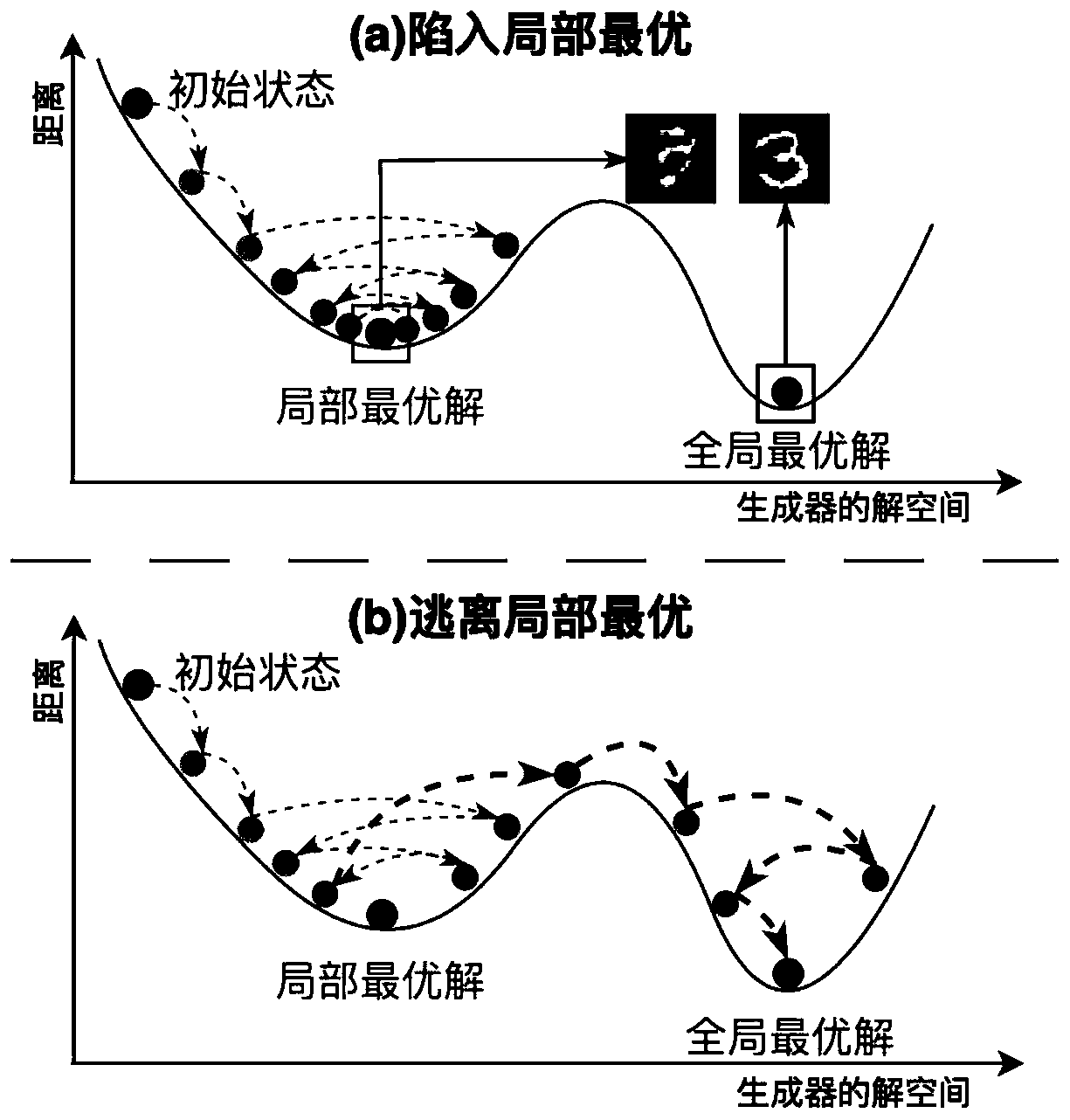
[0061] refer to figure 1 , it should be noted that, in any embodiment of the present invention, the method disclosed in the present invention is applied to the sample processing of the minority class. Due to the limited number of samples of the minority class, the existing GAN model may only learn part of the minority class distribution, and thus may fall into local optima, such as figure 1 As shown in ...