Method for reducing ds DNA fragment tandems in CRISPR-Cas9 gene editing, and application thereof
What is AI technical title?
AI technical title is built by Patsnap AI team. It summarizes the technical point description of the patent document.
A technology of gene editing and fragmentation, which is applied in the field of genetic engineering and can solve problems such as affecting the accuracy of the technology, reducing cascading methods, and gene targeting failure
Active Publication Date: 2020-09-11
GEMPHARMATECH CO LTD
View PDF0 Cites 0 Cited by
Summary
Abstract
Description
Claims
Application Information
AI Technical Summary
This helps you quickly interpret patents by identifying the three key elements:
Problems solved by technology
Method used
Benefits of technology
Problems solved by technology
In most cases, traditional PCR analysis failed to identify these multiple integration events, which seriously affected the precision of the technique (see Skryabin BV, et al. Pervasive head-to-tail insertions of DNA templates mask desired CRISPR -Cas9-mediated genome editing events. Sci Adv. 2020;6(7):eaax2941.)
In the field, Southern, qPCR, PCR and other methods are usually used to detect whether there is tandem, but there is no effective method to reduce tandem
Method used
the structure of the environmentally friendly knitted fabric provided by the present invention; figure 2 Flow chart of the yarn wrapping machine for environmentally friendly knitted fabrics and storage devices; image 3 Is the parameter map of the yarn covering machine
View more
Image
Smart Image Click on the blue labels to locate them in the text.
Viewing Examples
Smart Image
Click on the blue label to locate the original text in one second.
Reading with bidirectional positioning of images and text.
Smart Image
Examples
Experimental program
Comparison scheme
Effect test
Embodiment 1
[0057] In this example, a method for reducing the concatenation of double-stranded DNA fragments in CRISPR-Cas9 gene editing is provided.
[0058] (1) Construction of dsDNA
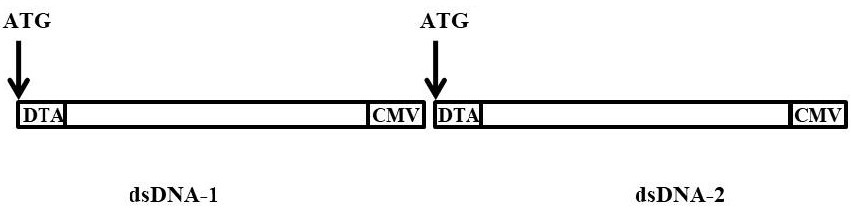
[0059] The schematic diagram of the structure of the dsDNA constructed in this example is as follows figure 1 shown;
[0060] Put DTA forward at the 5' end of dsDNA, CMV forward at the 3' end of dsDNA, and both ends of the dsDNA fragment contain EcoRV restriction sites;
[0061] Construct the designed sequence on the plasmid (Plasmid) vector, and use EcoRV to digest and purify to obtain dsDNA;
[0062] Among them, the enzymedigestionsystem is EcoRV 3 μL, plasmid 25 μL (concentration is 2 μg / μL), Buffer smart 10 μL, ddH 2 Make up to 100 μL with O;
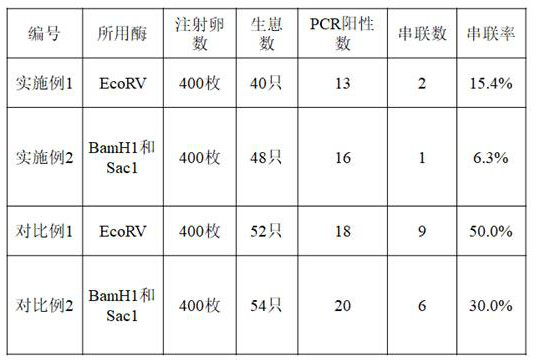
[0080] In this example, DTA is placed forward at the 5' end of dsDNA, and CMV is placed forward at the 3' end of dsDNA. At the same time, both ends of the dsDNA fragment contain restriction sites for BamH1 and Sac1, and the designed sequence is constructed on the plasmid The vector was digested with BamH1 and Sac1 and purified to obtain dsDNA.
[0081] The digestion system is: BamH1 3 μL, Sac1 3 μL, plasmid 25 μL (concentration is 2 μg / μL), Buffer smart10 μL, ddH 2 Make up O to 100 μL; enzyme digestion process: time 8 h; temperature 37°C;
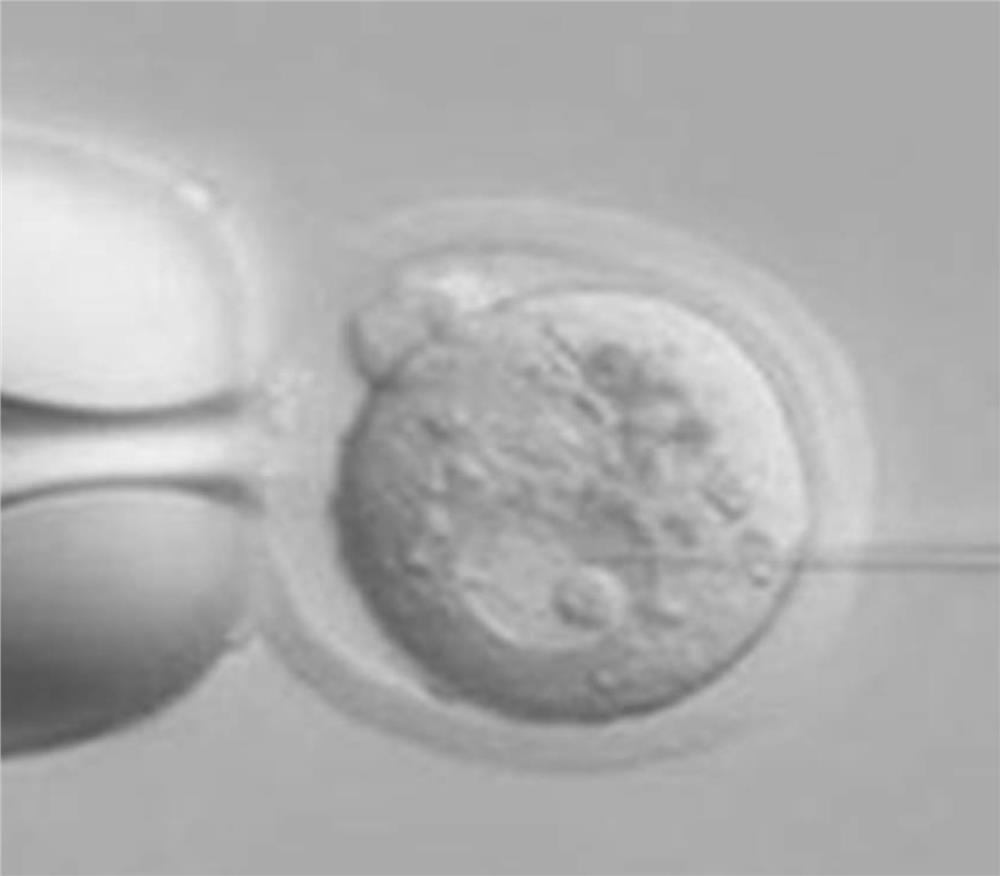
[0082] The steps of microinjection of mouse fertilized eggs were the same as in Example 1.
the structure of the environmentally friendly knitted fabric provided by the present invention; figure 2 Flow chart of the yarn wrapping machine for environmentally friendly knitted fabrics and storage devices; image 3 Is the parameter map of the yarn covering machine
Login to View More
PUM
Login to View More
Abstract
The invention provides a method for reducing ds DNA fragment tandems in CRISPR-Cas9 gene editing, and application thereof. The method comprises the following steps: connecting a suicide gene at a 5'end of a ds DNA, connecting a promoter of the suicide gene at a 3'end, mixing the ds DNA with a CRISPR-Cas9 reaction system, and transferring the mixture to a to-be-edited cell for completion of CRISPR-Cas9 gene editing. A suicide gene element and a promoter element thereof are connected to two ends of the ds DNA respectively, the promoter and the suicide gene are linked in series in case of a DNA tandem, and expression of the suicide gene is induced, so that the host cell is killed, death of the host cell is promoted, and the DNA tandem is removed.
Description
technical field [0001] The invention relates to the field of genetic engineering, and relates to a method for reducing the concatenation of double-stranded DNA fragments in CRISPR-Cas9 gene editing. Background technique [0002] Suicide gene refers to the introduction of certain viral or bacterial genes into target cells, and the expressed products are toxic substances or can catalyze the transformation of non-toxic precursors into toxic substances, thus causing the receptors carrying the gene to Cells are killed and such genes are called suicide genes. DTA and TK are two suicide genes commonly used in eukaryotic cells, among which DTA can produce toxic substances without adding substrates, and TK needs to add substrates to play a suicide role. At present, suicide genes are often used to treat tumors and infectious diseases, and are often used as negative screening in genetic engineering. [0003] With the in-depth study and interpretation of the two repair methods of non-...
Claims
the structure of the environmentally friendly knitted fabric provided by the present invention; figure 2 Flow chart of the yarn wrapping machine for environmentally friendly knitted fabrics and storage devices; image 3 Is the parameter map of the yarn covering machine
Login to View More
Application Information
Patent Timeline
Application Date:The date an application was filed.
Publication Date:The date a patent or application was officially published.
First Publication Date:The earliest publication date of a patent with the same application number.
Issue Date:Publication date of the patent grant document.
PCT Entry Date:The Entry date of PCT National Phase.
Estimated Expiry Date:The statutory expiry date of a patent right according to the Patent Law, and it is the longest term of protection that the patent right can achieve without the termination of the patent right due to other reasons(Term extension factor has been taken into account ).
Invalid Date:Actual expiry date is based on effective date or publication date of legal transaction data of invalid patent.


 Login to View More
  Login to View More