
Block selection common space mode feature extraction method for motor imagery electroencephalogram
A co-space pattern and motion imagery technology, applied in the field of pattern recognition, can solve the problems of redundant information and noise affecting classification performance, and achieve the effects of improving classification performance, reasonable channel distribution, and avoiding differences
- Summary
- Abstract
- Description
- Claims
- Application Information
AI Technical Summary
Problems solved by technology
Method used
Image

Examples
Embodiment Construction
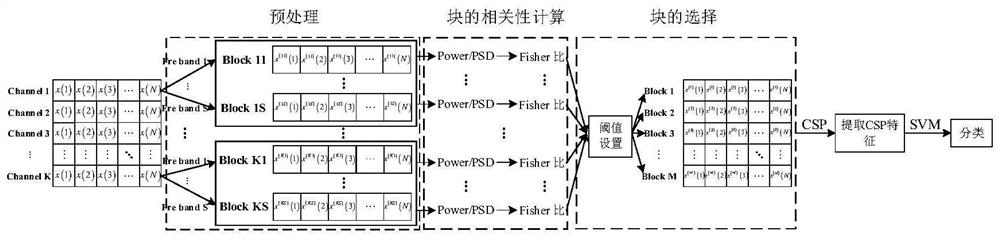
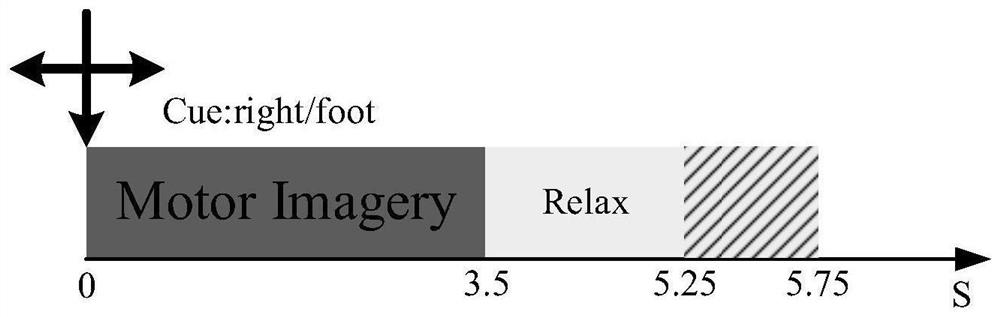
[0041] The method for feature extraction of block selection and co-space pattern based on motor imagery EEG of the present invention will be described in detail below in conjunction with the accompanying drawings. Such as figure 1 , the implementation of the present invention mainly includes 4 steps: (1) multi-channel EEG signal acquisition and preprocessing; (2) correlation calculation of blocks; (3) block selection; (4) CSP feature extraction and SVM classification. Assuming that the EEG data collected in the experiment has K channels, the data obtained by dividing the EEG of each channel into frequency bands is called a block. Each channel is divided into S frequency bands of equal bandwidth, and then K×S blocks are generated. Record the data of the block corresponding to the sth frequency band of the kth channel as x (ks) (n), k=1, 2,..., K, s=1, 2,..., S, n=1, 2,..., N, where N is the number of sampling points for each block. Assuming that the subject conducts a total ...
PUM
 Login to View More
 Abstract
Description
Claims
Application Information
 Login to View More