Antistatic photosensitive resin for photocuring rapid prototyping and preparation method and application thereof
What is AI technical title?
AI technical title is built by Patsnap AI team. It summarizes the technical point description of the patent document.
A photosensitive resin, antistatic technology, used in the field of 3D printing
Active Publication Date: 2021-04-20
SUN YAT SEN UNIV
View PDF5 Cites 2 Cited by
Summary
Abstract
Description
Claims
Application Information
AI Technical Summary
This helps you quickly interpret patents by identifying the three key elements:
Problems solved by technology
Method used
Benefits of technology
Problems solved by technology
[0006] The purpose of the present invention is to overcome the lack of photosensitive resin compositions for special applications in the prior art, and provide a kind of antistatic photosensitive resin for photocuring rapid prototyping
Method used
the structure of the environmentally friendly knitted fabric provided by the present invention; figure 2 Flow chart of the yarn wrapping machine for environmentally friendly knitted fabrics and storage devices; image 3 Is the parameter map of the yarn covering machine
View more
Image
Smart Image Click on the blue labels to locate them in the text.
Viewing Examples
Smart Image
Click on the blue label to locate the original text in one second.
Reading with bidirectional positioning of images and text.
Smart Image
Examples
Experimental program
Comparison scheme
Effect test
preparation example Construction
[0062] Among them, in the preparation process of modified multi-walled carbon nanotube 1#, hyperbranched epoxy resin HyPerE102 was selected; in the preparation process of modified multi-walled carbon nanotube 2#, hyperbranched epoxy resin HyPerDE1050 was selected.
[0063] The antistatic photosensitive resins of the various embodiments of the present invention and comparative examples are prepared through the following processes: cationic photocurable components, free radical photocurable components, cationic photoinitiators, free radical photoinitiators, modified multi-walled carbon nanotubes Stir and mix with antioxidant at 25°C for 60 minutes to obtain.
[0064] Wherein, the test method of each performance index of each embodiment and comparative example is as follows:
[0065] 1) Critical exposure energy E c and curing depth D p The test: using the SLA 3D printer, in the known laser power P L , laser scanning interval h s case, using different laser scan rates V s , f...
Embodiment 1~7 and comparative example 1~5
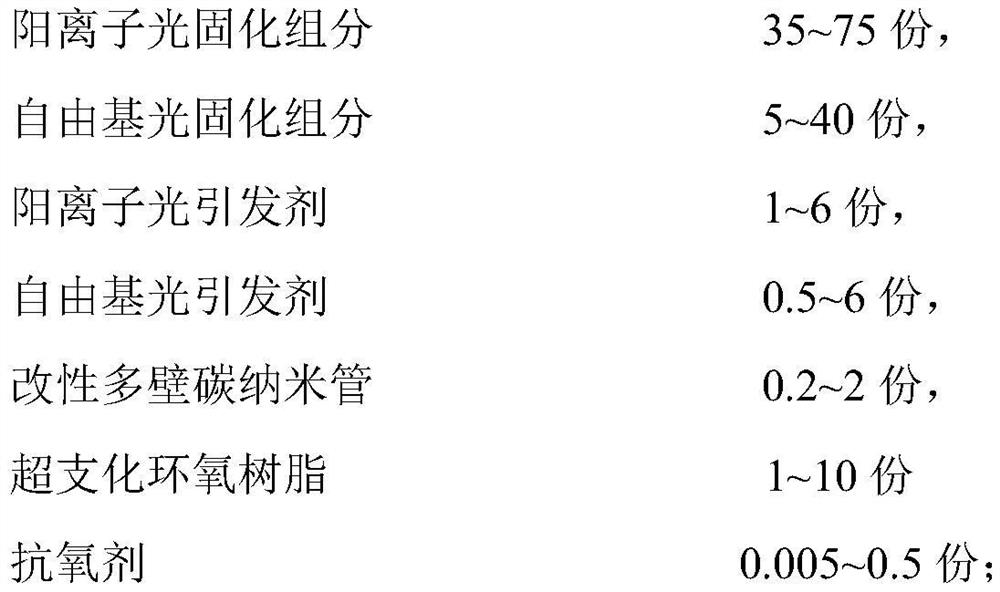
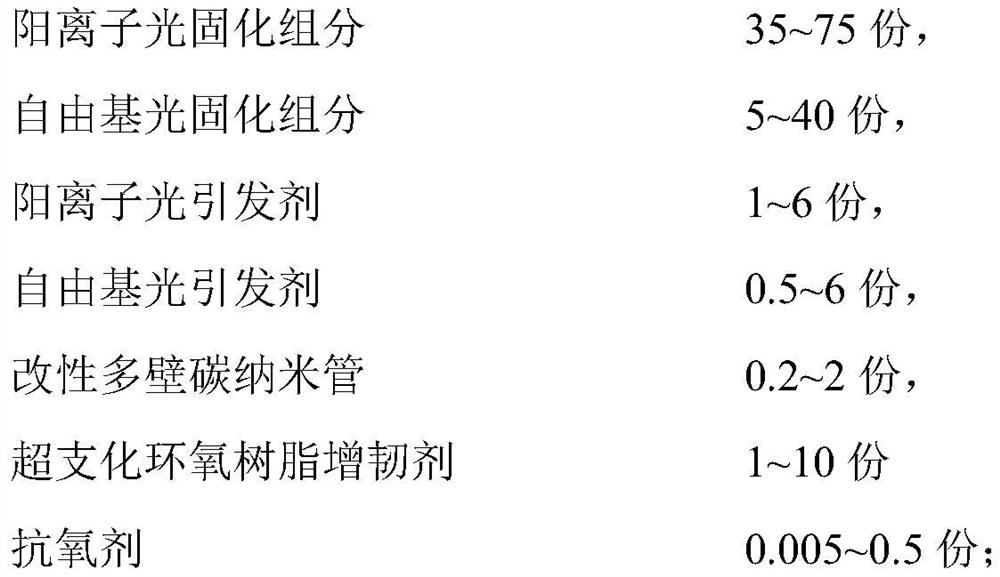
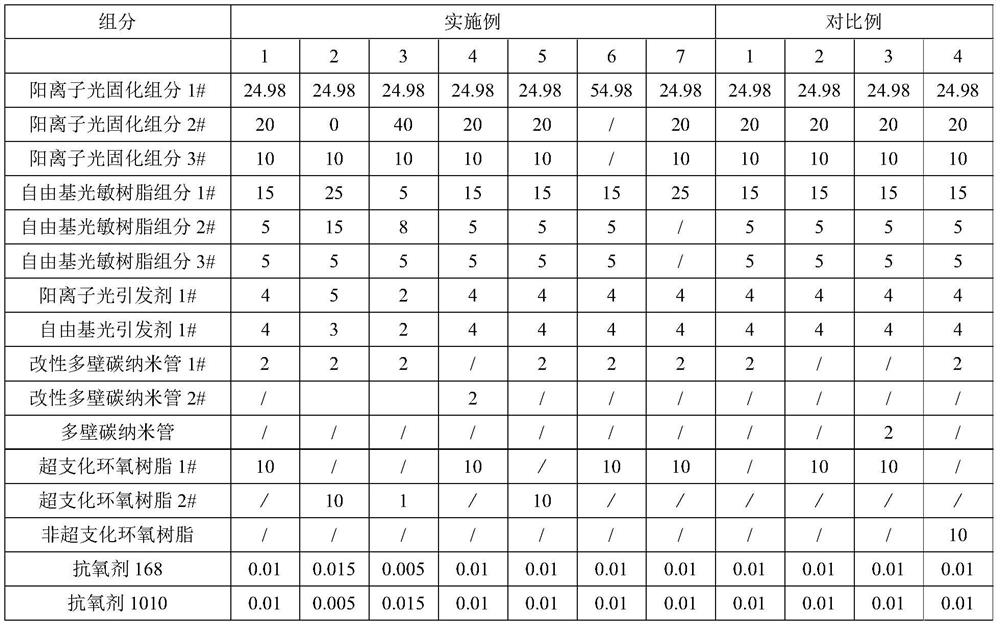
[0075] The present embodiment and comparative example provide a series of antistatic photosensitive resins, the formulations of which are listed in Table 1 below.
[0076] The formula (part) of table 2 embodiment 1~7 and comparative example 1~4
[0077]
[0078] In addition, a commercially available white material was used as Comparative Example 5.
[0079] According to the method mentioned above, the properties of the antistatic photosensitive resins of the various examples and comparative examples were measured, and the results are shown in Table 2.
[0080] The performance test result of each embodiment and comparative example of table 2
[0081]
[0082] It can be seen from Table 2 that the antistatic photosensitive resin provided by each embodiment of the present invention has a good antistatic effect under the addition of a very low conductive agent, and the surface resistance value of the cured product is far lower than 10 9 Ω, low viscosity, excellent mechanica...
the structure of the environmentally friendly knitted fabric provided by the present invention; figure 2 Flow chart of the yarn wrapping machine for environmentally friendly knitted fabrics and storage devices; image 3 Is the parameter map of the yarn covering machine
Login to View More
PUM
Property
Measurement
Unit
Surface resistance
aaaaa
aaaaa
Login to View More
Abstract
The invention relates to antistatic photosensitive resin for photocuring rapid forming and a preparation method and application thereof. The antistatic photosensitive resin comprises a cationic photocuring component, a free radical photocuring component, a cationic photoinitiator, a free radical photoinitiator, a modified multi-walled carbon nanotube, hyperbranched epoxy resin and an antioxidant. The antistatic photosensitive resin provided by the invention has the advantages of better antistatic effect, low viscosity, extremely low conductive agent addition amount, better photocuring activity of a resin system, excellent mechanical properties of a resin curing material, good toughness, uniform resistance value, and good surface precision and dimensional stability of a printed piece, and the surface resistance value of a cured product is lower than 10<9> ohms.
Description
technical field [0001] The invention belongs to the technical field of 3D printing, and in particular relates to an antistatic photosensitive resin for photocuring rapid prototyping, a preparation method and application thereof. Background technique [0002] Light-curing rapid prototyping technology (SLA) is the first rapid prototyping technology put into commercial application. Its specific working principle is as follows: use a computer program to control the ultravioletlaser to scan and move on the surface of the photosensitive resin, so that the photosensitive resin is cured to form a model. single layer. After each layer of photosensitive resin is cured, the curing platform will move a thickness of a single layer, and then the resin will fill the formed space through automatic flow or passive smearing, and then cure again. Repeat this to get the formed parts. Stereo-curing rapid prototyping technology can precisely control laser movement, has the advantages of low en...
Claims
the structure of the environmentally friendly knitted fabric provided by the present invention; figure 2 Flow chart of the yarn wrapping machine for environmentally friendly knitted fabrics and storage devices; image 3 Is the parameter map of the yarn covering machine
Login to View More
Application Information
Patent Timeline
Application Date:The date an application was filed.
Publication Date:The date a patent or application was officially published.
First Publication Date:The earliest publication date of a patent with the same application number.
Issue Date:Publication date of the patent grant document.
PCT Entry Date:The Entry date of PCT National Phase.
Estimated Expiry Date:The statutory expiry date of a patent right according to the Patent Law, and it is the longest term of protection that the patent right can achieve without the termination of the patent right due to other reasons(Term extension factor has been taken into account ).
Invalid Date:Actual expiry date is based on effective date or publication date of legal transaction data of invalid patent.


 Login to View More