
Electrical tree numerical simulation method and system in polymer insulating material
An insulating material and numerical simulation technology, which is applied in electrical digital data processing, design optimization/simulation, instruments, etc., can solve the problem of attenuation of insulation performance, inconformity with percolation theoretical properties, and inability to properly explain the phenomenon of electrical tree branch initiation and growth, etc. problem, to achieve the effect of accurate numerical simulation results
- Summary
- Abstract
- Description
- Claims
- Application Information
AI Technical Summary
Problems solved by technology
Method used
Image

Examples
Embodiment 1
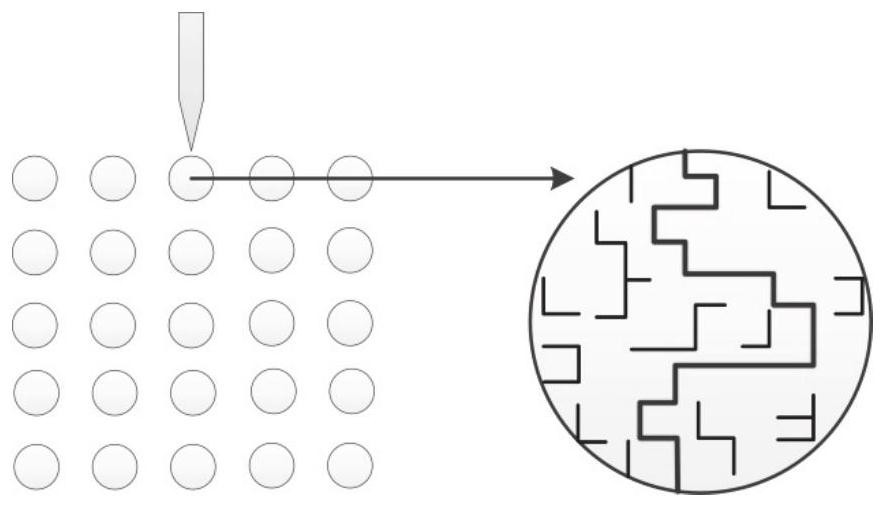
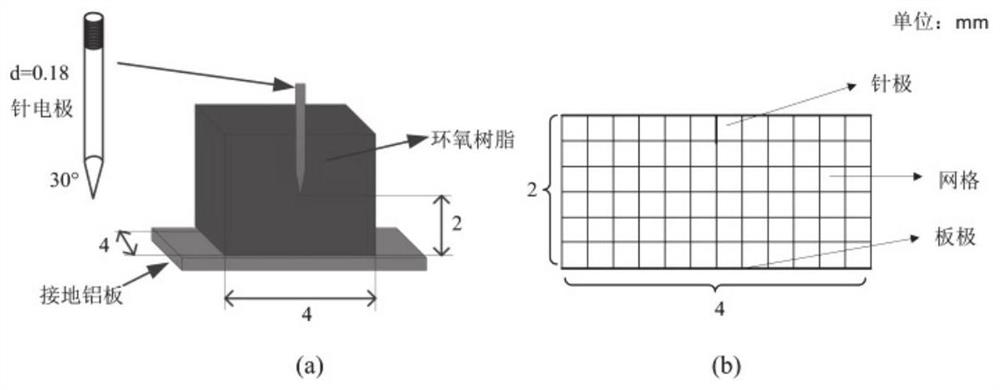
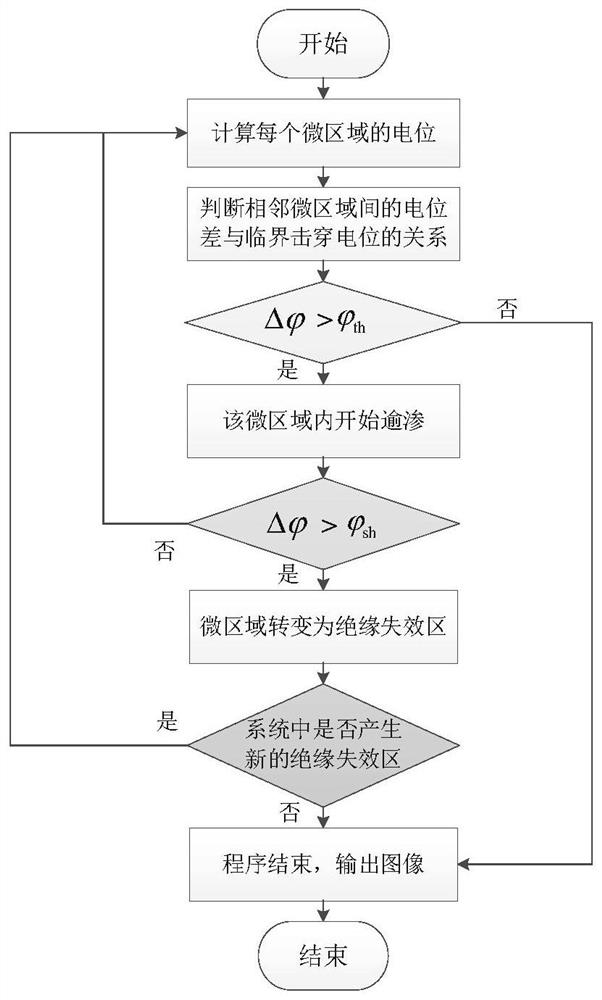
[0045] This embodiment discloses a method for numerical simulation of electrical dendrites in polymer insulating materials. In order to illustrate the above, firstly, the simulation structure diagram of electrical dendrites is described, as shown in figure 2 shown. For the convenience of verifying the numerical simulation results of this patent, the literature "Champion J V, Dodd S J, Stevens G C. Analysis and modeling of electrical tree growth in synthetic resins over a wide range of stressing voltage. JPhys. D Appl. Phys. 1994, 27 , 1020-1030" of the experimental data in the simulation analysis, the electrode structure and dielectric used for discharge such as figure 2 As shown in (a), the dielectric is epoxy resin CY1311, and its length, width and height are 4mm; the stainless steel needle electrode is selected according to the national standard GB / T 4240 "Stainless Steel Wire", the diameter of the needle body is 0.18cm, and the radius of curvature of the needle tip is 3...
Embodiment 2
[0082] The purpose of this embodiment is to provide a computing device, which includes a memory, a processor, and a computer program stored in the memory and operable on the processor, and the processor implements the steps of the above method when executing the program.
Embodiment 3
[0084] The purpose of this embodiment is to provide a computer-readable storage medium.
[0085] A computer-readable storage medium, on which a computer program is stored, and when the program is executed by a processor, the steps of the above-mentioned method are executed.
PUM
| Property | Measurement | Unit |
|---|---|---|
| Diameter | aaaaa | aaaaa |
| Breakdown field strength | aaaaa | aaaaa |
Abstract
Description
Claims
Application Information
 Login to View More