Unlock instant, AI-driven research and patent intelligence for your innovation.

Method for detecting branch points and cross points of retinal blood vessels in OCTA image

A retinal blood vessel and detection method technology, which is applied to the detection of retinal blood vessel bifurcation points and intersections in OCTA images, can solve problems such as time-consuming and labor-intensive, loss of blood vessel details, and discontinuity of blood vessels, so as to improve detection performance and suppress The effect of feature activation

Pending Publication Date: 2021-10-19
CHONGQING UNIV
View PDF10 Cites 1 Cited by
  • Summary
  • Abstract
  • Description
  • Claims
  • Application Information

AI Technical Summary

Problems solved by technology

[0004] Accurate segmentation of OCTA images is a great challenge due to the complex vascular network and blurred contrast between vessels and background
Using traditional image processing methods such as filtering, thresholding, and edge detection to segment vessels in OCTA images can lead to glitches, vessel discontinuities, and loss of vessel detail
Although some deep learning-based methods are effective in OCTA image segmentation, manual annotation of blood vessel segmentation maps for training is quite time-consuming and labor-intensive.

Method used

the structure of the environmentally friendly knitted fabric provided by the present invention; figure 2 Flow chart of the yarn wrapping machine for environmentally friendly knitted fabrics and storage devices; image 3 Is the parameter map of the yarn covering machine
View more

Image

Smart Image Click on the blue labels to locate them in the text.
Viewing Examples
Smart Image
  • Method for detecting branch points and cross points of retinal blood vessels in OCTA image
  • Method for detecting branch points and cross points of retinal blood vessels in OCTA image
  • Method for detecting branch points and cross points of retinal blood vessels in OCTA image

Examples

Experimental program
Comparison scheme
Effect test

Embodiment Construction

[0059] Embodiments of the present invention are described in detail below, examples of which are shown in the drawings, wherein the same or similar reference numerals designate the same or similar elements or elements having the same or similar functions throughout. The embodiments described below by referring to the figures are exemplary only for explaining the present invention and should not be construed as limiting the present invention.

[0060] Our goal is to detect and classify vessel bifurcations and intersections in OCTA images without vessel segmentation.

[0061] Object detection based on deep learning can directly complete detection and classification at the same time, which meets our needs. Object detectors can generally be classified into anchor-based and anchor-free. In target detection, the anchor box needs to be carefully designed according to the detection task and data set. Proper anchor box design can bring excellent performance, otherwise it will lead to ...

the structure of the environmentally friendly knitted fabric provided by the present invention; figure 2 Flow chart of the yarn wrapping machine for environmentally friendly knitted fabrics and storage devices; image 3 Is the parameter map of the yarn covering machine
Login to View More

PUM

No PUM Login to View More

Abstract

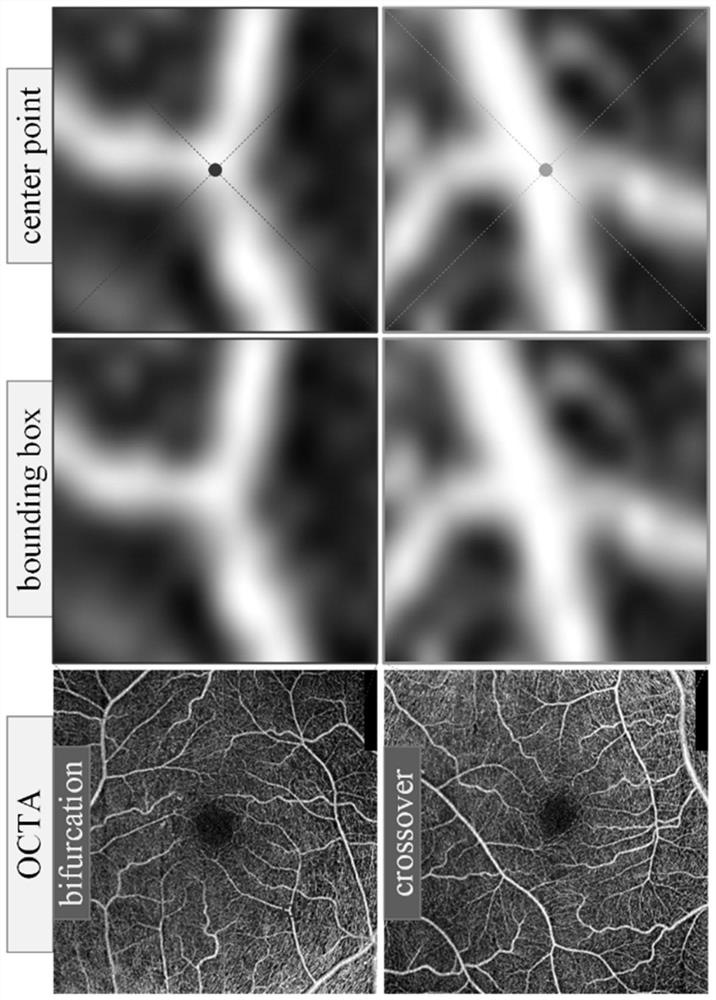
The invention provides a method for detecting a retinal vessel bifurcation point and a cross point in an OCTA image. The method comprises the following steps: S1, extracting and fusing features of an input image by using a stacked hourglass network; S2, inputting the features extracted in the step S1 into three prediction branches to predict a central point heat map, local offset of a central point and a target size; and S3, obtaining a classification result and position information of the blood vessel feature points from the three prediction branches. According to the method, the blood vessel bifurcation points and the cross points in the OCTA image can be directly detected and classified at the same time; and a stacked hourglass network in the Center Net is improved by using an attention gate, and the attention gate can highlight valuable features in the OCTA image and inhibit irrelevant feature activation, so that the detection performance is improved.

Description

technical field [0001] The invention relates to the field of biomedical engineering, in particular to a method for detecting bifurcation points and intersection points of retinal blood vessels in OCTA images. Background technique [0002] Retinal vasculature is an important component of clinical pathology and is associated with many ocular diseases. Quantitative analysis of retinal vasculature can facilitate the diagnosis and treatment of diseases involving vascular abnormalities. Optical coherence tomography angiography (OCTA) is a new ophthalmic examination technique developed in recent years. Compared with traditional fluorescein angiography, OCTA is a non-invasive and safe imaging technique that requires no intravenous dye and is faster and easier to perform. OCTA can generate data for multiple retinal and choroidal layers and can reveal structural and blood flow information. Currently, OCTA has become a valuable imaging tool for observing retinal blood vessels. [0...

Claims

the structure of the environmentally friendly knitted fabric provided by the present invention; figure 2 Flow chart of the yarn wrapping machine for environmentally friendly knitted fabrics and storage devices; image 3 Is the parameter map of the yarn covering machine
Login to View More

Application Information

Patent Timeline
no application Login to View More
IPC IPC(8): G06T7/00G06T7/13G06T7/73G06K9/46G06K9/62G06N3/04G06N3/08
CPCG06T7/0012G06T7/13G06T7/73G06N3/04G06N3/08G06T2207/10101G06T2207/20081G06T2207/20084G06T2207/30041G06T2207/30101G06F18/24
Inventor 汪成亮肖诗童李世迎钟代笛
Owner CHONGQING UNIV